I was watching some interviews of
Gulzar recently on YouTube. One thing that he mentioned in almost all his conversations
was the impact of India’s partition on his life and works. Not surprising for
someone who was born on the other side of the border that wasn’t present at
that point of time, Gulzar talked very fondly about the land that was once a
part of his being, and that presently was alienated from him, at least in terms
of physical distances. But despite this admission, we find that the man was
hardly ever a part of any cinematic venture that explored the stories of that
painful time. Most of his work that revolved around that motif was not done for
the big screen. His poems, his stories, and anecdotes on the subject are a part
of his poetry books, his memoirs, and some plays that have been adapted from
the same.
Gulzar in a still from Jallian Wala Bagh
However my quick research
reminded me of one movie set in pre-independence India, which Gulzar
contributed to immensely. Jallian Wala
Bagh, a movie directed by Mr. Balraj
Tah (one time director/film-maker), had its screenplay and dialogues
written by the maestro of words. Chronicling the events around the horrific
incident that gave a new impetus to the Indian Nationalist movement, the movie
can also be termed as a sketchy biography of Shaheed Uddham Singh, the revolutionary young man who murdered the
man largely responsible for the mass massacre that happened on 13th
April, 1919.
Parikshit Sahni essays the role
of Uddham Singh, while Vinod Khanna and Deepti Naval play major parts that
bring in some star value to the otherwise non-commercial looking venture. Shabana
Azmi has an insignificant cameo, but the surprise of the show is a meaty role by
none other than Gulzar. As a young man contributing to the freedom struggle while
living in London, Gulzar delivers a patchy performance that vindicates his
decision of not going in front of the camera ever again. However the portions
involving him are some of the most polished part of the otherwise amateurish attempt
by the first time director.
The movie is far from being a
very fine one. However, at just over 100 minutes in length, it is a reasonably
good watch, at least from the point of view of being an important film based on
true events. It is tough to describe it as a biopic as it fails to do justice
to that genre despite having Uddham Singh as a fulcrum for the narrative. As an
effort that documents a critical chapter of our freedom movement, the movie
again falls short. Ultimately it ends up as a confused attempt that could have
been made into a defining feature, had some more research and effort been done
before making it. Some of the factors that redeem the movie are:
Non-violence vs Violence: How to get India to revolt?
Its depiction of the underling
conflict between the extreme revolutionaries and the moderate (and non-violent)
Gandhian reformers. The characters of Om Shivpuri and Vinod Khanna, father and
son, are at constant loggerheads regarding the approach that the freedom
struggle should adopt. Here Deepti Naval provides the balancing act and
articulates the difficulty in making one choice out of the two. This debate
later continues between Uddham Singh and Om Shivpuri’s character in London, two
decades after the incident of Jallian Wala Bagh.
The introduction of a global
perspective to the proceedings in the later part of the film. When Uddham Singh
reaches London, the world is in a state of conflict, with Hitler on the warpath.
It is refreshing to see a movie talk about the broader canvas, while not losing
the grip of the core plot. The use of an English lady’s character that supports
Uddham Singh and Sunil (Gulzar) against the British is done really well, and
executed sans any stereotypes.
A major part of the second part
(which is set in England) is in English. This again is quite different for a
movie that largely talks to a Hindi speaking audience. In fact this leads me to
believe that the second part of the movie, which has much finesse as compared
to the first, must have been shot first. The first hour of the movie (the
events leading to the massacre) might have been shot later with more mainstream
appeal in the hope of giving the movie a commercial release.
Parikshit Sahni as 'Uddham Singh', the revolutionary who killed Micheal O'Dwyer, the man responsible for the massacre of Jallian Wala Bagh
In the hands of an expert (or
rather more ambitious) director, the subject of the movie could have been
exploited better. Haven’t we seen many Hollywood movies going back to the past
to churn our Oscar winning films? Here it must be said that our Hindi film
industry has not made use of the vast source of literature that our
pre-independence days resulted it. Neither has our period of struggle been
given its due importance in many of our films. We have a very few films that
talk about that era, and sadly many of them are on similar subjects (with the
life of Bhagat Singh seeing more than five cinematic representations over the
years).
A Poster of the movie: Highlighting the commercial elements, while concealing the real ones
A completely misleading poster of the movie- playing up the drunkard jilted-lover image of Rajesh Khanna, and glorying a five minute Jeetendra appearance. The movie is nothing like what this poster indicates.
Five minutes into the
movie, and you can make out it is a Gulzar film. This Rajesh Khanna and Hema
Malini film is though not directed by the maestro himself, but by Meraj, who
was an assistant to the man in most his earlier directorial ventures. But
everything- be it the dialogues or the treatment, or even the look given to the
lead actors- looks straight out of the Gulzar school of film-making. That he
has written the screenplay is just a part of this happy occurrence.
The story is set in a
village, very much like the Jeetendra- Hema Malini starrer Khushboo that came
just two years or so before this movie. But this time, instead of Jeetendra,
the moustache is donned by (the then on the wane) superstar, who gets to play a
meaty author (read Gulzar)-backed role. Ravi (Rajesh Khanna) is a city bred educated
but unemployed youngster, who doesn’t lose his sense of humor and wit despite
his many failures to secure a decent employment. A chance encounter leads him to
the job of a dakiya (postman) in a
nearby village, which he gladly accepts. In the village he soon gets around to
doing his job with much sincerity and dedication. Within no time gets
acquainted with most of the village folk- each of who have their own story to
tell. These include a senile old lady who awaits the return of her son, a young
widow who has lost her husband in the war- but has not lost the zest for
living, and a young lady named Mohini (Hema Malini) who to Ravi’s pleasant
surprise appears more than willing to strike a companionship. Soon Ravi and
Mohini start meeting everyday and Ravi falls in love with her, completely
oblivious to the fact that she has very little interest in him- the person, and
most of her attention is reserved for Ravi- the postman. This is because Mohini
expects a letter from her lover, an army-man, to reach her. Ravi’s pleasing
ways and respectful manners lead her to confide in him her relationship with
this soldier (Jeetendra in a guest appearance). This love story of hers
completely shatters Ravi’s heart, who had genuinely felt that Mohini’s
affections were a result of them drawing closer to one another with each
passing day. But consoling himself, Ravi decides to go the city and look for
this soldier who had not written to Mohini despite his many promises. When he
returns, the news arrives that Mohini’s beloved is no more and has lost his
life in the war. It then becomes his responsibility, being a postman, to break
this news to Mohini…
Not unlike Khushboo,
this story too looks like a chapter out of Malgudi Days with all its simple and
unhurried appeal. The drama in the story is somewhat based on the fact that in
those days very few village people could read and write their own letters- and the
responsibility of the same then rested upon the village postman- who thus
became an essential part of their lives. In that sense the village postman
acted like a ‘social glue’, being a common element in all the villagers’ lives.
Here the song ‘Dakiya Daak Laya’
reflects on pretty much the same sentiment. While the postman drama is the
backdrop, the innocent love-story with all its uncertainty and apprehensions,
is the motif in the movie. Ravi’s one sided love, and his expression of the
same through his sketches (that are revealed at the end), is quite endearing. The
most unique thing about the movie however, is that despite all its underlying tension;
it retains a light-hearted spirit on the surface. There are many instances of
humor, though like in all other Gulzar movies, they are quite understated. But
quite unlike most of his films, the music score here is not too memorable with
two of the songs being quite situational, and a forced nautanki dance number (picturised on Rekha) not being as fun as it
should have.
Rajesh Khanna puts in
an earnest act, and quite underplays his character for most parts. It is easy
to make out that he was a very fine actor, and thus his fall from fame appears
more baffling (though perhaps that had more to do with his off-screen issues). Hema
Malini is effective, though it looks like she walked down straight from the
sets to Khushboo to this movie. The supporting cast doesn’t have much to do
here with Farida Jalal (another Khushboo connection), Asrani, Amjad Khan, and
Master Raju being the most popular ones from the ensemble.
Parting
Note: This movie is a sweet love-story that deserves a
watch by all those who like such village themes. And when you add the fact that
it is almost a lost Gulzar film, it becomes a must watch for his fans.
The star-cast and Imdb summary of this Bhimsain Khurana film
gave an impression of it being a film in the mould of ‘Chhoti si Baat’ or
‘Rajnigandha’. After all, one can hardly expect an Amol Palekar or a Zarina
Wahab to star in a movie that is not a feel-good entertainer. But ‘Gharonda’ is
hardly that Basu Chatterjee or a Rajshri movie from the 1970s that would leave
you smiling and cause you to drift away in a simple and endearing world where
everyone is good at heart and there are hardly any vices. It surely tells a
story of two working-class people living in an urban city (much like Chhoti si
Baat and Rajnigandha), but here the tone and tenor is drastically different.
The world out here is the big and bad one where people aren’t always sweet and
don’t always have the best of intentions. They are insecure yet ambitious,
apprehensive yet ruthless. They hardly think beyond their own interests and
seldom give a damn about the lives of others. The film tells the story of two
people in love who dream to have their own house in the concrete jungle of
Mumbai, daring to take on all the challenges that the city throws on them. How their
lives take a drastic turn post this, is what the film is all about.
Gharonda is more like a Shyam Benegal or a Govind Nihalani film
in its treatment. Emphasizing on the dark human desires and talking about
people going through their most troubled times, the movie is a dark and
pessimistic take on human emotions and their worth (or worthlessness) in a big
modern city like Bombay. Amol Palekar and Zarina Wahab play office colleagues
who fall in love and decide to marry. But before taking the marital plunge,
they decide to own a flat of their own for which Amol is forced to take a loan.
But in a rather cruel twist of fate, the builder with whom they book a flat
turns out to be a swindler. Not able to accept this big monetary loss, Amol’s
room-mate, who had also booked a flat with the same builder, commits suicide. Amol
completely breaks down but not before making an indecent proposal to Zarina
that literally breaks her heart. Accepting defeat at the hands of the heartless
society, Amol asks Zarina to marry their elderly boss (Shreeram Lagoo) who had
shown interest in her on more than once occasion. He tells her that their boss
couldn’t be expected to live for more than a few months at best, and after his
death they could get together again and live comfortably off the old man’s
wealth. Outraged at this suggestion, Zarina breaks all ties with him. But owing
to her unstable financial condition and her wish to fulfill her younger brother’s ambitions of
studying abroad, she decides to honor her boss’s proposal to her and marries
him. However, she accepts her husband wholeheartedly and makes all the efforts
to have him hale and hearty again. Meanwhile, devastated by this betrayal, Amol
loses all interest in life and becomes a recluse…
There are a lot of elements in this film that are
unconventional. Amol is shown to be living in a shady men’s hostel where one of
room-mates has regular tete-e-tete with prostitutes. Even Amol brings Zarina to
his room for the first time with not so noble intentions. The old man’s pursuit
of a young Zarina (almost his daughter’s age) is again not something which is regular.
Amol’s dissonance with the world and his complete disregard for his own self
post Zarina’s marriage, again is something which is not worthy of a Hindi movie
hero. He becomes an urban version of Devdas, and there is also a mention of his
involvement with prostitutes. Zarina’s comfort level with her much senior
husband is again dramatic, and quite uncomfortable. She becomes his trophy wife
without any complaints and accepts him with all his deficiencies. More than a
wife, she becomes his nurse, his householder, and his closest friend. Thus all
the characters in the story have shades of grey, which is truly unique for a
movie of its time and age.
The songs of the film are quite unlike the rest of the
narrative. They are given an easy treatment and are sans any dramatic or
visceral connotations. In fact if seen in isolation, they would give a
completely different impression about the movie. ‘Do Deewane Sheher Mein’ is the memorable song from the album, one
for which Gulzar won many accolades. As far as the performances go, Amol
Palekar attempts a completely different role and although he does well, it is
difficult to accept him this pessimistic and discontent avatar. Zarina Wahab
too is not very convincing in the complex role and it easy to see why she didn’t
become a very popular actress of that time. A Shabana Azmi instead of her could
have added a completely different texture to the performance with her penchant
for such complicated characters. Similarly a Shreeram Lagoo hasn’t got that
imposing aura that his character needed. One feels that a Sanjeev Kumar or an
Amjad Khan could have taken the film to an altogether different level.
Parting Note: Gharonda is a semi-Shyam Benegal
film with a Rajshri cast- It has a powerful narrative that could have been well
served by likes of Naseeruddin Shah, Sanjeev Kumar, and Shabana Azmi. The film
tells a novel story and is given a realistic treatment. However because of its
weak casting it fails to create a great impact and ends up being good film, but
hardly a must watch one.
These days I have been watching a lot fewer movies than before. After writing my 50th post (on Masoom) in the recall series, I have decided to take a break from old movies for a few days, and now I am catching up on some of the recent acclaimed Hindi movies that I didn’t pay much attention to at the time when they released. So this week I saw Tigmanshu Dhulia’s Haasil (after watching the superb Paan Singh Tomar), Satya (Ram Gopal Varma’s finest hour arguably), and Vishal Bhardwaj’s The Blue Umbrella. Haasil and Satya are widely recognized as brilliant films, and I concur with most of the glowing reviews received by the two movies that I read post watching them. But none of them has the haunting quality that the third film I saw has. Maybe it is because there have been many an attempts to rehash and cash in on the Satya cult (Ram Gopal Varma has done quite a bit of it himself), while the atmospherics of Haasil has been matched by movies like Gulaal and a few others. Or maybe it is just because the settings of Satya and Haasil are more familiar to the average Hindi movie audience.
On the other hand, The Blue Umbrella is truly a unique film. Everything- from its simple storyline, its performances, its setting, its intentions, to its unconventional execution has incredible freshness and charm. Prima facie it is a children’s film based on a novella by Ruskin Bond. Most certainly it is that, but more importantly it is also a film that makes you feel for its lead characters- and for that it takes a very difficult route- it makes you part of the longing the characters experience. Longing for acceptance, longing for joy, and longing for appreciation- wonderfully conveyed through their longing for a beautiful Japanese blue umbrella. The umbrella here is an important plot instrument, as while the story is woven around it, it also acts as a metaphor for all the small joys in life that may not be big achievements, but are certainly no less in the kind of happiness and satisfaction they lead to.
The movie transports you to a small village in Himachal Pradesh. The setting is idyllic and pristine, from the rain-washed valleys to the snow clad roads, from the small kutcha-pucca huts to the almost family like village bonhomie. The people are as simple as they come- uncontaminated and pure. They have aspirations that don’t have the grand vision and scale like the aspirations of the city people have. Their smiles are genuine, their laughs are uninhibited. Their sorrows are sudden and wild like torrential hailstorms that leave behind a brighter landscape when they leave. Their slight quirks, their eccentricities may be jarring to the outsider, but they are a part of their way of life- their way of living.
Movies are stories on celluloid- it is an oft repeated statement. But this particular movie is the quintessential story on celluloid. There is no other way to describe it. It is like a page out of a children’s story book and its imagery gives an impression that that particular story book must be very well illustrated. Mr. Vishal Bhardwaj has certainly followed his instincts and a crystal clear vision. I have seen three of his other films- Makdee, Kaminey, and 7 Khoon Maaf. And ‘The Blue Umbrella’ is my favorite from whatever I have seen of him.
I strongly urge all the people who like movies and fiction- to watch this movie. It is just 90 minutes- and it will surely transport you to a world that is alien to us, but in a certain way a very small part of us. Just a tip- persist with the movie- Pankaj Kapoor’s weird ways and idiosyncrasies might put a few people off in the beginning- but by the end they will be sure to realize the finesse and dexterity of his performance.
This is my 50th post in the series. To mark the milestone I choose one of my favorite films for discussion- Shekhar Kapoor's 1983 feature Masoom, starring Naseeruddin Shah, Shabana Azmi, and Jugal Hansraj (as a child artist) in principal roles. The film is one of the most acclaimed ones from that time and is the winner of many a awards for its actors as well as for the people responsible for its timeless music- Gulzar (lyrics, screenplay, and dialogues), and RD Burman (music director). Shekhar Kapoor also won tremendous appreciation for his able handling of a sensitive subject in his debut directorial effort.
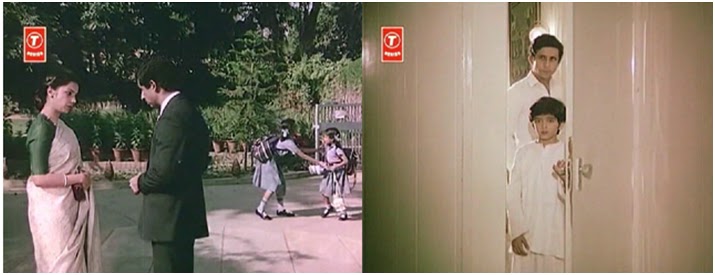
Masoom has quite a following amongst Hindi movie lovers and is widely recalled as one of the most loved films from that time. Thus I design this post as a tribute to the movie where I will recount some of my favorite moments from the film apart from discussing some subtle aspects. For the same I am using some screen-shots from the movie- my first attempt at the method.
The family
One of the most loved aspects about the movie is the wonderful portrait of an urban nuclear family it paints. Indian cinema from the time of its inception has always stressed on the joint family system as the perfect way to live. Rarely did one see a movie in which a nuclear family was shown to be so happy and contented. It was maybe a reflection of our society and our culture which stresses on the importance of living together. Thus seldom did we see a family on celluloid sans the parents or the multitude of siblings and cousins. Masoom is truly unique in that sense for that period of time. It was truly an advertisement for the Government initiative which says 'Chhota Parivaar Sukhi Parivaar'.
Also it was one of the few movies that celebrated the urban way of living. DK Malhotra (Naseerudin Shah) is a successful architect who owns an idyllic house in a posh colony of Delhi. His wife Indu (Shabana Azmi) is the quintessential urban housewife who has a household help for assisting her in the daily chores, has a garden to look after, is educated and helps the kids with their homework. The way their house is set up shouts sophistication and richness. The family has its dinners and lunches and breakfasts on a fancy dinner table. The culinary on the table is all un-Indian and the kids are quite proficient in table manners. The children have a separate room all for themselves, and the parents don't mind going to parties without them. At the parties the wife quite enjoys it when her husband makes a mockery of himself in an inebriated state. The weekends are spent at a posh club with bonfires and all.
The friends
Both DK and Indu are part of the 'high society'. Their friends and acquaintances are from the same world. DK's best friend and confidante Suri (Saeed Jaffrey) is an exuberant Punjabi who likes his wine and women and is quite into sports. He is a proud father of a spoilt kid and enjoys his son's impudence and relishes his slight achievements. But the gregarious fellow is good man at heart and a true friend to DK. With him DK can discuss his worst fears and the biggest mistakes without feeling ashamed. In him he has a 3 AM friend who he can call upon at any time in times of adversity.
But despite all of the urbane feel and the progressive attitude in life, it is still a male dominated world. The women of both the households are housewives who have nothing much to do apart from looking after their home and children while they wait for their husbands to return from work. Indu's friend Chanda (Tanuja) plays a crucial role in shaping her thought process. Chanda, more than a friend, is an influencer who acts as a reference to Indu when times become tough for her. In the initial portions of the movie Chanda is a fiercely independent woman who has adopted a tough persona to hide the sorrow that haunts her from inside caused by her husband abandoning her for some other woman. She vows to never forgive her husband and channelizes the feeling of rejection through her sarcastic and cynic view of the world. But during the end portions of the movie her tough exterior breaks down when her husband returns to her, and she forgives him. This happens at a time when Indu herself is slowly coming to terms with her husband's infidelity and is drawing closer to the young boy her husband had fathered with some other woman.
The Infidelity
A married DK visits his Alma-mater for a reunion and runs into the beautiful and enigmatic young daughter of his teacher- Bhavna (Supriya Pathak). There is something quaintly charming about the lady that pulls him towards her. Their interactions are wistful and thus their encounter is one that has an inexplicable sadness attached to it.Maybe the fact that they both realize the pointless nature of their brief courtship leads to this regretful longing. But Bhavna, despite being cognizant of the ill-fated future, goes ahead with the brief relationship. Soon DK returns to his world and his wife and forgets all about this ephemeral romance. Bhavna to her part never tries to contact him, even when she gives birth to his son. This quirky spirit of Bhavna is strangely alluring. And Gulzar created a similar character (Maya) in his tale of unrequited romance (Ijaazat).
The confession
When DK discovers that he has a son outside his marriage with Bhavna, he is of course devastated. But he makes no effort to hide this fact from Indu. In one of the most poignant scenes from the film, he confesses in front of his wife. This scene comes very early into the narrative, which is again rather unconventional. In such situations in most movies, the guilty party tries to evade this moment of confrontation and makes all efforts to delay it to as late as possible- to eternity if feasible. Here by standing up and facing the truth while admitting to the the worst, DK shows great strength of character. But more than that it shows the amount of love he has for his wife. He knows that he has caused great hurt to her, but he faces this fact head-on without fearing the repercussions.
The arrival
The arrival of Rahul (Jugal Hansraj)is fraught with tension as expected. The boy is quiet and deeply affected by the loss of his mother. But despite all his nervousness, there is an air of confidence in the way he talks and looks around. The aura he has is a quaint cocktail of melancholy and warmth. His eyes are expressive, and gives away more than what his words do. The new setting for him is a challenge. But he is unaware of the fact that his arrival is as big a challenge to Indu, if not more. From this point, the most intriguing moments of the movie are between her and the boy. Her internal struggle, her confusion, and her being unable to take a tough stance against the lovable boy is a real treat to watch. The arrival of Rahul is also a welcome change in the lives of the two girls Pinky and Minni (The elder one played by a young and as sprightly as always Urmila Matondkar).
The new family
The bonding between the three kids is delightful to watch. The younger sister Minnie is less tentative and the more curious of the two. She and Rahul strike a friendship immediately. The elder Pinky is slightly more reserved and takes her time to lose her guard against the stranger boy. But when Rahul helps her with some difficult Maths, she too starts liking him immensely. The song 'Lakri Ki Kaathi' is a joy to watch with the three sharing great camaraderie. Post the song comes one of the most touching moments of the movie when Rahul gifts Indu a self-made wooden box. This is again a moment when the motherly love in Indu is itching to come out and embrace the boy, but the hurt wife in her stops her from doing so.
My favorite scene
DK and Suri's families go for a picnic on a weekend. In a game of cricket Suri's spoilt and bratty boy spanks DK the bowler all over the park. A proud Suri watches his son bat splendidly from behind the wickets. The ball is then taken by Rahul and he runs in to bowl... The result is expected yet sweet. He clean bowls Suri's young boy. What follows is something truly heartwarming. Seeing Rahul beat Suri's son at the game DK exults in joy. There is a feeling of great pride in him which he is unable to restrain. The father in him forgets for a moment the precarious situation that his family faces due to his illegitimate son. He almost proclaims to the world... "he is my son". Only thing is, that there is no one in earshot.
Tujhse Naraaz Nahin Zindagi... Hairan Hoon Main
The genius of Gulzar. Remarkably simple words that convey a sea of emotions. Certainly one of the most memorable songs to have come out of his pen. The soothing tune and the wonderful lyrics are coupled with some excellent visuals with DK and Rahul spending some quality father-son time with each other. The scenes are reminiscent of the Salman Khan starrer 'Jab Pyaar Kisi Se Hota Hai'. The movie that came in the late 90s is most certainly inspired by Masoom, and no wonder it is one of my favorite Salman Khan films :)
The drama
Rahul soon learns that DK is none other than his own father. Unable to take in the shock, Rahul's young mind loses its composure and he runs away from DK's place. His disappearance creates great drama with DK losing his cool and driving all over his portion of the city along with Suri, searching for Rahul. At home the two sisters are unable to handle the stress and break down. Once again the character with the most confused emotions is Indu. She is worried for Rahul, but restrains herself from expressing her worry out aloud.
The differences that were created since Rahul's arrival start creating an inferno in Indu's head while he goes missing. Her's is most certainly the most complex role of the lot and Shabana Azmi does full justice to her. In the end the compassionate mother in her wins over the hurt wife, and that leads to a happy climax!
Parting Note: Masoom is truly a special film. It deserves to be seen and savored by all those who like their movies to be simple yet alluring. Parting with the song that's synonymous with the movie today.
What would be the worst part of living a nomad’s life? The lack of a settled dwelling? Or the felling of constant disengagement with the society?
Human beings are not meant to live alone. People, who try to fool themselves into believing that they need no one else in their lives, are usually the ones who get the worst out of this unforgiving world. One can never stop having attachments in the world around us, and one cannot really leave everything behind and move to another location taking everything away with him. This is because while moving from one place to the other, some small part of one’s heart always does get left behind. One cannot really escape this, however hard one tries. And that’s the reason people find it so hard to say goodbye.
Gulzar’s ‘Namkeen’ is a simple film about simple people who have to work very hard to make a decent living. It is a story of a nomadic truck driver Gerulal (Sanjeev Kumar in one of the last significant roles of his illustrious career) who picks up contractual work that requires him to travel to various towns, and that does not allow him to settle down at one place for long. For his latest assignment, he has to live in a small hilly village for a few days, and he picks up residence as a paying guest with a family of four ladies- one mother (Waheeda Rehman) and her three young daughters (Sharmila Tagore, Shabana Azmi, and Kiran Vairale). Soon, he gets sucked into their world- their problems, their hopes, and their day to day living. But before he can truly make them a part of his life (although at one level that happens just days into his stay with them), he has to leave the village and move on.
This is one movie where the drama is understated, and a lot of time is given to the building up of the relationship between the three girls and Gerulal. How he becomes so important to them and how manages to win the trust of them all, including their mother, is shown with the help of a series of bitter-sweet exchanges between them, most of which leave a smile of the face of the viewer. There are subtle references to the hardships that a household, composed entirely of women, has to face in a rural setting. The bonding between the three sisters, their respect for their senile mother, and their warm acceptance of a complete stranger in their lives- all of this reflects the rootedness and simplicity of the people of our villages. On the other hand Gerulal, the foul mouthed-large hearted truck driver, is equally respectful and warm towards his hosts and he demonstrates this warmth through his genuine concern for the ladies and his efforts to alleviate the challenges they face.
Gulzar mounts the story (written by Samresh Basu who had collaborated with Gulzar previously for Kitaab) on a very realistic canvas. The proceedings gradually transport you to the quaint little world of a small hill-station, and therein lay the magical Gulzar touch that makes make-believe believable. The dialogues are crisp and witty- another of the man’s hallmark. The performances are quite good, which is somewhat needless to say for Gulzar could have made even logs act, and this movie boasted of few of the most celebrated performers of that time. Sanjeev Kumar is Sanjeev Kumar- restrained, believable, and completely natural. Sharmila Tagore pitches in with a much more polished act than her previous attempt in a Gulzar movie- Mausam. Shabana Azmi is saddled with one of her rare supporting roles. The scene stealer however is the youngest sister, played by Kiran Vairale. Hers is a fiery character with a streak of rebellion, and she manages to hold her own in front of the best actors of those times. Waheeda Rehman, the veteran, in the role of the mother is effective, but hers does seem to be a labored performance.
The music by RD Burman doesn’t boast of a truly memorable song, but all songs are melodious and go with the texture of the narrative. The best one is ‘Raah pe Rahte hain’, a song in the same philosophical mode as ‘Musafir Hoon Yaaron’ from Parichay.
Parting Note: Namkeen is another good movie from Gulzar’s stable; I guess there isn’t really any below the mark movie made by the maestro (just a few left for me to catch up on). I guess a thoughtful and articulate man as Gulzar who was primarily a writer (and a superb one at that) would have found it hard to make a movie which was not at least above average.
The one thing common to all Gulzar movies is that they all have very simple titles. Write a story (or a poem for that matter), and you would know that sometimes it is a lot tougher to think up a title for it than the actual writing itself. Kinaara, Parichay, Khushboo, Mausam, Lekin, Angoor, Kitaab, Namkeen, Achanak, Ijaazat, Maachis… all these names tell so much about their respective movies- not always before viewing them- but more so after you experience them. Try asking a few people to give some alternative names to these stories- most likely you would get really varied answers and none would have the pertinence and relevance of the titles Gulzar chose for them. Only a highly observant and artistically articulate man like him can think of things like these. However, try doing the same exercise for the 1972 movie by him starring Sanjeev Kumar and Jaya Bhaduri, and I don’t think you would need to put in much ‘Koshish’ (effort), for there can really be no other name for this sensitive feature by arguably (and most certainly in my eyes) the best story-teller that Hindi cinema has seen…
It is a movie that would have most certainly provided reference points to films like Khamoshi (The Sanjay Leela Bhansali one). A story of a deaf and dumb couple (Haricharan and Aarti) and their attempts to lead a normal respectable life is a delightful watch for more reasons than one.
First. It’s abstinence from melodrama for most parts- For a movie on two handicapped people, Koshish is amazingly restrained in most things it attempts and refrains from the clichéd trappings of such stories. In that sense it is fresh perspective, and a few scenes bring out this perspective wonderfully well. One such scene is when the two, relieved at finding out that their new-born son does not suffer from the same handicap as they do, start whistling alternately to capture the attention of the kid from two sides of the bed on which he rests comfortably. The rapturous whistles (growing in intensity every second) attract the attention of all the people on the street, who are shunned out in good humor by the joyous father Haricharan. The people continue with daily chores after having a good laugh. It is the treatment of this laughter by the normal people around the two, which is really different here. The focus is entirely on the world between Haricharan and Aarti, and the rest of the world doesn’t really matter.
Two. The detailing- Utmost care is given in depicting the sign language authentically. In fact the schooling shown for the deaf and dumb kids is heartening to see. The way the two interact with each other and with the rest of the world is so realistic, and so well researched, that it is hard to believe that Sanjeev Kumar and Jaya Bhaduri have the gift of sound and speech in real life.
Three. The thought- The idea is not only to show the difficulties that a handicapped couple may face while trying to lead a respectable life, but also how such people can rise even above the normal people if they remain optimistic and are given the right environment and opportunities to succeed. One thing that is repeated more than once in the film (or in fact said more than once in the film by one of the characters) is the deaf and dumb are blessed for they will never hear the bad things that are said in the world, and will never say the bad things that are said in the world. It is a refreshing view that acts as the thrust for the narrative.
Four. Its love story- If one has to put a genre to this movie (forget for a moment that its leads are handicapped), then it is no question a love story. It has everything- from the initial meeting, to frequent interactions, to those stolen moments, to the hesitancy and ultimately the acceptance. Even post marriage how their love stands the test of time and difficult times, is what the movie emphasizes on.
And Last. Its performances- Yes, it is a kind of movie where even average performances from the leads would have appeared wonderful. But leaving aside this fact, both Sanjeev Kumar and Jaya Bhaduri pitch in with WONDERFUL performances- it is actually hard to find the right words to describe the finesse and the polish in their efforts. Right from the start to the finish, Sanjeev Kumar just converts completely into the deaf and dumb Haricharan on screen, and not even for an iota of a second does his real life persona becomes visible from behind character that he plays. The same goes for Jaya Bhaduri, who delivers a knock-out performance that will rank amongst the best if one has to make a list of the top performances by female actors in Indian cinema. The supporting cast provides able support, especially Om Shivpuri who plays a blind man and a friend to the couple.
But there are certain portions in the film that are not as convincing as the rest. The entire Asrani track is kind of tangential to the central theme, and does not actually add anything to the plot, except a few bits of drama. The track is not even given a proper closure, which is highly uncharacteristic of Gulzar (but then this was just his second film). Also, I felt that the climax raised more questions rather than answering some- and the end was slightly hurried and meek. But even then, in a delightful trick, Gulzar smartly completes a circle by referencing an earlier dialogue in the narrative. One slightly disappointing thing about the movie is that its music (by Madan Mohan) is nothing to write home about, which is so unlike a Gulzar movie.
Parting Note: The movie is certainly a must watch for its freshness, its novelty, its finesse, and most importantly- its thought. Another gem from Gulzar…
‘Lekin’ is a movie best remembered for this timeless song by Lata Mangeshkar. Directed by Gulzar and produced by the nightingale of Bollywood herself (along with her Brother Hridyanath Mangeshkar, who also takes up the responsibility of composing music for the film), Lekin is the most 'hatke' theme attempted by Gulzar in his long and illustrious directorial career. It is a story that is mythical, rustic, and open to interpretations- like so many of the folktales that can be heard in villages abode to old monuments that act as bridges between our past and the present. Starring Vinod Khanna and Dimple Kapadia in principal roles, Lekin is a story seeped in the culture of the most mystical part of our nation- Rajasthan.
Samir (Vinod Khanna) is sent to a non-descript village in Rajasthan to evaluate and classify the possessions of an old palace that was once owned by the king of that region, and the doors to which have not been opened since the past few decades. On the way he has a strange encounter with a gypsy woman (Dimple Kapadia). Not thinking too much about it, he reaches his destination where he discovers that his old friend Siddique (Amjad Khan) is now a collector. The very next day he starts his job in the old palace, but things take a strange turn when he meets the gypsy woman once again. Soon, a lot of things start happening thick and fast around Samir, of which he cannot make any sense at all. How Samir gets embroiled in the age old forgotten tale of the sandy ruins, and how his life gets hijacked by an apparition from the past, is what the movie is all about.
The movie is different not only in terms of its story, but also in terms of the way Gulzar has treated it. He very beautifully captures the mood of the ‘lands of kings’, and adds a stamp of authenticity in each and every frame of the narrative. He creates a world that sucks you into it, and involves just like a very well written and intriguing bit of poetry. There is suspense, but it is not hurried. Everything is languid, and each and every bit of the puzzle unfolds patiently. It appears that Gulzar wants the viewers to feel the restiveness, the confusion, and the curiosity that is haunting Samir. Also, in terms of its theme, Gulzar chooses a story that could well have been converted into a tacky Ramsey affair, in the hands of a lesser and a more commercially inclined man. But Gulzar not only tells a story, he also raises a lot of questions about the paranormal, and the supernatural. Of course, the viewers are left to form their own interpretations through the course of the story, and also at the end of it all. It may all seem implausible, as it does to the protagonist initially, but then suddenly it may start making sense. Or rather, you would stop caring about its plausibility, and would just start to go with the flow of the proceedings (that is what happened with me). The only glitch is that this flow gets a little too slow in the middle of the movie- and that has led to it becoming a lengthy feature at around 160 min.
There are a lot of important characters in the story played by well known names of that time including Alok Nath and Vijayendra Ghatge. Hema Malini chips in with a very important cameo appearance. And like in most Gulzar movies, the music plays an additional character, one which often commands more respect than the mere mortals on screen. That said, even the mortals aren’t far behind in this feature, for both Vinod Khanna and Dimple Kapadia do a fabulous job. Dimple Kapadia looks ethereal, and talks more through her eyes than through her words. Amjad Khan (highly obese at the fag-end of his career) is efficient as the hero’s best friend and confidante- and so is the actress who plays his wife.
Parting Note: For those who don’t mind a slow pacing to their movies, and can digest a theme involving supernatural elements, Lekin is a very good watch.
Well this one is considered one of the classics of Indian cinema and is a favourite with many movie lovers. Despite knowing this, I was pushing back watching it for some reason or the other. Last week I finally decided to take the plunge and watch this tragic melodrama starring Sridevi and Kamal Hasan. And post viewing it, I was certainly left with mixed feelings.
Written and Directed by Balu Mahendra (a famous South Indian director), with dialogues by Gulzar, ‘Sadma’ is not your regular romance flick with a dash of melodrama thrown in. I think most are aware of its premise- a young upright and honest fellow giving shelter and care to a mentally challenged girl, and in the process falling in love with her.
Kamal Hasan’s plays Somprakash (Somu), a lonely guy who is a teacher in a private school based at one of the idyllic settings in the hill station Ooty (Karnataka). He is a self-sufficient fellow- he lives alone, cooks his own food, and does his own chores. Moreover Somu’s morals are not fractured, and he is loyal to his boss whose young second wife (Silk Smitha) makes direct passes at Somu almost every other day. His life takes an unexpected turn when he visits a city brothel at the insistence of his friend, and meets Reshmi (Sridevi). He finds Reshmi to be a strange case. Although a grown up woman, Somu discovers that she has the disposition of a six year old child. She talks, behaves, laughs, and cries like a kid, and Somu for his life cannot fathom how she got stuck in a brothel. He decides to help escape the place and ends up taking her with him to his place in Ooty. How the two grow closer, and become indispensible for each other over the course of time, is what the movie is all about.
The story is unconventional- but it is actually the characterization that is the highlight of the movie. The characters of Somu and Reshmi are extremely well etched out and the director knows exactly how to present them. Their personalities are a study in contrast; while Somu is a taciturn and stolid fellow with a great strength of character, Reshmi is all that Somu isn’t- playful and joyous. Thus the child-like Reshmi ends up filling the void of loneliness in Somu’s life and the two end up sharing a lot of bitter-sweet moments that form the best moments of the film too. As the narrative progresses, it incorporates two delightful and soothing songs by Gulzar and Ilayaraaja-
“Surmayee Ankhiyon Mein, Nanha Munna ek Sapna De Jaana”
“Aye Zindagi, Gale Laga le”
The climax of the movie is one of the most heart-wrenching you would ever see, and I think it is this climax that takes the movie from being just a good watch to being a must watch in most people’s eyes. However I feel that despite all the good things that this movie boasts of, it also has some serious embarrassing moments and does not escape the trappings of pleasing the front benchers of those times. And for me, because of this a lot is taken away from the overall impact of the movie- The entire Silk Smitha track is cringe worthy, and there is also one hideous song sequence between her and Kamal Hasan. Similarly the character played by Gulshan Grover with all his typical villainy complete with over the top glaring and lustful staring at the lead heroine is a complete put off. There is a mandatory action scene too, where the school teacher assumes a superhero avatar and jumps into a twenty feet deep pit to bash the villain. Frankly, all these things take the focus away from the central theme of the movie and add unnecessary minutes to the run-time.
Kamal Haasan delivers a first-rate performance and reinforces his credentials of being a terrific artist. His act in the last few minutes of the movie is considered one of his very best and might have actually decided the National Award in his favour. Sridevi’s performance appears a touch overdone. In some scenes I thought she was really irritating and did not manage to the embrace the cuteness and innocence her character required. But maybe she was just following the Director's vision, and that’s what he wanted from her. Silk Smitha, the film's other important character, just irritates with her in your face raunchiness and over the top expressions. The director tries to bring a touch of sensibility to her track by adding a dash of the lonely-young-wasted second bride theme.
Parting Note: While Sadma is certainly a good watch, and is notches above the regular entertainers Bollywood dished out in the 1980s, in my opinion is not exactly as perfect a film it is made out to be. Good-of course no question, but great- I don’t think so…
On the maestro Gulzar’s 75th birthday, this is my humble attempt to recall one of my favorite films of his, one that I have watched many a times over the years and still find as endearing and as fresh as the first time I saw it- ‘Parichay’.
One of his early films, Parichay starred Jeetendra, Jaya Bhaduri, Pran, and Sanjeev Kumar (in an important cameo appearance). It is a simple story of an unemployed youngster, Ravi (Jeetendra in his first of the three movies with Gulzar), who takes up the job of coaching and reforming the five grandchildren of a wealthy businessman, Rai Saheb (essayed by Pran), in his uncle’s (AK Hangal) village. The grandchildren include Rama (Jaya Bhaduri), who is the eldest and is thus the leader of the pack. The five children are disrespectful and obstinate, and don’t share good vibes with their grandfather, owing to the strained relationship he shared with his son and their late father (Sanjeev Kumar). In an effort to reform them, Rai Saheb employed a series of tutors prior to Ravi, but all of them had been forced to leave by the five children’s reluctance to study and their penchant for naughty antics.
When Ravi takes up the job, the five of them try to do with him what they had done with their previous tutors and make him a subject of their tricks and pranks. But what leaves them utterly surprised is the calm manner in which Ravi brushes aside these pranks and does not even complain about the same to Rai Saheb and their strict aunt. What furthers their astonishment is that Ravi even refuses to use the stick to reprimand them, much to the displeasure of their aunt. Soon the kids take to his honesty, simplicity and affable nature, and start responding to his methods and his words. He becomes a very important part of their lives, and even Ravi develops a growing fondness for them, especially for Rama. How their relationship pans out is what the film is about.
The one thing that is noticeable about all Gulzar movies is that they all have very simple titles, which however always have some deep meaning attached and some strong connect with the story and the mood of the film. He calls this story Parichay, and rightly so for it is essentially about how the kids get introduced to their grandfather, with whom they don’t share a warm relationship, and vice versa. It is also a story of Ravi’s self discovery and his journey towards developing a purpose in life.
The performances by the leads are fantastic, but the real highlights of the movie are the really cute acts by the two youngest kids, and the stellar performance by Pran as the misunderstood Grandfather who is really out of ideas about how to make up with his distanced grandchildren. Even Asrani pitches in with an honest act- he was really one of the most versatile and efficient character artist of his times. The music of the movie acts as a character in itself, such is its beauty and such is its relevance to the narrative. RD Burman came up with some memorable music for Gulzar’s words, and the result were three splendid songs- the evergreen ‘Musafir hoon yaaron’, the haunting melody ‘Beeti na Bitayi raina’, and the charmingly playful ‘saare ke saare’.
As in all his other films, Gulzar chooses a simple tale with a heart and adds his masterly strokes in the form of witty dialogues, splendid music and moving drama. The craft of caressing a simple plot into an evocative and engaging feature is something that Gulzar practiced with trademark precision and uncanny ease over the years. It is hard to find any other Indian director with such a rich and full body of work, and adding his contributions to the world of poetry and music, he becomes truly unmatched and unparalleled.
Hoping that the magician lives on and on… his films and songs surely will…
Hill stations, as settings for a movie, almost always result in a laidback charm that draws the viewers into a world where everything is pristine, most locales are virgin, people are earthly and simple, and the weather is spectacular. Gulzar’s ‘Mausam’ is one such tale where the setting plays a huge role in drawing the attention of the viewers, especially in the initial bits. Starring Sanjeev Kumar and Sharmila Tagore, Mausam has unrequited love as the core of the story it has to tell - always a subject that manages to engage if attempted properly.
The movie opens with the haunting melody- ‘Dil Dhoondta Hai, fir wahi, fursat ke raat din’. I don’t recall any other song in any other movie having so much influence over the entire span of the story as this one has. The song epitomizes the theme of the movie- it is all about a man who is once again looking for ‘Fursat’- inner peace. Dr. Amarnath Gill (Sanjeev Kumar is a look and feel similar to his previous movie with Gulzar-Aandhi), owner of a pharmaceutical company, moves to Darjeeling for a small break from his hectic daily routine. The valley is familiar to him, for some twenty years ago; he had been to the same place as a medical student and had fallen in love with the daughter of a local ‘vaid’-Chanda (Sharmila Tagore in an author backed role). He had made a promise to her that he would return soon and take her along with him. But owing to some unforeseen circumstances he had not been able to keep his promise.
Now, all these years later, he starts to hunt for her and her whereabouts. Through his flashbacks and reminiscences we get to know of his story and how he fell in love with Chanda. Hunting her lost love after all these years proves to be far tougher than what he imagined at first. However after following one lead after the other, he manages to learn all about what happened to Chanda after he had last met her. What he discovers brings great grief to him along with a feeling of extreme guilt, for Chanda had spoilt her life pining for him and his return. He decides to trace ‘Kajli’ (Sharmila Tagore again), Chanda’s daughter, who was the only living memory of Chanda left in the world. Chanda had been forced to marry someone owing to her tough circumstances and Kajli was the only kid she bore from the marriage. However when he finally manages to find Kajli, he gets the shock of his life. He finds that she was now an uncouth and irreverent prostitute who refused to acknowledge him and his fatherly feeling for her. Unable to leave her in such a pitiable condition, he decides to take her with him and make an attempt to transform her into someone respectable and dignified. How their relationship pans out is what the movie is about in the last hour or so.
Mausam is a path breaking film that could have served as a reference point for many later films like Lamhe and others, including the ones that dealt with prostitution. The treatment is bold and realistic, and sometimes too in your face (especially in the scenes between Kajli and Dr. Gill). What makes this movie truly memorable are its music and the performances by its two main leads. The music by Madan Mohan is truly spectacular. The ‘Dil Dhoondta Hai’ song comes more than once in the narrative and this song alone makes the soundtrack evergreen. The other songs too are good and go well with the theme of the movie. Like is always the case with a Gulzar movie, the song take narrative forward rather than stalling it (like in most other Hindi movies).
The performance by Sanjeev Kumar is truly amazing. He is one of the best actors in Hindi cinema ever (if not the best) and he makes acting look so simple. He is superbly restrained in emotional scenes and simply effortless. The scene when he finally breaks down after learning everything about Chanda is truly heart-wrenching. Sharmila Tagore looks miscast initially as Chanda, but it is as Kajli when she truly comes alive and pitches in with an uninhibited performance that was certainly bold for its times. There are not many supporting characters that have a major role to play.
Parting Note- I am losing count of how many Gulzar movies I have written about and am starting to wonder whether the man ever got it wrong. Mausam is one more gem from his stable- that deserves a patient viewing most probably on a lazy Sunday afternoon.


.jpg)




.jpg)


