After watching ‘Mohan Joshi Hazir Ho’, a deftly written early 80s flick by Saeed Mirza, one realizes how little of (and in) Mumbai has changed in all these years. Or rather, how little has our society evolved. In fact, watching this movie can lead one to reflect upon how seeds of the modern day degeneration we see around us, had already been sown some decades back…
The film is a depiction of the power struggle between the land grabbing aristocracy and the common man buried under the debris of avarice while also being burdened by the daily skirmishes he has to master for mere self-preservation. And it is a strong depiction indeed, for, despite its simple motif of one man leading a judicial battle against a malicious land-owner, it contains multiple narrative streams, all being helmed by some of the finest parallel cinema actors and performers of the time. Also stark is the sarcastic (and caustic) tone of the proceedings, where humor is sufficiently employed to take digs on pretty much everything that’s lacking in our judicial system, and how it heeds to arm-twisting and delaying tactics of the influential.
One thing that I look forward to in a satirical movie is to see what kind of closure it choses for itself. Does it end on an ‘All is well/All can be well’ note leaving behind a ray of optimism, or whether it revels in the hopelessness of the situation and concludes on a pessimistic note. As this particular movie moves along, the odds for the latter happening keep on getting stronger. More so, the tone of the film is quite unequivocal in regards to this. But despite the unambiguous defeatism of the narrative, it is engrossing for most parts, largely helped by the actors playing out their quirky, well-written characters to the hilt.
Parting Note: The movie is a must watch, if not for everything else, just for the fact that it has hardly lost its relevance even after so many years, and makes points extremely pertinent to even this day.
“Zulm karna paap hai,
par zulm sehna us se bhi bada paap hai”
This line may be an oft
repeated one in many of the old Hindi Masala potboilers from the 70s and the
80s. But few would expect it to be the most definitive and poignant lines from
Shyam Benegal’s take on the curses of the feudal system, Nishant (Night’s end). Nishant is a story set in the
pre-independent era when our country was no country at all, but an
agglomeration of fiefdoms, kingdoms, and states- some tiny and non-descript,
while some mighty and formidable. Benegal tells the tale of one of the many
insignificant Indian villages from that time, which has a landlord family
lording over it. This village remains unnamed throughout the film which implies
that the story could have been an occurrence in any part of our country. Though
from the dialect and the customs and traditions shown in many of the scenes, it
can be inferred that it is somewhere in Andhra where the cruel Zamindar (Amrish
Puri) and his three younger brothers exploit the poor and helpless villagers in
a bid to sustain and further their dominance over them.
Like Benegal’s previous
work Ankur, this one is a no-frills
representation of an era and a place that we deliberately choose to glaze over
while talking about our great nation. Written by noted playwright Vijay
Tendulkar, the seemingly straightforward story has many contours and dimensions
that cannot be missed. However, the first forty minutes of the movie are
devoted solely to setting the context and establishing the characters. Through
some cleverly handled sequences we are introduced to the terror of the powerful
feudal lords, their blatant and brazen suppression of the villagers through
their illicit ways, their intra-familial dynamics wherein the eldest brother is
the commander, the next two (Mohan Agashe and Anant Nag) are his devoted
uncouth followers, while the youngest Vishwam (Naseeruddin Shah) is a sometimes
reluctant sometimes eager follower of his elder brothers’ ways and means. This much
confused youngest brother Vishwam later becomes the inadvertent catalyst of a
violent revolution that sees the villagers take up the arms against their
oppressive guardians, while his much affected wife Rukmini (Smita Patil) can be
nothing but a silent observer.
Vishwam and Rukmini
While we have had movies
that have dealt with the issue of zamindari,
Nishant is unique as it mainly addresses the issue of carnal exploitation by
the debauched men of the landlord family, while the other forms of exploitation
are relegated to the backdrop. Unabashed in its treatment and unequivocal in
its approach, the misdoings of the zamindars is clearly highlighted through the
bouts of drinking and sexual gratification the brothers indulge in every night
at the expense of one or the other innocent village girl. This world of moral
depravity is shaken when the youngest brother Vishwam gets attracted to the
wife of the village schoolmaster (Girish Karnad). The schoolmaster and his wife
Sushila (Shabana Azmi) move in to the village and just as they slowly start to
get attuned to the ways of the land, the Zamindar brothers’ forcibly take her
away to their haveli, while her
hapless husband kicks and wails watched on by the suppressed villagers. At the haveli, Sushila becomes a sexual object
to the brothers, though the access to her is primarily given to the youngest
Vishwam who is terribly besotted by her beauty. She is kept confined in the
house, and slowly resigns to her fate. On the other hand her husband tries to
appeal to all the official authority in this regard, but proves unsuccessful. But
egged on by the village priest and spurned by an exchange he has with his wife
in the temple (when she is allowed a visit there by Vishwam), the schoolmaster
sparks a revolution in the villagers that takes a violent turn…
The reference to Ramayana is obvious in the way the
narrative pans out. The Ravanas
(Zamindars) forcibly take Sita
(Sushila) as her hostage and keep her in Lanka
(Haveli). Then Ram (schoolmaster)
assembles a sena (villagers) to fight
against the devil. However the similarities end here as everything else is a
much stark departure from what happens in the epic. The treatment here is dark
and disturbing, which makes the movie quite hard to watch (I saw it in two
sittings).
It is tough to talk
about performances in such a film where the written material is so strong. All
the actors do a terrific job. In fact this movie is one of the early movies in
the careers of all the major stalwarts of parallel cinema- Naseeruddin Shah,
Shabana Azmi, Smita Patil, Girish Karnad, and Amrish Puri. However the two
strongest performances are by delivered by Amrish Puri and Shabana Azmi. The
latter is simply brilliant in the temple sequence when she meets her husband.
The way she expresses helplessness, defiance, anger, and disgust is simply seen
to be believed. Amrish Puri has the physicality and presence of the cruel
villain, and the director fully capitalizes on it by giving him such a persona.
Parting Note: Like Ankur, this one too is a disturbing watch
that basically mirrors some uncomfortable truths about our society through an engaging
story. These Shyam Benegal films are a study in contrast to the Rajshri films
from the same time that dwelt on all the things that were happy, well, and
bright in our villages. In my opinion each of these schools of film-making is
as important as the other and should be treasured equally.
Govind Nihalani’s
Party, based on a play by noted Marathi playwright Mahesh Elkunchwar, is
indulgent cinema at its most brilliant. This irreverent indulgence however can
be mostly attributed to the playwright, for it is set in the world of elitist
art and theatre and there are long ramblings about the responsibility of art
and its connections to politics. And thus, this is one of those rare Hindi movies
that give the impression of being entirely written on paper before any of their
shots were canned. It is the quintessential theatrical cinema, minus all its
negative connotations. It is hard to remember any other such movie where long visceral
monologues were the fodder for most of the narrative.
The movie is set
entirely in one long party where the most elite and distinguished theatre
personalities and journalists gather to celebrate the success of one of their
own. This constrained time-frame and space builds up tremendous tension in the
exchanges of many of the characters. But before the party is set in motion, the
main characters get introduced one by one through a series of poignant scenes.
A veteran insecure writer who is becoming stricken by the shallowness of his
work, and his alcoholic and lonely girlfriend of ten years who craves for his
attention; a bespectacled, fiercely independent, female journalist who is an
open supporter of Maoists; an upcoming and hugely talented playwright who is
grappling with the lack of purpose in his writing; a middle aged socialite who
is throwing the party to celebrate her writer friend’s recent award, and her
daughter who is a single mother waiting for the return of her lover, a talented
young writer himself, who has gone to support and fight with the adivasis in the jungles of Andhra; a
middle aged theatre star actor who has lost his own identity in the maze of
iconic characters that he has lived and breathed. The troubles and emotions of
all these characters collide and implode while they party and the wine flows…
Apart from these main
characters under the spotlight, there are many other interesting peripheral
characters that act as the director’s tool to make a comment on the moral
depravity that is quite rampant in such high-society circles. The shallowness
and superficiality that infests such people who are nothing but troubled souls
from inside, quite unable to fight their own demons, is brought out remarkably
through a series of exchanges that are quite intriguing to witness. And witness
is what a stolid, sober, and quiet family friend of the rich hostess of the
party does- Amrish Puri, once again after Aakrosh,
in a role that is not quite connected to the main happenings in the narrative,
but still is a vital and significant vehicle to channelize the director’s
vision. He is the assured presence which is so unlike the rest of the people in
the party, and yet in some ways as artificial as everyone else, for he chooses
to take a back seat and let the show go on, despite his many reservations with
a lot that happens during the course of the night. In some ways his character
symbolizes a lot of people in our society who are dissatisfied and unhappy with
the social happenings, but remain on the surface shielding themselves from the
gaze of the dirty maze.
The political backdrop
of the proceedings adds an intriguing dimension to all discussions between the
lead characters. The growing social unrest in some corners of the country, and
how some people some people pretend to be affected by it all is brought out
wonderfully well through some dramatic exchanges. This backdrop also gives an
opportunity to the makers to debate and discuss an issue that evidently is of
great importance to them- the intertwining of art and politics and can both be
really kept separate from one another. The last half an hour or so is devoted
exclusively to this debate, and the rest of the things are relegated to the
background. This change of texture is not exactly sudden, but is still quite
stark. To many it may come across as too quirky, but it is nothing but an
honest expression of an artist’s most personal thoughts and conflicts...
Some of the leading
theatre personalities of that time make up the ensemble cast; however the two
champions of parallel cinema of that time- Naseeruddin Shah and Om Puri are
given very small but significant cameos to play. All the actors do a seemingly
fabulous job, but it has to be said that hardly anyone of them has been made to
transcend his or her comfort zone. The written material is so strong and
emphatic, and the treatment is so very much like a theatre play, that these
veterans of the stage would have hardly found it very challenging.
Parting Note: Party is
one of Govind Nihalani’s finest works, if not the finest. However it is hard to
infer how much of its finesse can be attributed to him, and how much of it is
the brilliance of the playwright who has written the play. It is certainly a
much watch for all those who like watching unconventional cinema.
This is my 50th post in the series. To mark the milestone I choose one of my favorite films for discussion- Shekhar Kapoor's 1983 feature Masoom, starring Naseeruddin Shah, Shabana Azmi, and Jugal Hansraj (as a child artist) in principal roles. The film is one of the most acclaimed ones from that time and is the winner of many a awards for its actors as well as for the people responsible for its timeless music- Gulzar (lyrics, screenplay, and dialogues), and RD Burman (music director). Shekhar Kapoor also won tremendous appreciation for his able handling of a sensitive subject in his debut directorial effort.
Masoom has quite a following amongst Hindi movie lovers and is widely recalled as one of the most loved films from that time. Thus I design this post as a tribute to the movie where I will recount some of my favorite moments from the film apart from discussing some subtle aspects. For the same I am using some screen-shots from the movie- my first attempt at the method.
The family
One of the most loved aspects about the movie is the wonderful portrait of an urban nuclear family it paints. Indian cinema from the time of its inception has always stressed on the joint family system as the perfect way to live. Rarely did one see a movie in which a nuclear family was shown to be so happy and contented. It was maybe a reflection of our society and our culture which stresses on the importance of living together. Thus seldom did we see a family on celluloid sans the parents or the multitude of siblings and cousins. Masoom is truly unique in that sense for that period of time. It was truly an advertisement for the Government initiative which says 'Chhota Parivaar Sukhi Parivaar'.
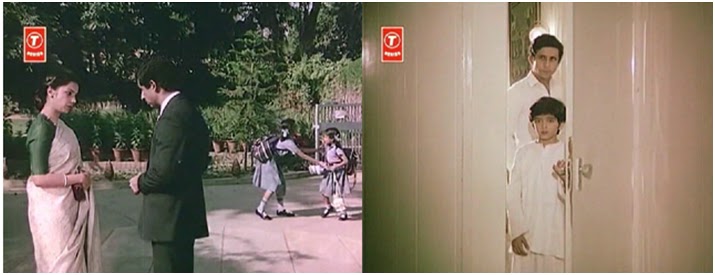
Also it was one of the few movies that celebrated the urban way of living. DK Malhotra (Naseerudin Shah) is a successful architect who owns an idyllic house in a posh colony of Delhi. His wife Indu (Shabana Azmi) is the quintessential urban housewife who has a household help for assisting her in the daily chores, has a garden to look after, is educated and helps the kids with their homework. The way their house is set up shouts sophistication and richness. The family has its dinners and lunches and breakfasts on a fancy dinner table. The culinary on the table is all un-Indian and the kids are quite proficient in table manners. The children have a separate room all for themselves, and the parents don't mind going to parties without them. At the parties the wife quite enjoys it when her husband makes a mockery of himself in an inebriated state. The weekends are spent at a posh club with bonfires and all.
The friends
Both DK and Indu are part of the 'high society'. Their friends and acquaintances are from the same world. DK's best friend and confidante Suri (Saeed Jaffrey) is an exuberant Punjabi who likes his wine and women and is quite into sports. He is a proud father of a spoilt kid and enjoys his son's impudence and relishes his slight achievements. But the gregarious fellow is good man at heart and a true friend to DK. With him DK can discuss his worst fears and the biggest mistakes without feeling ashamed. In him he has a 3 AM friend who he can call upon at any time in times of adversity.
But despite all of the urbane feel and the progressive attitude in life, it is still a male dominated world. The women of both the households are housewives who have nothing much to do apart from looking after their home and children while they wait for their husbands to return from work. Indu's friend Chanda (Tanuja) plays a crucial role in shaping her thought process. Chanda, more than a friend, is an influencer who acts as a reference to Indu when times become tough for her. In the initial portions of the movie Chanda is a fiercely independent woman who has adopted a tough persona to hide the sorrow that haunts her from inside caused by her husband abandoning her for some other woman. She vows to never forgive her husband and channelizes the feeling of rejection through her sarcastic and cynic view of the world. But during the end portions of the movie her tough exterior breaks down when her husband returns to her, and she forgives him. This happens at a time when Indu herself is slowly coming to terms with her husband's infidelity and is drawing closer to the young boy her husband had fathered with some other woman.
The Infidelity
A married DK visits his Alma-mater for a reunion and runs into the beautiful and enigmatic young daughter of his teacher- Bhavna (Supriya Pathak). There is something quaintly charming about the lady that pulls him towards her. Their interactions are wistful and thus their encounter is one that has an inexplicable sadness attached to it.Maybe the fact that they both realize the pointless nature of their brief courtship leads to this regretful longing. But Bhavna, despite being cognizant of the ill-fated future, goes ahead with the brief relationship. Soon DK returns to his world and his wife and forgets all about this ephemeral romance. Bhavna to her part never tries to contact him, even when she gives birth to his son. This quirky spirit of Bhavna is strangely alluring. And Gulzar created a similar character (Maya) in his tale of unrequited romance (Ijaazat).
The confession
When DK discovers that he has a son outside his marriage with Bhavna, he is of course devastated. But he makes no effort to hide this fact from Indu. In one of the most poignant scenes from the film, he confesses in front of his wife. This scene comes very early into the narrative, which is again rather unconventional. In such situations in most movies, the guilty party tries to evade this moment of confrontation and makes all efforts to delay it to as late as possible- to eternity if feasible. Here by standing up and facing the truth while admitting to the the worst, DK shows great strength of character. But more than that it shows the amount of love he has for his wife. He knows that he has caused great hurt to her, but he faces this fact head-on without fearing the repercussions.
The arrival
The arrival of Rahul (Jugal Hansraj)is fraught with tension as expected. The boy is quiet and deeply affected by the loss of his mother. But despite all his nervousness, there is an air of confidence in the way he talks and looks around. The aura he has is a quaint cocktail of melancholy and warmth. His eyes are expressive, and gives away more than what his words do. The new setting for him is a challenge. But he is unaware of the fact that his arrival is as big a challenge to Indu, if not more. From this point, the most intriguing moments of the movie are between her and the boy. Her internal struggle, her confusion, and her being unable to take a tough stance against the lovable boy is a real treat to watch. The arrival of Rahul is also a welcome change in the lives of the two girls Pinky and Minni (The elder one played by a young and as sprightly as always Urmila Matondkar).
The new family
The bonding between the three kids is delightful to watch. The younger sister Minnie is less tentative and the more curious of the two. She and Rahul strike a friendship immediately. The elder Pinky is slightly more reserved and takes her time to lose her guard against the stranger boy. But when Rahul helps her with some difficult Maths, she too starts liking him immensely. The song 'Lakri Ki Kaathi' is a joy to watch with the three sharing great camaraderie. Post the song comes one of the most touching moments of the movie when Rahul gifts Indu a self-made wooden box. This is again a moment when the motherly love in Indu is itching to come out and embrace the boy, but the hurt wife in her stops her from doing so.
My favorite scene
DK and Suri's families go for a picnic on a weekend. In a game of cricket Suri's spoilt and bratty boy spanks DK the bowler all over the park. A proud Suri watches his son bat splendidly from behind the wickets. The ball is then taken by Rahul and he runs in to bowl... The result is expected yet sweet. He clean bowls Suri's young boy. What follows is something truly heartwarming. Seeing Rahul beat Suri's son at the game DK exults in joy. There is a feeling of great pride in him which he is unable to restrain. The father in him forgets for a moment the precarious situation that his family faces due to his illegitimate son. He almost proclaims to the world... "he is my son". Only thing is, that there is no one in earshot.
Tujhse Naraaz Nahin Zindagi... Hairan Hoon Main
The genius of Gulzar. Remarkably simple words that convey a sea of emotions. Certainly one of the most memorable songs to have come out of his pen. The soothing tune and the wonderful lyrics are coupled with some excellent visuals with DK and Rahul spending some quality father-son time with each other. The scenes are reminiscent of the Salman Khan starrer 'Jab Pyaar Kisi Se Hota Hai'. The movie that came in the late 90s is most certainly inspired by Masoom, and no wonder it is one of my favorite Salman Khan films :)
The drama
Rahul soon learns that DK is none other than his own father. Unable to take in the shock, Rahul's young mind loses its composure and he runs away from DK's place. His disappearance creates great drama with DK losing his cool and driving all over his portion of the city along with Suri, searching for Rahul. At home the two sisters are unable to handle the stress and break down. Once again the character with the most confused emotions is Indu. She is worried for Rahul, but restrains herself from expressing her worry out aloud.
The differences that were created since Rahul's arrival start creating an inferno in Indu's head while he goes missing. Her's is most certainly the most complex role of the lot and Shabana Azmi does full justice to her. In the end the compassionate mother in her wins over the hurt wife, and that leads to a happy climax!
Parting Note: Masoom is truly a special film. It deserves to be seen and savored by all those who like their movies to be simple yet alluring. Parting with the song that's synonymous with the movie today.
Slight periods of darkness interspersed with glorious hours of sunshine. But at the end, the darkness had to prevail…
Mrinal Sen’s 1984 feature film Khandar (ruins) is a deeply moving account of human predicament, that despite it lugubrious approach ends up as a poignant and redoubtable study of how our past and our roots always have a formidable role to play in shaping our future. The emphasis is on stillness of time and incidentally (or rather intentionally) the main character is a still photographer. It’s his art that acts like a window to the director’s mind and his vision. The story though basic alludes to a deep thought that is far visceral than what it looks on surface.
A young man Dipu (Pankaj Kapoor) takes his two friends, Subhash (Naseeruddin Shah) and Anil (Annu Kapoor), along to his ancestral ruins in the heartlands of the country where once his family were the plenteous ‘zamindars’. The decrepit ruins are a photographer’s delight and thus Subhash cannot keep his alacrity in check and decides to take a panoramic view of the surrounding from the roof of their ‘haveli’ despite it being pitch dark on the first day of their arrival itself (he uses an electric torch for the same). The circular gaze of his torch falls upon the intricate wall structures on the building opposite to him until it captures a face in a window- the face of a woman…
Later he comes to know that the woman is Dipu’s cousin Jamini (Shabana Azmi) who lives all alone in the spawning derelict ruins along with her invalid mother who can’t even move an arm without someone’s intervention. Dipu tells him and Anil about her being the only members of their family who had refused to leave the ‘haveli’ even as the others around them had left for the big cities in search for a better and a more secure livelihood (triggered by a malaria epidemic that had struck the region a few years back). He also tells them that both Jamini and her ailing mother were waiting for a guy who had promised to come and take Jamini along with him as his wife. This very hope was what was keeping the old lady alive. Intrigued by it all Subhash decides to visit the mother and daughter while Dipu paid them a cursory visit. But in an unexpected turn of events, the mother (who no longer has the sense of vision) imagines Subhash to be the very guy who had promised to take her daughter away from the ruins and help her escape her vacuous and wasteful life.
What follows next is that Subhash finds himself drawn towards the extremely nubile and pragmatic Jamini, but cannot bring himself to admit it. At the same time a slight hope starts building up inside Jamini that Subhash would indeed ask her hand for marriage. At more instance than one, both of them meet and there is a tacit confluence of these thoughts. However nothing is expressed verbally. Jamini’s comportment changes drastically while talking to Subhash. The intonation in her voice and the lurch in her sentences convey a great internal struggle that is only compounded by her mother’s inexorable questions and remarks. On the other hand Subhash starts hiding his face behind his camera to eschew giving away what was going on in his mind. His fingers keep on clicking away and he starts capturing each and every aspect of the quaint ‘khandar’, while avoiding taking that one picture that would be the closest to his heart.
After three days the time comes for them to leave the ruins, Subhash cannot hold himself back and jumps out of the bull-cart just prior to their departure and runs towards Jamini’s quarters. Till the very last moment he cannot resolve his predicament, and ultimately leaves upon taking just one last photograph, that of Jamini looking at him in a hopeful manner through the door of her house of confinement. This last photograph would keep haunting Subhash for the rest of his life…
The movie is akin to a beautiful and languid prose that is suffused with thought. Through the sinuous performances by the case, especially by Shabana Azmi who is beyond wonderful in her portrayal of the lady thwarted by her own roots, the movie sublimates into something which is very rare in Hindi cinema.
Parting Note: The movie is simply a must watch. It’s unfortunate that the only print available for it online is not too great and the scenes shot in the darkness of the night are difficult to comprehend. But it is no hindrance as at a certain level it was meant to be that way- only those who know the dark can appreciate the munificence of the glorious sunshine!
Unlike the west, Indian cinema has seen very few books being adapted into movies. Shyam Benegal’s ‘Junoon’ is one of those rare features that sources its material from a book; Ruskin Bond’s novella ‘A Flight of Pigeons’ being the subject of attention in its case. The book was written by Bond in the early 1970s, and is the story of the trials and tribulations faced by an English family during the Indian mutiny of 1857, in a small Indian town-Shahjahanpur. It is a true account told from the perspective of Ruth, the young daughter of an English officer, who witnesses the brutal killing of her father at the hands of the communal mob that breaks out during the mutiny. How she, her mother, and the rest of her family including her granny and a cousin manage to keep themselves alive over the course of the next one year, is what the book talks about. But more than being a story of survival and an account of human helplessness, Bond’s book is a showcase of how human compassion and empathy has no communal boundaries, and how true love can keep the worst in a man at bay.
It is a powerful written material that Shyam Benegal chooses to bring alive on celluloid. However what he puts across in his film is an entirely different perspective that follows a texture that is far from what the book adopts. While the book has its focus on the humane relationships between people from two communities at war, the movie treats the backdrop of the 1857 mutiny as an opportunity to make some political points (including some slightly jingoistic ones) and centers the plot around the obsessive love (‘Junoon’) that Javed Khan (Shashi Kapoor as a dashing Pathan) had for Ruth (Nafisa Ali in her debut role). The movie is also an ‘Indian’ version in a way that the mutiny is shown in a highly positive light (something that was not done in the book written by the Anglo Indian Bond), and the atrocities that the British Raj committed on the helpless Indians are brought out emphatically. Also, while the book condemned the violence committed on Ruth’s family and their ilk, the movie somewhat justifies the virulent means adopted by the rebels lead by Sarfaraz Khan (Naseeruddin Shah is a role that seems to be written for him).
The movie takes off with a starting credit ‘qawalli’, featuring a vagabond fakir and introducing the protagonist Javed Khan on horseback. This qawalli is a really stretched one and tests the patience of the viewer, and in my opinion should have been done away with or compressed generously (I can imagine some people in the audience contemplating leaving the auditorium when the movie would have been playing in theatres). However, like in the book, the actual story starts off with the killing of Ruth’s father in a church, and her and her family’s subsequent surreptitious refuge in Lala Ramjimal’s (Kulbhushan Kharbanda) house. Soon their nervous and unsafe stay at Lala’s home ends when Javed Khan (one of the rebels who were fighting the ‘firangis’) discovers them and takes them to his place where his wife (Shabhana Azmi) welcomes them reluctantly owing to her fears about the supposedly illicit and open ways of the English women. Her fears prove somewhat right when Javed Khan admits being besotted by Ruth since a long time and expresses his wish to marry her and make her his second begum. This proposal by him starts a slight battle of egos and wits between him and Ruth’s mother (Mariam).
The movie from here on becomes a tale of Javed Khan’s unrelenting pursuit of Ruth’s love. Being a true Pathan he refrains from having her by force, and rather shows great dignity and poise when his people accuse him of putting his obsession over everything else. A great deal of spark is added to the proceedings by Javed’s wife Firdaus (played by Shabhana Azmi). She is quite expressive of her dislike for Ruth and her mother, and revolts quite vociferously in front of her husband, who determinedly ignores her constant complaints. Parallel to this, Sarfaraz Khan (the leader of the rebels and Javed Khan’s brother in law) is shown marshalling his troops against the British in Delhi, and subsequently in Kanpur.
Meanwhile Ruth’s mother and Javed Khan agree upon a condition that she would give him her daughter’s hand in marriage if the British lose the battle (otherwise Javed would never even think about her again). Javed Khan reluctantly accepts this agreement on the insistence of his ‘Chachi’, who incidently had grown very fond of Mariam and Ruth, and at whose place they both were residing for a while. So the fortunes of Javed’s love get attached to the sepoy mutiny that was burning in many of the country, and which was being brutally suppressed by the British troops at most places.
A tale of fierce love that remains unrequited in an extremely volatile political situation, Junoon is more than an account of India’s first war for independence. It is a complex film, which has more meaning than what it conveys overtly through its narrative. Shyam Benegal has left it upon the viewers to form their own interpretations and opinions. One question that arises when you finish watching this movie is whether Javed Khan was justified in putting his love over all other rational and irrational things in the world. Frankly, there is no answer, to this- but this tale suggests that love may be a human failing, but it is also the most powerful emotion in the world. The last scene of the film, when Javed returns to the village while risking his life, to catch a last glimpse of Ruth before escaping with his family to safety, is one of the most powerful ones of the movie. While Mariam refuses Javed to meet Ruth even one last time, Ruth by herself disobeys her mother and lets the Pathan have a final gaze at herself, till he turns around and trots away on his horse. This gesture by Ruth is a silent acceptance of her love and affection for Javed. So while Javed loses Ruth, he does manage to win her love and devotion, and that too quite handsomely for it is mentioned that Ruth decided to remain unmarried for the rest of her life.
To do his bidding, Shyam Benegal chooses a splendid star-cast. While Shashi Kapoor (in his first film as producer) is phenomenal in the central role, Jennifer Kendel (Shashi Kapoor’s wife) who plays Ruth’s mother is heartwarming in her portrayal of a strong woman faced with a very difficult situation. Shabhana Azmi is energetic and excels in an extended cameo, while Naseeruddin Shah is his usual brilliant self in a powerful role of a leader of the rebels. Nafisa Ali, in a central role in her very first film, is raw and somewhat amateurish (her discomfort comes across more glaringly in company of seasoned actors as the rest of the cast). Deepti Naval, Kulbhushan Kharbanda, and Sushma Seth pitch in with solid supporting acts.
Shyam Benegal paints the movie on a very realistic canvas. The 19th century Indian town is recreated authentically, and the other elements of a good historical like the costumes, dialects, and vocabulary seem all in place. The music of the film is classical Hindustani, and may appeal to the connoisseurs of that kind of music.
Apart from giving a different tenure to the story, what Benegal does differently from Bond’s book is that he gives a lot of emphasis on the metaphorical title that Bond chose for his book (The flight of the pigeons). So while at one level Javed Khan is shown to be quite fond of his pigeons, on the other Sarfaraz Khan in anguish equates Ruth and her family to worthless Pigeons that had captured Javed Khan’s thought process. At another level, the film culminates on the note when all the local people are forced to flee from the town to save themselves from the fast approaching British troops.
Parting Note: For people who are interested in History, and do not mind a leisurely pace to the proceedings, Junoon is a must watch. And for anyone who is interested in reading, ‘the flight of the Pigeons’ is a must read (it’s a short novella and won’t take much time).