Showing posts with label classic. Show all posts

Sunday, June 1, 2014

Sara Akash (1969)

A 1969 film, ‘Saara Akash’ is the debut directorial feature of Basu Chatterjee, who later went on to make some of the most acclaimed films of the 70s and the 80s. It is very much a non-mainstream effort with mostly first time actors forming the cast, and has been given a very unique treatment by Chatterjee, especially in terms of its experimental shot-taking, quirky camera angles, and use of nano-flashbacks to depict the internal conflicts of the chief protagonist. Like many of the director’s later efforts, the movie has its basis in literature and its story is adapted from the first part of a novel of the same name, written by noted Hindi writer Rajendra Yadav.

The movie has a very novel premise about how a newly-wed husband and wife don’t exchange even a single word between themselves for almost six months. Set in a traditional middle class Hindu family in the historical city of Agra, the story is soaked in the atmospherics of the Indian grassroots, especially the ones associated with the custom of arranged marriages in a joint family system.

A young man, yet to complete his formal education, is married off to a beautiful and demure girl, much against his wishes. The girl too has had some schooling, and is seen as someone who is well educated by the general societal standards set for her kind. Thus, completely unprepared for matrimony, both youngsters enter into a relationship that is marked by uncertainty, apprehension, and bashfulness. After making an inauspicious beginning by completely ignoring each other on their first night together, their problems only get compounded, as the reservations they have towards one another keep on getting fueled by their family dynamics.

The boy is fiery and ambitious, heavily influenced by the ideals of Subhash Chandra Bose and other noted public figures that had a stirring impact on the youth of those days. He channels a firm outward belief that marriage is nothing but an impediment in the makings of a great man, resulting in him assuming a tough face in front of his wife, despite covertly longing for her companionship. Some of the most delectable moments of the film are the ones that highlight this contradiction, and mostly involve him completely ignoring her presence, despite wanting to do the exact opposite. Till about halfway into its duration, the film has a light-hearted approach and derives humor from such situations. However, the tone of the film soon changes as the focus shifts on the other half of the conundrum, i.e. the inner world of the bride, who is harangued not just by her husband’s insurmountable apathy, but also by his family members’ demanding behavior and condescending attitude towards her education, especially from the jealous women-folk of the household. In a poignant scene that illustrates this change of treatment, the girl makes a mistake while doing a household chore and is severely reprimanded by her mother-in-law, and when the boy enters the scene and is told about the misdeed done by his wife on whom he has no apparent control, he goes forward and slaps her, which marks the first physical contact between the couple. Later he cries like a baby, hating himself for that act of physical abuse, and mocking his own fake ideals that couldn’t stop him from hitting his wife. The result of this unfortunate occurrence is that he starts spending more and more time outside the home, taking refuge in solitude or in passing time with his friends. On the other hand the girl’s solitude becomes even more absolute, especially when her confinement’s only solace, the boy’s sister with whom she shares some sort of understanding, is sent back to her husband despite her many protests.

Throughout its short duration of 90 minutes, the film unequivocally portrays the plights of a newly wedded bride in a patriarchal, male-dominated set-up. In the alien environment of her husband’s home, the young girl is shown to get little respite, and her world gets completely distraught as she gets abandoned by what could have been her only source of comfort in the unforgiving situation, her husband.  The husband, on the other hand, comes across mostly as a pitiable and spineless figure, with little points of redemption. Hardly out of his childhood, his mind replete with regressive societal notions on how a wife should behave and not behave, and at the same time heavily influenced by the elders in his family, the boy-man’s helplessness too comes out on occasions when he breaks into a child-like smile on being teased by a friend, or when he shyly dreams about little moments of intimacy with his wife.

The acting by the two leads, Rakesh Pandey and Madhu Chakravarty is impressive and both manage to do complete justice to their extremely complex characters. The three most familiar faces in the cast are those of AK Hangal, Dina Pathak, and Jalal Agha, but none of them have really much to do. There are no songs in the film; however, the music by Salil Choudhary, which plays mostly in the background, fits the mood of the film very well.

Parting Note: An exceptionally well shot experimental film with a very realistic treatment that remains topical, despite the forty-five years that have passed since its making. A must watch for all those who wish to study and savor the parallel Hindi art-film movement, which according to many, started with this film.


Interesting fact: The film was shot entirely in the ancestral home of its writer, Rajendra Yadav (source Wikipedia)

Wednesday, May 14, 2014

Gaman (1978)


Muzzafar Ali’s first film, Gaman, is an effort that, at one level, delineates the chasm between the India of the villages, and the India ruled by urbanity. At another level, it portrays the multitude of different worlds that inhabit the urban fold. The film keeps oscillating between two starkly shot geographic settings throughout its duration; Kotwara, a small village in Uttar Pradesh, and Mumbai, the quintessential metropolis, simmering with a lure that is almost Pied-Piper-esque. The lead character, essayed by a tremendously understated Farookh Sheikh, migrates to the big city from this native village of his, in search for a living, leaving behind a newly-wedded wife and an ailing mother. This migration (or Gaman), is his last resort, much like how it is for thousands of his ilk. How his life first interacts, and later merges, with the all-encompassing landscape of Mumbai, and how he constantly tries to make peace with the guilt of having left his family behind, while all the time trying to seek redemption in this choice made by him, is what the film is all about, at least on the surface. But the director has ensured that deeper connotations are implied by giving a very unique treatment to the screenplay, where instead of focusing on the affairs of just the main leads, he has created a mesh of similarly themed stories of human survival, which suffuse into each other, and construct an ensemble. And yet the handling is minimalistic, and in most of the frames the emotions are more explicit through the visuals, than through the words spoken by the characters.

The movie is also an excellent example of crowd-sourcing and how ‘real’ people, places, and locations have been used in the narrative (The director duly metions the natives of Kotwara in the credit roll). In fact, it is hard to find a frame which looks inauthentic or which might have been shot on a set or in a studio. Mumbai too has been shot painstakingly, with much love, and for anyone familiar with the city’s terrains, the cinematography of the movie is reason enough to give the movie a watch. The language, grammar, and dialect of the words and the music of the film is rooted in realism and is full of references from history, and especially that from the history of Islam, for the lead characters are Muslim, and their native village, as in the film, has a sizeable Muslim population. The practices observed during Muharram at the village of Kotwara have been shot guerilla style and are depicted unequivocally. In a poignant moment from the film, the lead character gets caught in a frenetic Maharashtrian celebration, and is promptly reminded of the Muharram communal mourning back at his village. This is perhaps another way to bring to fore the intermingling of cultures, which the director portrays, not just by setting his film in the melting pot of all humanity that is Mumbai, but also by relegating the religious identities of his characters to the background by treating them in a very matter of fact manner, which in itself is very refreshing. The songs too are reflective of this timeless convergence that is perhaps the most defining feature of Indian socio-cultural fabric; the music (by Jaidev) is based on our ‘Hindustani’ tradition and has a classical base with the lyrics in both Hindi and Urdu. Half of the songs are set against Smita Patil’s incredibly expressive eyes in the backdrop. She hardly has any dialogue to speak in the film, and yet she says a lot in each and every frame she is present in. 

Signing off with the song ‘Seene Mein Jalan’, which is the perhaps the best remembered song from the movie… 


P.S.- Nana Patekar has a character role in the movie, while Satish Shah also appears in a scene.

Wednesday, October 16, 2013

Dard Ka Rishta (1982)


An artist’s best work is often the one that has risen out the melting pot of his own life experiences.  The best artists in the world are known to create art for themselves, not caring much about the expectations the world burdens their shoulders with.  In fact, there have been innumerable cases where an artist was not even acknowledged during his or her lifetime; the famous painter Van Gogh’s name comes to mind as a prime example of such an occurrence. If we have to looks for an example closer home, the name of Guru Dutt can be mooted in this regard. Although he wasn’t completely unappreciated while he lived and made movies, his true worth was recognized only after an untimely death. Though, it must also be said while citing his example that cinema, as compared to painting or music, is a highly corrupted art form, owing to the fact that films are almost always made for an audience and are hardly ever devoid of commercial considerations.
Another observation that I will make before turning to discuss the movie I wish to discuss in this post, is that it is often painful experiences and grief that act as the most effective catalysts to the most creative of expressions. This particular sentiment has been widely popularized by the movie ‘Rockstar’, but I had to say it to set the context.
Sunil Dutt, was a prolific actor, and more than just an occasional director/producer. In fact it won’t be wrong to say that some of his directorial/production ventures were far more ambitious than most of the movies he starred in as an actor. From ‘Yeh Raaste Hain Pyaar Ke’ which dealt with a taboo real life adultery case, to ‘Yaadein’ that was an unique experiment with just a soliloquy piecing together a narrative, to big canvas dacoit films like ‘Mujhe Jeene Do’ and ‘Reshma aur Shera’, the man was never afraid to challenge the stereotype. In 1981, the year in which his son Sanjay was launched by him in ‘Rocky’, he suffered a huge personal setback when his beloved wife Nargis succumbed to cancer. Out of this great grief must have emerged the story and concept of ‘Dard Ka Rishta’ a movie that he made just after, as a tribute to his wife, and apparently to further the cause of cancer awareness and research. And in my view, this particular movie, made as a labor of love and pain, is the best movie out of all that were produced by him. 
The structure of the story is simple but touches upon many issues that remain relevant even today. One, it highlights the conflict in the mind of an expat originally from a poor/developing country like ours, of whether to lead a somewhat selfish existence where there are many personal gains to be had, or whether to go back to one’s own country and contribute using the skills gain abroad. Two, it talks about the conflict in the mind of a doctor, of how to best use one’s education, that is, to use it as a privilege or as an aid to the society’s betterment, also whether to make best use of what’s current, or whether to throw oneself into research and look for better methods to improve on the current.  Three, it looks at the relationship between an estranged couple, and how it plays out when they meet after many years. Four, it looks at the plights (and the delights) of a single parent, on how kids such raised, mature quicker and come to terms with life’s realities and responsibilities a lot sooner than kids indulged by both the mother and father together. Five, through a somewhat clichéd and yet entertaining side-track it looks at the eternal Hindu-Muslim communal issue, which again is an apparent offshoot of Sunil Dutt’s own life, owing to his marrying a Muslim lady. Lastly, and above all, it highlights how difficult it is to face loss, to watch a loved one die, and not being able to do anything about it.

The story, refreshingly for a Hindi movie of that time, has a broad geographic canvas a narrative that has a wide time span. Thus, the characters and lives evolve and grow as the story progresses. Most impressive is the restraint on melodrama, which is left implied and unsaid on most occasions, truly unique for a 1980s Hindi movie. A lot of this can be attributed to the calmness and grace that is brought to the screen by all the female actors- Smita Patil, Reena Roy, and a young Khushboo (the famous actress in South Indian films) who plays Sunil Dutt’s daughter. Sunil Dutt, essaying the lead male part, expectedly acts with great sincerity and sensitivity. The music by RD Burman is pleasant to the ears and complements the mood of the film.

Also unlike most Hindi movies, it is difficult to decide what the best parts/scenes of the movie are. The father-daughter relationship is heartwarming and in essence is the core to the plot, but the subsidiary emotional linkages, for instance the relationship the girl shares with the servants/helpers of their household comes out very well through some nicely written scenes. The NRI portions of the story, which would have done Jhumpa Lahri proud, have a stamp of finesse and class. The medical procedures and functioning of a foreign health-care setup, as shown in the movie, give the impression of being well researched. The only dated bit of the movie is the part where Sunil Dutt has to marry Reena Roy because of certain unfortunate circumstances, but even that can be excused as a well-received big-star movie used the same plot device as much as twenty-five years later (How Shahrukh Khan ends up marrying Anushka Sharma in his blockbuster hit Rab Ne Bana Di Jodi).

 
Overall, the movie is well worth its slightly long duration, and is quite a classic if you consider the period it was made in, and the personal element of the maker involved. It is unfortunate that this movie is seldom talked about in the media circles (it even fails to receive a mention in the main body text of Sunil Dutt’s Wikipedia page).

Friday, January 18, 2013

Taxi Taxie (1977)


In 1976, Martin Scorsese came up with Taxi Driver, a movie that went on to be viewed as one of the best films ever. Starring Robert De Niro, the movie garnered tremendous critical acclaim and emerged as a cult classic. Over the years many directors have been inspired by its style and the way it went about constructing a psychological study of a man leading a life shrouded by disturbing elements, or rather deconstructing the psychological state of disturbed man finding it difficult to come to terms with his environs.

Closer home, a man called Irshaad made a movie titled Taxi Taxie, casting Amol Palekar in the lead as a taxi driver operating in the metropolis of Mumbai. This movie that came out in 1977 seems to be clearly inspired by the English classic that released a year before. However it must be said that it is the best sort of inspiration. The director/writer has been influenced by the idea of his famous contemporary from the west, and has created a completely different movie, completely different narrative of his own, which is quite unique and interesting.
Amol Palekar, quite fondly given the moniker ‘Hero’ by his fellow Mumbai Taxiwallahs, is an honest and diligent worker who spends most of his time on the streets of Mumbai, helping various people move around the city. However, he himself finds it difficult to navigate through certain cobwebs in his mind, which keep pushing him back to his past. His choice of being a taxi driver, despite being well qualified academically, comes as an enigma to his old college friend who he runs into one day. He justifies it by voicing the joys of being constantly with various passengers, who he treats like fellow companions in the journey of life. The profession, thus, is his way of parrying off any chances of falling prey to loneliness. There is also a more romantic reason of him wanting to search for an old flame who he hopes would run into him, if luck is on his side. Thus, all the time his eyes keep searching for that familiar face while he drives through the good and bad wonders of the city.

As a part of his routine, Hero chances into a hapless (and kind) prostitute more than once, and forges a friendly relationship with her. He also meets a struggling playback singer who somehow reminds him of his flame who he wants to reconnect with quite badly. There is also a kind Christian landlady with whom he shares a lovely bond. It is through these relationships that Hero’s thoughts and conflicts are brought to the fore wonderfully well.

The movie is quite atmospheric and the city of Mumbai plays a crucial role in binding the narrative. Quite like the recent Aamir Khan starrer Talaash, a movie that also shares some other similarities with this thirty five year old forgotten flick. People who have been to Mumbai will find it quite interesting to see all their favourite places from ‘town area’ being given due prominence in the film (without ever pushing the main context to the background). Some deftly handled small touches can be appreciated after every few minutes, which makes the film appear very technically sound in spite of the apparent low budget.

The best thing about the movie is that despite its very heavy subject and philosophical tone, it never comes across as too much to take in. Some light-hearted moments are nicely done, and some appear contrived today, but by and large it is an extremely fresh screenplay which at least I have not seen replicated in (or replicated from) any other Hindi movie. Apart from Amol Palekar and a stunningly beautiful and assured Reena Roy, none of the actors show much finesse. However the below average acting acumen of two of the three leading ladies is not at all jarring, as Amol is in each and every frame to balance proceedings. 

The music is tuneful and soothing, and surprisingly not overdone. But it is one of those Hindi movies which do not need the crutches of super-hit songs to stand tall. The meat in the concept and the surprisingly well written dialogues take care of almost everything. Another point worth appreciating about the feature is that it never meanders, even when its lead meanders in his realms of thoughts. In the hands of a lesser director, the plot could have turned into a crime/mystery drama, (I have seen some Hindi movies taking that route after showing a lot of promise in the initial reels) but fortunately here the man in-charge sticks to the point.

Parting Note: Taxi Taxie is a very good Hindi film lost in oblivion. Definitely an excellent watch even today.


Sunday, October 28, 2012

Annadata (1972)

Many of our old Hindi movies have messages that have not lost their relevance over the years. In fact some of them seem to have been written with a crystal ball in tow, for the incipience of the issues they reflected on at that time has turned into a chronic persistence in the modern world of today. Annadata, one such film made by Asit Sen almost forty years ago, is a film that moots the breeding selfishness in the modern materialistic world and questions whether there is any good left in the world deafened by the rumble of avarice and ambition.

A rich industrialist Amba Prasad (essayed by an immensely likable Om Prakash) is referred to as annadata because of his largesse and charitable disposition. In the urban jungle that incubates the battle between the haves and the have-nots, he stands tall as someone who uses his wealth for the good of everyone, and not just for himself. However, false news of his death opens a can of worms when a large number of his blood relatives start fighting amongst themselves while staking a claim to his empire. But what truly breaks his heart is when his adopted daughter claims to have been an illicit relationship with him (forced by her gold-digging parents), just to proclaim herself to be a true heir to his vast empire. This cruel accusation completely shatters the old man’s faith in the world and he leaves everything he owns in care of his manager, while embarking on a journey, with only his pet dog accompanying him, to discover his lost belief in mankind.


On his journey when he is just about to give up all hope, a chance encounter brings him in touch with Aarti (Jaya Bhaduri), who nurses him to good health. In the days that follow Amba Prasad discovers how one woman epitomized all that he was looking for in the world- honesty, selflessness, benevolence, and righteousness. When he had started getting the feeling of been marooned on an island of spite and no respite, Aarti’s care and love ensnares him in her small yet salubrious world that blossoms with empathy of its occupants. Amba Prasad also strikes a quaint companionship with Aarti’s lover Arun (Anil Dhawan), an idealist painter whose lack of means makes him hesitant to solemnize his love for Aarti.

The movie is far from perfect despite the well intentioned premise. There are unnecessary scenes and also some shoddy acting, led by a very stiff and unintentionally hilarious Anil Dhawan. A polished actor would have definitely added tremendous weight to some complex scenes that fail to achieve their purpose with the present actor. The songs by Salil Chowdhary, though melodious, aren’t as neatly woven with the story as say Gulzar film songs would be. But Jaya Bhaduri and Om Prakash’s assured presence, and the brevity of most scenes that could have fallen in the trap of sermonizing, ensures that the film remains a light yet meaningful watch that ends on a positive note. In fact the film traverses the gargantuan distance between pessimism and optimism in just about two hours.

Parting Note: Annadata is akin to a Hrishikesh Mukherjee film that has its screenplay woven around a good idea, and is given a light-hearted treatment with melodrama kept to the bare minimum.

Monday, October 15, 2012

Dastak (1970)


That knocking on the door…

In the process of discovering and experiencing some lesser talked about or simply forgotten chapters of Hindi cinema, I have being surprised more than once by the sensitivity of our storytellers. There have been so many instances of ordinary real life emotions being brought out extraordinarily on celluloid, that one has to admire the thoughtfulness and the dexterity of the people who ‘wrote’ our Hindi movie heritage. Almost all the movies that we see today are a reflection on some or the other film from our past. Yes, there have been quantum changes in technique, setting, and circumstances, but the core emotions remain quite the same.

And thus when I saw Dastak, conceptualized and brought to life by Rajinder Singh Bedi, one of the stalwarts of Hindi and Urdu literature (and films), I was quite taken aback. Here is one story that is so unique, and so very glowing with brilliance, that it has almost no parallel. The idea, the context, and the sheer execution of this very human and humane drama, is a delight to watch.

A young recently married couple move into a small house in one of those crowded and cramped spaces of Mumbai. In a neighbourhood bustling with activity, the two decide to embark on a lifelong journey together. But all their dreams and all their expectations go for a toss once they discover the murky identity of their new abode, i.e. once they discover that just before them their home was being occupied by a notorious nauch girl and prostitute. Every second day in the middle of the night when the world sleeps, Hamid and Salma are harrowed by incessant knocking on their main door, by some or the other lost soul seeking refuge in the arms of Shamshad Begum, a lady who even in her absence manages to cast a icy cold wall between the much in love couple. How all this affects the psyche of the two, and how they attempt to fight the war their neighbourhood wages against them, is what the film is all about. At the same time a discerning viewer will appreciate the social commentary made in the background, leveraging upon what all happens in the foreground.

Rehana Sultan as Salma
There are so many metaphors used in the film, but none as striking as the caged mynah that becomes the third occupant of the cursed flat in question. Every day Hamid goes to work, leaving his comely wife Salma trapped at home. Her very existence till the evening, when Hamid returns, becomes a monumental challenge. The claustrophobic neighbourhood, with its closely packed blocks of urban settlement, ensures that there are always some prying eyes trying to close in on her whenever she seeks a bout of fresh air through the windows. The notoriety that their flat gives them moreover ensures that whenever she tries take forward her father’s legacy in classical singing, there are always suspicious voices to be heard questioning her integrity and the very fabric of their matrimony. Thus Salma without Hamid is not very different from their pet mynah that at least has the consolation of being free inside the cage, unlike its owner.

The other aspect of the story is Hamid’s struggle to find a new flat for himself and his wife. The city is unforgiving in its demeanour, with its intimidating tall structures and unscrupulous people. His work-life too is not exactly a cruise as every now and then he lands in a situation of moral dilemma where his ideals ensure that he makes no financial headway to erase ghosts of his wretched personal life.
Sanjeev Kumar as Hamid

In one very significant phase of the screenplay the couple decides to just run away from everything, back to their village. But there too, they witness enough misery to be compelled to return to their cursed urban abode. This excursion from reality to another reality teaches the two an important lesson that they acknowledge towards the end of the film, just after a spectacular climax. The last sequence of the story, that also includes a song, is a stamp of genius. One of the best Hindi movie climaxes ever for one of the most unique Hindi film ever!

The performances from the two protagonists, Sanjeev Kumar and Rehana Sultan are mesmerizing to the core. Has there ever been a more natural actor than the former? Rehana Sultan, in one of her first few films, is so good that it looks like she was born to play this role. The songs by Madan Mohan are melodious and heart-wrenching with lyrics that will make you bow your heads (and backs) in respect. What poetry by Majrooh Sultanpuri!

Parting Note: Do watch this film. Do watch this film. Do watch this film. Do watch this film. Do watch this film. (substitute for 5 stars)

P.S.: The chief editor for the film was Hrishikesh Mukherjee! 


Wednesday, July 25, 2012

Yaadein (1964)


Almost fifty years ago, with this movie, Sunil Dutt attempted something remarkably innovative and courageous… a hundred minute feature starring no one else but himself!


Vanity is undesirable. But no one can deny that some of the greatest artists been some of the most vainglorious people of their time. Be it painters or actors, politicians or writers. If the vanity was not in their words, it was in their works. If it was not in their works, it was in their actions. In some ways a Mahatma Gandhi walking semi-naked, with just a loincloth on, into the viceroy’s office was a blasphemously vain thing to do!

So, is humility overrated?

Cinema, being a visual medium, is a breeding ground for narcissism. Some people, the privileged lot blessed by above average looks, express the very emotion by being very finicky about their physicality. Some others take the other route, of being much in love with their craft- and in the process many of them end of pushing the envelope. ‘Yaadein’ is one such example where an artist’s indulgence with himself and his craft has produced an extremely unique and personal piece of work. More than a movie, it is a statement that there is no limit to creativity and that the possibilities are indeed infinite.

But all said and done cinema is a medium to entertain, most would say. But a few would add that it is also a medium to express. However, the two things are seldom separate as more innovative the expression, more is the probability of it also being entertaining. So is ‘Yaadein’ entertaining? Depends on what your cup of tea is.
For those who can appreciate experiments for how much out from the box they are, will certainly relish watching the movie, despite its excruciatingly slow pace. Also, there is another set of people (a big one at that) who might identify with a lot of things Sunil Dutt does in the movie- people who are married and especially ones who have been that for a while. But those who look for a story (a majority I presume) would be disappointed (that is if they manage to complete the film- my guess is they won’t! I just about managed myself).

The film has a young Sunil Dutt coming home after work and discovering that his wife has walked out of his life- taking with her their two kids and leaving behind a note… and lifetime of memories. As the night progresses the man starts reminiscing of the past and transforms from being an angry and vengeful husband to a helpless and hopeless romantic, longing for his wife and kids. In the process his soliloquy is what keeps the audience company. Instead of using other actors, Sunil Dutt uses sounds, dialogues, shadows, puppets, balloons, and what not- to create the scenes. To an ardent movie lover, this very compromise and how it is executed would be worth the hundred minutes of the run-time.

Once I was done watching the film, a question just came to my mind intuitively. How does Sanjay Dutt feel when he watches this film of his parents? It is like reading a personal diary for it contains so many moments that seem to come straight out of Sunil Dutt and Nargis Dutt’s lives. Today both of them are no more, but their work would remain forever for the benefit of their posterity (and the fans). Truly, cinema (or art in general) is one sure way created by mere mortals to achieve immortality. It is their elixir; it is their ‘Piyush’… (pardon couldn't resist!)

Monday, April 30, 2012

Palkon Ki Chhaon Mein (1977)


A completely misleading poster of the movie- playing up the drunkard jilted-lover image of Rajesh Khanna, and glorying a five minute Jeetendra appearance. The movie is nothing like what this poster indicates. 

Five minutes into the movie, and you can make out it is a Gulzar film. This Rajesh Khanna and Hema Malini film is though not directed by the maestro himself, but by Meraj, who was an assistant to the man in most his earlier directorial ventures. But everything- be it the dialogues or the treatment, or even the look given to the lead actors- looks straight out of the Gulzar school of film-making. That he has written the screenplay is just a part of this happy occurrence.

The story is set in a village, very much like the Jeetendra- Hema Malini starrer Khushboo that came just two years or so before this movie. But this time, instead of Jeetendra, the moustache is donned by (the then on the wane) superstar, who gets to play a meaty author (read Gulzar)-backed role. Ravi (Rajesh Khanna) is a city bred educated but unemployed youngster, who doesn’t lose his sense of humor and wit despite his many failures to secure a decent employment. A chance encounter leads him to the job of a dakiya (postman) in a nearby village, which he gladly accepts. In the village he soon gets around to doing his job with much sincerity and dedication. Within no time gets acquainted with most of the village folk- each of who have their own story to tell. These include a senile old lady who awaits the return of her son, a young widow who has lost her husband in the war- but has not lost the zest for living, and a young lady named Mohini (Hema Malini) who to Ravi’s pleasant surprise appears more than willing to strike a companionship. Soon Ravi and Mohini start meeting everyday and Ravi falls in love with her, completely oblivious to the fact that she has very little interest in him- the person, and most of her attention is reserved for Ravi- the postman. This is because Mohini expects a letter from her lover, an army-man, to reach her. Ravi’s pleasing ways and respectful manners lead her to confide in him her relationship with this soldier (Jeetendra in a guest appearance). This love story of hers completely shatters Ravi’s heart, who had genuinely felt that Mohini’s affections were a result of them drawing closer to one another with each passing day. But consoling himself, Ravi decides to go the city and look for this soldier who had not written to Mohini despite his many promises. When he returns, the news arrives that Mohini’s beloved is no more and has lost his life in the war. It then becomes his responsibility, being a postman, to break this news to Mohini…

Not unlike Khushboo, this story too looks like a chapter out of Malgudi Days with all its simple and unhurried appeal. The drama in the story is somewhat based on the fact that in those days very few village people could read and write their own letters- and the responsibility of the same then rested upon the village postman- who thus became an essential part of their lives. In that sense the village postman acted like a ‘social glue’, being a common element in all the villagers’ lives. Here the song ‘Dakiya Daak Laya’ reflects on pretty much the same sentiment. While the postman drama is the backdrop, the innocent love-story with all its uncertainty and apprehensions, is the motif in the movie. Ravi’s one sided love, and his expression of the same through his sketches (that are revealed at the end), is quite endearing. The most unique thing about the movie however, is that despite all its underlying tension; it retains a light-hearted spirit on the surface. There are many instances of humor, though like in all other Gulzar movies, they are quite understated. But quite unlike most of his films, the music score here is not too memorable with two of the songs being quite situational, and a forced nautanki dance number (picturised on Rekha) not being as fun as it should have.

Rajesh Khanna puts in an earnest act, and quite underplays his character for most parts. It is easy to make out that he was a very fine actor, and thus his fall from fame appears more baffling (though perhaps that had more to do with his off-screen issues). Hema Malini is effective, though it looks like she walked down straight from the sets to Khushboo to this movie. The supporting cast doesn’t have much to do here with Farida Jalal (another Khushboo connection), Asrani, Amjad Khan, and Master Raju being the most popular ones from the ensemble.

Parting Note: This movie is a sweet love-story that deserves a watch by all those who like such village themes. And when you add the fact that it is almost a lost Gulzar film, it becomes a must watch for his fans. 

Sunday, March 25, 2012

Delightful Longing: The Blue Umbrella


These days I have been watching a lot fewer movies than before. After writing my 50th post (on Masoom) in the recall series, I have decided to take a break from old movies for a few days, and now I am catching up on some of the recent acclaimed Hindi movies that I didn’t pay much attention to at the time when they released. So this week I saw Tigmanshu Dhulia’s Haasil (after watching the superb Paan Singh Tomar), Satya (Ram Gopal Varma’s finest hour arguably), and Vishal Bhardwaj’s The Blue Umbrella. Haasil and Satya are widely recognized as brilliant films, and I concur with most of the glowing reviews received by the two movies that I read post watching them. But none of them has the haunting quality that the third film I saw has. Maybe it is because there have been many an attempts to rehash and cash in on the Satya cult (Ram Gopal Varma has done quite a bit of it himself), while the atmospherics of Haasil has been matched by movies like Gulaal and a few others. Or maybe it is just because the settings of Satya and Haasil are more familiar to the average Hindi movie audience.

On the other hand, The Blue Umbrella is truly a unique film. Everything- from its simple storyline, its performances, its setting, its intentions, to its unconventional execution has incredible freshness and charm. Prima facie it is a children’s film based on a novella by Ruskin Bond. Most certainly it is that, but more importantly it is also a film that makes you feel for its lead characters- and for that it takes a very difficult route- it makes you part of the longing the characters experience. Longing for acceptance, longing for joy, and longing for appreciation- wonderfully conveyed through their longing for a beautiful Japanese blue umbrella. The umbrella here is an important plot instrument, as while the story is woven around it, it also acts as a metaphor for all the small joys in life that may not be big achievements, but are certainly no less in the kind of happiness and satisfaction they lead to.  

The movie transports you to a small village in Himachal Pradesh. The setting is idyllic and pristine, from the rain-washed valleys to the snow clad roads, from the small kutcha-pucca huts to the almost family like village bonhomie. The people are as simple as they come- uncontaminated and pure. They have aspirations that don’t have the grand vision and scale like the aspirations of the city people have. Their smiles are genuine, their laughs are uninhibited. Their sorrows are sudden and wild like torrential hailstorms that leave behind a brighter landscape when they leave. Their slight quirks, their eccentricities may be jarring to the outsider, but they are a part of their way of life- their way of living.

Movies are stories on celluloid- it is an oft repeated statement. But this particular movie is the quintessential story on celluloid. There is no other way to describe it. It is like a page out of a children’s story book and its imagery gives an impression that that particular story book must be very well illustrated. Mr. Vishal Bhardwaj has certainly followed his instincts and a crystal clear vision. I have seen three of his other films- Makdee, Kaminey, and 7 Khoon Maaf. And ‘The Blue Umbrella’ is my favorite from whatever I have seen of him.

I strongly urge all the people who like movies and fiction- to watch this movie. It is just 90 minutes- and it will surely transport you to a world that is alien to us, but in a certain way a very small part of us. Just a tip- persist with the movie- Pankaj Kapoor’s weird ways and idiosyncrasies might put a few people off in the beginning- but by the end they will be sure to realize the finesse and dexterity of his performance.  

Saturday, March 3, 2012

Masoom (1983)

This is my 50th post in the series. To mark the milestone I choose one of my favorite films for discussion- Shekhar Kapoor's 1983 feature Masoom, starring Naseeruddin Shah, Shabana Azmi, and Jugal Hansraj (as a child artist) in principal roles. The film is one of the most acclaimed ones from that time and is the winner of many a awards for its actors as well as for the people responsible for its timeless music- Gulzar (lyrics, screenplay, and dialogues), and RD Burman (music director). Shekhar Kapoor also won tremendous appreciation for his able handling of a sensitive subject in his debut directorial effort. 
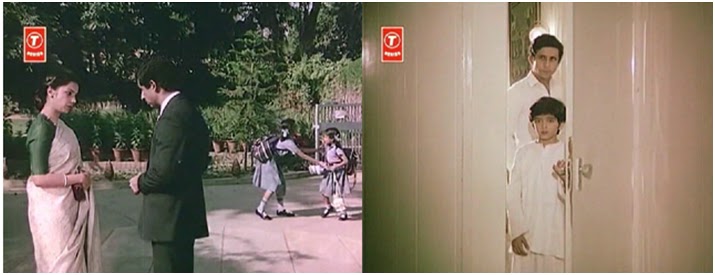
Masoom has quite a following amongst Hindi movie lovers and is widely recalled as one of the most loved films from that time. Thus I design this post as a tribute to the movie where I will recount some of my favorite moments from the film apart from discussing some subtle aspects. For the same I am using some screen-shots from the movie- my first attempt at the method. 

The family

One of the most loved aspects about the movie is the wonderful portrait of an urban nuclear family it paints. Indian cinema from the time of its inception has always stressed on the joint family system as the perfect way to live. Rarely did one see a movie in which a nuclear family was shown to be so happy and contented. It was maybe a reflection of our society and our culture which stresses on the importance of living together. Thus seldom did we see a family on celluloid sans the parents or the multitude of siblings and cousins. Masoom is truly unique in that sense for that period of time. It was truly an advertisement for the Government initiative which says 'Chhota Parivaar Sukhi Parivaar'.

Also it was one of the few movies that celebrated the urban way of living. DK Malhotra (Naseerudin Shah) is a successful architect who owns an idyllic house in a posh colony of Delhi. His wife Indu (Shabana Azmi) is the quintessential urban housewife who has a household help for assisting her in the daily chores, has a garden to look after, is educated and helps the kids with their homework. The way their house is set up shouts sophistication and richness. The family has its dinners and lunches and breakfasts on a fancy dinner table. The culinary on the table is all un-Indian and the kids are quite proficient in table manners. The children have a separate room all for themselves, and the parents don't mind going to parties without them. At the parties the wife quite enjoys it when her husband makes a mockery of himself in an inebriated state. The weekends are spent at a posh club with bonfires and all. 

The friends

Both DK and Indu are part of the 'high society'. Their friends and acquaintances are from the same world. DK's best friend and confidante Suri (Saeed Jaffrey) is an exuberant Punjabi who likes his wine and women and is quite into sports. He is a proud father of a spoilt kid and enjoys his son's impudence and relishes his slight achievements. But the gregarious fellow is good man at heart and a true friend to DK. With him DK can discuss his worst fears and the biggest mistakes without feeling ashamed. In him he has a 3 AM friend who he can call upon at any time in times of adversity. 

But despite all of the urbane feel and the progressive attitude in life, it is still a male dominated world. The women of both the households are housewives who have nothing much to do apart from looking after their home and children while they wait for their husbands to return from work. Indu's friend Chanda (Tanuja) plays a crucial role in shaping her thought process. Chanda, more than a friend, is an influencer who acts as a reference to Indu when times become tough for her. In the initial portions of the movie Chanda is a fiercely independent woman who has adopted a tough persona to hide the sorrow that haunts her from inside caused by her husband abandoning her for some other woman. She vows to never forgive her husband and channelizes the feeling of rejection through her sarcastic and cynic view of the world. But during the end portions of the movie her tough exterior breaks down when her husband returns to her, and she forgives him. This happens at a time when Indu herself is slowly coming to terms with her husband's infidelity and is drawing closer to the young boy her husband had fathered with some other woman. 

The Infidelity
A married DK visits his Alma-mater for a reunion and runs into the beautiful and enigmatic young daughter of his teacher- Bhavna (Supriya Pathak). There is something quaintly charming about the lady that pulls him towards her. Their interactions are wistful and thus their encounter is one that has an inexplicable sadness attached to it.Maybe the fact that they both realize the pointless nature of their brief courtship leads to this regretful longing. But Bhavna, despite being cognizant of the ill-fated future, goes ahead with the brief relationship. Soon DK returns to his world and his wife and forgets all about this ephemeral romance. Bhavna to her part never tries to contact him, even when she gives birth to his son. This quirky spirit of Bhavna is strangely alluring. And Gulzar created a similar character (Maya) in his tale of unrequited romance (Ijaazat). 

The confession
When DK discovers that he has a son outside his marriage with Bhavna, he is of course devastated. But he makes no effort to hide this fact from Indu. In one of the most poignant scenes from the film, he confesses in front of his wife. This scene comes very early into the narrative, which is again rather unconventional. In such situations in most movies, the guilty party tries to evade this moment of confrontation and makes all efforts to delay it to as late as possible- to eternity if feasible. Here by standing up and facing the truth while admitting to the the worst, DK shows great strength of character. But more than that it shows the amount of love he has for his wife. He knows that he has caused great hurt to her, but he faces this fact head-on without fearing the repercussions. 

The arrival

The arrival of Rahul (Jugal Hansraj)is fraught with tension as expected. The boy is quiet and deeply affected by the loss of his mother. But despite all his nervousness, there is an air of confidence in the way he talks and looks around. The aura he has is a quaint cocktail of melancholy and warmth. His eyes are expressive, and gives away more than what his words do. The new setting for him is a challenge. But he is unaware of the fact that his arrival is as big a challenge to Indu, if not more. From this point, the most intriguing moments of the movie are between her and the boy. Her internal struggle, her confusion, and her being unable to take a tough stance against the lovable boy is a real treat to watch. The arrival of Rahul is also a welcome change in the lives of the two girls Pinky and Minni (The elder one played by a young and as sprightly as always Urmila Matondkar). 

The new family

The bonding between the three kids is delightful to watch. The younger sister Minnie is less tentative and the more curious of the two. She and Rahul strike a friendship immediately. The elder Pinky is slightly more reserved and takes her time to lose her guard against the stranger boy. But when Rahul helps her with some difficult Maths, she too starts liking him immensely. The song 'Lakri Ki Kaathi' is a joy to watch with the three sharing great camaraderie. Post the song comes one of the most touching moments of the movie when Rahul gifts Indu a self-made wooden box. This is again a moment when the motherly love in Indu is itching to come out and embrace the boy, but the hurt wife in her stops her from doing so. 

My favorite scene
DK and Suri's families go for a picnic on a weekend. In a game of cricket Suri's spoilt and bratty boy spanks DK the bowler all over the park. A proud Suri watches his son bat splendidly from behind the wickets. The ball is then taken by Rahul and he runs in to bowl... The result is expected yet sweet. He clean bowls Suri's young boy. What follows is something truly heartwarming. Seeing Rahul beat Suri's son at the game DK exults in joy. There is a feeling of great pride in him which he is unable to restrain. The father in him forgets for a moment the precarious situation that his family faces due to his illegitimate son. He almost proclaims to the world... "he is my son". Only thing is, that there is no one in earshot. 

Tujhse Naraaz Nahin Zindagi... Hairan Hoon Main
The genius of Gulzar. Remarkably simple words that convey a sea of emotions. Certainly one of the most memorable songs to have come out of his pen. The soothing tune and the wonderful lyrics are coupled with some excellent visuals with DK and Rahul spending some quality father-son time with each other. The scenes are reminiscent of the Salman Khan starrer 'Jab Pyaar Kisi Se Hota Hai'. The movie that came in the late 90s is most certainly inspired by Masoom, and no wonder it is one of my favorite Salman Khan films :)

The drama
Rahul soon learns that DK is none other than his own father. Unable to take in the shock, Rahul's young mind loses its composure and he runs away from DK's place. His disappearance creates great drama with DK losing his cool and driving all over his portion of the city along with Suri, searching for Rahul. At home the two sisters are unable to handle the stress and break down. Once again the character with the most confused emotions is Indu. She is worried for Rahul, but restrains herself from expressing her worry out aloud. 
The differences that were created since Rahul's arrival start creating an inferno in Indu's head while he goes missing. Her's is most certainly the most complex role of the lot and Shabana Azmi does full justice to her. In the end the compassionate mother in her wins over the hurt wife, and that leads to a happy climax!

Parting Note: Masoom is truly a special film. It deserves to be seen and savored by all those who like their movies to be simple yet alluring. Parting with the song that's synonymous with the movie today.