Showing posts with label Hrishikesh. Show all posts

Sunday, May 25, 2014

Chaitali (1975)


This is a mid 1970s movie starring Dharmendra and Saira banu in lead roles, and directed by none other than Hrishikesh Mukherjee, a man who helmed arguably some of the best Hindi movies made ever. There is another great matter of prestige attached to this feature, that of it being a Bimal Roy production, albeit posthumous. Bimal Roy, who himself arguably made some of the best Hindi movies ever, is also seen by many as the precursor to Hrishikesh Mukherjee, who he mentored along with a man called  Sampoorn Singh Kalra, better known as Gulzar. So it will be fair to say that ‘Chaitali’, as a movie, boasts of some enviable pedigree. And yet, it is one of those criminally under-seen movies, reflected in just a handful of ratings it has garnered on Imdb (less than 20 on last count). It might have been a commercial failure at that time, but does it deserve the obscurity that it is shrouded in today? For sure not, as, though the film is not faultless, it is still a reasonably engaging dramatic feature that makes a social comment on delinquency, forgiveness, and redemption. 

Adapted from a Bengali short story of the same name, Chaitali inhabits a world that is much different from the general Hrishikesh Mukherjee fold, wherein most of his movies stayed away from depicting the darker strata of our social order. The narrative is centered on Chaitali (Saira Banu in the title role), a woman who has been forced by her circumstances and her unfortunate upbringing to occupy a space that constantly haunts her, but from which she not being able to escape. Creating a stark contrast, her life merges with a more typical Hrishikesh Mukherjee middle-class urban household, full of family values and righteousness. The first few minutes of the movie establish this moral rectitude and bonhomie of this family, headed by a kind matriarch, and assisted by that ever cheerful and passionately loyal servant (Asit Sen yet again). The tone and tenor of the film then changes considerably when Chaitali enters the household, guiltily taking advantage of goodness of the elderly matron, with the intention of swindling some money. All this while, the younger son of the family Manish, (Dharmendra in a mostly subdued role) is aware of the reality of the woman, but takes pity on her circumstances, apart from developing a soft corner for her. The drama later shifts to a religious sanctuary on the hills, where Chaitali shares her life story honestly with Manish, who gets utterly shaken by the grimy details of her upbringing, which include a criminally inclined father on the run, a brothel, many lecherous eyes eager to pounce on her adolescence, and a suitor (played uninhibitedly by Asrani) who is both a danger and a comfort to her in the murky vicinities of her life.  
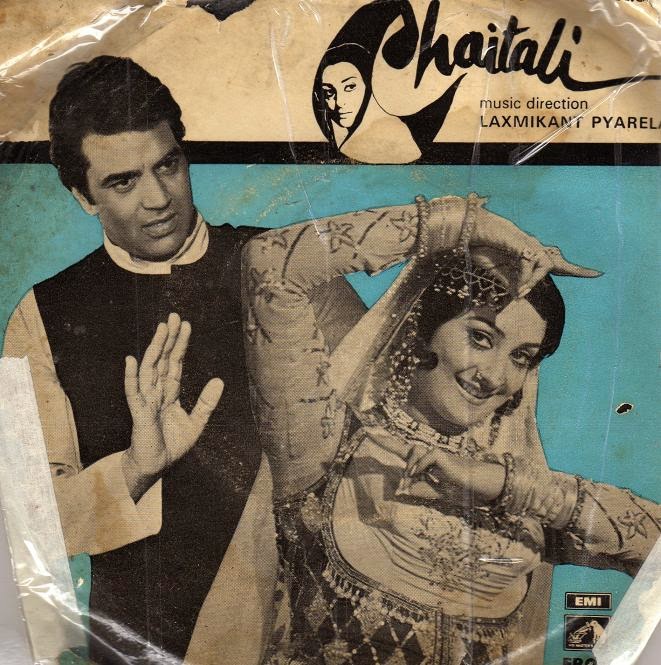

Throughout the story and its dramatic last act (the best executed out of the lot in my view), Chaitali comes across as a highly complex character, both repulsed by and dependent on crime and delinquency. And this confusion, somehow, gets reflected in the treatment of the film, with its highly uneven tone oscillating between glimmers of hope and pits of hopelessness. Dharmendra’s part is under-cooked and not well defined, with neither his motivations, nor his intentions, and nor his beliefs, coming out on screen clearly. This in some ways gets evened out by strong subsidiary characters- chiefly the lawyer elder brother (who gets a lot to do in the last act) and his wife (Bindu in a meaty part, but hamming it up completely).  

The music of the film, much like the film itself, is not popular at all. There are just three songs, and seen in isolation, two of them are pleasant enough. But none add to the movie in any which way; this lack of memorable tunes another reason for the oblivion the film finds itself today.

Signing off with a vintage 'on-the-set' still from the filming of an outdoor shot from the movie:
http://cinegems.in/dharmendra-hrishikesh-mukherji-durga-khote-and-saira-banu-on-the-locations-of-chaitali-1975/


Monday, October 15, 2012

Dastak (1970)


That knocking on the door…

In the process of discovering and experiencing some lesser talked about or simply forgotten chapters of Hindi cinema, I have being surprised more than once by the sensitivity of our storytellers. There have been so many instances of ordinary real life emotions being brought out extraordinarily on celluloid, that one has to admire the thoughtfulness and the dexterity of the people who ‘wrote’ our Hindi movie heritage. Almost all the movies that we see today are a reflection on some or the other film from our past. Yes, there have been quantum changes in technique, setting, and circumstances, but the core emotions remain quite the same.

And thus when I saw Dastak, conceptualized and brought to life by Rajinder Singh Bedi, one of the stalwarts of Hindi and Urdu literature (and films), I was quite taken aback. Here is one story that is so unique, and so very glowing with brilliance, that it has almost no parallel. The idea, the context, and the sheer execution of this very human and humane drama, is a delight to watch.

A young recently married couple move into a small house in one of those crowded and cramped spaces of Mumbai. In a neighbourhood bustling with activity, the two decide to embark on a lifelong journey together. But all their dreams and all their expectations go for a toss once they discover the murky identity of their new abode, i.e. once they discover that just before them their home was being occupied by a notorious nauch girl and prostitute. Every second day in the middle of the night when the world sleeps, Hamid and Salma are harrowed by incessant knocking on their main door, by some or the other lost soul seeking refuge in the arms of Shamshad Begum, a lady who even in her absence manages to cast a icy cold wall between the much in love couple. How all this affects the psyche of the two, and how they attempt to fight the war their neighbourhood wages against them, is what the film is all about. At the same time a discerning viewer will appreciate the social commentary made in the background, leveraging upon what all happens in the foreground.

Rehana Sultan as Salma
There are so many metaphors used in the film, but none as striking as the caged mynah that becomes the third occupant of the cursed flat in question. Every day Hamid goes to work, leaving his comely wife Salma trapped at home. Her very existence till the evening, when Hamid returns, becomes a monumental challenge. The claustrophobic neighbourhood, with its closely packed blocks of urban settlement, ensures that there are always some prying eyes trying to close in on her whenever she seeks a bout of fresh air through the windows. The notoriety that their flat gives them moreover ensures that whenever she tries take forward her father’s legacy in classical singing, there are always suspicious voices to be heard questioning her integrity and the very fabric of their matrimony. Thus Salma without Hamid is not very different from their pet mynah that at least has the consolation of being free inside the cage, unlike its owner.

The other aspect of the story is Hamid’s struggle to find a new flat for himself and his wife. The city is unforgiving in its demeanour, with its intimidating tall structures and unscrupulous people. His work-life too is not exactly a cruise as every now and then he lands in a situation of moral dilemma where his ideals ensure that he makes no financial headway to erase ghosts of his wretched personal life.
Sanjeev Kumar as Hamid

In one very significant phase of the screenplay the couple decides to just run away from everything, back to their village. But there too, they witness enough misery to be compelled to return to their cursed urban abode. This excursion from reality to another reality teaches the two an important lesson that they acknowledge towards the end of the film, just after a spectacular climax. The last sequence of the story, that also includes a song, is a stamp of genius. One of the best Hindi movie climaxes ever for one of the most unique Hindi film ever!

The performances from the two protagonists, Sanjeev Kumar and Rehana Sultan are mesmerizing to the core. Has there ever been a more natural actor than the former? Rehana Sultan, in one of her first few films, is so good that it looks like she was born to play this role. The songs by Madan Mohan are melodious and heart-wrenching with lyrics that will make you bow your heads (and backs) in respect. What poetry by Majrooh Sultanpuri!

Parting Note: Do watch this film. Do watch this film. Do watch this film. Do watch this film. Do watch this film. (substitute for 5 stars)

P.S.: The chief editor for the film was Hrishikesh Mukherjee! 


Sunday, January 29, 2012

Satyakaam (1969)


Many great men have exhorted the importance of following the path of truth, however arduous, in amazingly simple words (almost nonchalantly in many cases). Our holy relics, our Upanishads, and our two most significant historical texts- the Ramayana and the Mahabharata- too have averred vehemently that there is nothing greater than reveling in the knowledge and the spreading of truth. Hrishikesh Mukherjee, in his 1969 feature Satyakaam, pays homage to these thoughts by means of depicting the journey of a man who never wavers from this formidable path of truth.


Satyakaam is the story of Satyapriya ‘Sath’ Acharya (Dharmendra in what’s as per his own admission the best performance of his career), a young man born in a family that’s boasts on an illustrious lineage- all great men who spent their lives in the worship of truth and banished all thoughts of giving in to worldly pleasures that might have caused them to compromise on their ideals. His early education came from his grandfather Satyasharan Acharya (Ashok Kumar in a look that was used by Hrishikesh Mukherjee in another film with the actor at around the same time- Aashirwaad), who continued to remain the ultimate source of enlightenment and inspiration to him. The story is narrated through the eyes of Satyapriya’s best friend Naren (Sanjeev Kumar) and begins with both of them coming to the end of their engineering days in the year 1947, just months prior to India gaining independence.

Satyapriya and Naren pass their final exams and await their encounter with the real world where they would have to use the wealth of knowledge they had gained in the four years of their engineering (The story is set sixty years before our times so the engineers of today might not identify with their earnestness- even I don’t). Just fresh out of college they and their colleagues embark on a fun trip to celebrate their success, but on the way their bus meets with a terrible accident in which they lose one of their classmates. This incident is not touched upon later in the film, but it seems like the director wanted to make a statement on life and its unpredictability through this misfortune that strikes the young Satyapriya and his friends. Soon after this mishap Satyapriya applies for and secures a job with a rich industrial estate as project engineer. In his first assignment he is sent to a remote Central Indian region to make a survey and appraise a huge land holding for the company. There he discovers that his bosses are in alliance with the prince of the particular riyasat and were least concerned by the actual project at hand. They instead had some ulterior motives for which they needed Satyapriya’s assistance. Also, during his assignment he meets with and strikes a companionship with Ranjanaa (Sharmila Tagore) who becomes a victim of the prince’s sexual assault on her. But despite this Satyapriya decides to marry her being fully aware that his grandfather would refuse to accept this match. But he makes a decision that goes with his ideals and his dharma. It is one chapter of his life that is given a lot of emphasis, but moving on the proceedings become rather less hurried and the story takes a lot of time leaps (though with not much time interval passing between them).

Three years subsequent to their marriage Satyapriya and Ranjanaa are living happily, though their only son (who is not Satyapriya’s own but instead a result of the Prince sexual assault) acts like an uncomfortable reminder of their past. Satyapriya keeps on taking up a lot of jobs but everywhere he finds it difficult to make peace with the corrupt ways of his colleagues and the society in general. With every such job he becomes more and more steadfast and life becomes a tough battle for him and his family. He takes to smoking and becomes quite irritable and discontent. Naren meets him more than once at various junctures of his life, and ultimately in a curious turn of fate Satyapriya gains employment as a junior engineer below him in a Government set-up. Even in his new role Satyapriya refuses to even pay heed to Naren’s slight requests for slowing down a bit and taking things easy. He even picks up a fight with his best friend over a difference of opinion in how to deal with a contract. Things in fact become worse that what they look on the surface- Satyapriya becomes so finicky about honesty and doing the right things that he even refuses to leave his office a few minutes before the official closing time of five in the evening. It is here that Naren makes a telling remark that excess of everything is bad, even the excess of ideals. Soon, in a tragic turn of fate, Satyapriya develops lung cancer and the last few minutes of the film deal with the last few days of his life.

Hrishikesh Mukherjee chooses a very complex subject and treats it in an unconventional manner. The movie is definitely a critique on our society and how we tend to ignore a lot of things while leading our lives. Through the ordeals of Satyapriya he makes a defining statement on how difficult it is for an honest man to live with his head high in today’s materialistic and insensitive set-up. But at the same time through the dissonance and irritability of Satyapriya, he makes the point that it is futile to stop appreciating the life around us by becoming a cynic and seeing the worst in each and every thing. By the end of his life, Satyapriya becomes so obsessed by his ideals that he even started ignoring the interests of his own family. In a way God decided to end his trials and tribulations by giving him the lung cancer, after having given him enough time to fall in love with life. So Satyapriya can be seen as both a loser and as a winner. In my view he was more of a loser than winner, but I am sure people will form quite diverse impressions if they decide to watch this movie.

Because of my above view, I see don’t see this movie as a perfect film. Although the narrative and story as such is unique and the intentions are definitely quite honest, I didn’t like Satyapriya’s character and was left disappointed by him- and it was his story. Of course it was how Hrishikesh Mukherjee must have intended it to be, but because of the way the story was treated, the movie failed to either inspire or educate or educate. It is lengthy and has many unnecessary sequences that don’t really add up to the central theme. Also, Satyasharan’s (Ashok Kumar) character is shown as caught between his Dharma and his traditions. He is neither here nor there- and so is the film in its entirety. The performances by the lead cast otherwise are indeed praiseworthy- Dharmendra especially more because he was Satyapriya- and he was the entire film.

Parting Note: More than a film, Satyakaam is a comment on the society in the form of a biopic of a fictional character. It is most certainly an important film and showcases the range of Hrishikesh Mukherjee as a director. But overall the film is not the classic that it promises it to be. 

Monday, July 4, 2011

Namak Haraam (1973)


What’s more important- profits or people? Now this is a lot closer to my current project in life- the Masters in Business Administration that I am pursuing. And this is also what Hrishikesh Mukherjee essentially tries to debate in his movie Namak Haraam starring Amitabh Bachchan and Rajesh Khanna in principal roles.

A story of two thick friends who can’t even imagine leading their lives without each other, this is a sensitive representation of the clashes between the capitalists and the labor class- a subject that had relevance not only in India, but also the world over.

Vicky (Amitabh in a boisterous and aggressive role that is light days apart from what he played in the earlier Rajesh Khanna-Hrishikesh Mukherjee collaboration ‘Anand’) and Somu (Rajesh Khanna) are alter-egos. While Vicky is the son of a rich industrialist, Somu comes from a family with limited means. Their bonding is so strong that Somu doesn’t mind Vicky funding the day to day activities of his household. They go to work together, they get fired together. They go to ‘mujras’ together and do pretty much everything together (it may be difficult to comprehend such a bonding in today’s times and some people might view it with suspicion).

Their lives take an unexpected turn when Vicky goes to Bombay and look after his business after his father suffers a mild heart attack and is advised rest by the doctor. While handling his business he refuses to accept some demands of the union leader Bipinlal (played by AK Hangal) rather bluntly- leading to the workers going on a strike. Later, on his father’s advice, Vicky has to publicly apologize to the Bipinlal- in an effort to pacify the agitating workers. He considers this act of apologizing utterly humiliating and vows to take revenge. For that very purpose he calls Somu to Bombay and places him at the factory with the workers, as one amongst them. They both hatch a plan which involves Somu gaining the support and trust of the workers, and in the process alienating Bipinlal from rest of the work-force.

Initially the things go according to plan but soon Somu starts getting affected by the plights and pains of the workers while being in close contact with them. The trigger proves to be an alcoholic poet Alam (Raza Murad in a heartwarming performance). Gradually Somu realizes that the workers’ demands for better wages and better working conditions are completely justified and the stance taken by Vicky and his father is a selfish one. There ensues the conflict and it is with Somu’s retaliation to Vicky’s claims that the title of ‘Namak Haraam’ gets justified.

The movie is really different from what was usually attempted in Hindi cinema in the 1970s. Some might even say that it was made with a socialist propaganda and tried to show the capitalist in a negative light. But I feel that such was the demand of that time when there was rampant exploitation of the worker class by the money minting factory owners. Of course today with human rights, labor rights, and Corporate Social responsibility things are much better. But the central idea of Profits Vs People is still relevant.

The performances, as expected, are top notch. Rajesh Khanna’s Somu steals the thunder from Amitabh Bachchan’s Vicky. The former is brilliant as a man caught between his best friend’s interests and the calls of his conscience. Simi Garewal and Rekha pitch in small-almost insignificant supporting acts. But for me the character of Alam was the highlight of the movie in the sense that it performed the role of the catalyst in taking the drama forward. His lines in the movie reflected haunting sadness-

“Nadiya se Dariya, Dariya se Sagar, Sagar se Gehra Jaam- Jaam mein doob gayi hai meri Jeevan ki har shaam”

Parting note- Namak Haram deserves to be seen by the lovers of Hindi cinema for it attempted something different from what was the norm and also boasts of powerhouse performances from two of its most popular superstars.


Monday, June 6, 2011

Jurmana (1979)


Amitabh Bachchan is the most iconic personality of Hindi cinema. This is the inference I draw after looking at his enviable filmography- which comprises of few of the most popular movies ever and at the same time still includes a range of movies on diverse subjects- covering diverse genres. It is a true testament to his phenomenal range as an actor that in a period in which he was dishing out ‘angry young man’ blockbusters and huge money spinners by the number, he still tried out stuff that gave him the opportunity to indulge different facets of his acting prowess. ‘Jurmana’ by Hrishikesh Mukherjee is his one such endeavor.

Starring him alongside Vinod Mehra and Rakhee Gulzar in lead roles, Jurmana is a romantic drama, kind of stuff that one would associate more with someone like Rajesh Khanna or one of the Kapoor clan. Bachchan plays Inder- a super-rich spoilt brat, a womanizer, and someone who believes in the philosophy that money can buy anything. On a visit to a quiet small town for a construction project, he meets his old college friend Prakash (essayed by Vinod Mehra), who is living a lifestyle that is poles apart from Inder’s own. A few days into his stay he spots Rama (Rakhee in a typical seedhi-saadhi avatar) and gets attracted to her charm, oblivious to the fact that his Prakash has true feelings for her. Just as Inder decides to woo Rama, Prakash gets its inkling- and there ensues a bet. Prakash believes that the simple Rama would in no way get attracted by the charms of the suave and debonair Inder, and would instead teach him a lesson. What Prakash doesn’t realize at that point of time is that it is this presumably harmless bet that would turn their lives upside down.

The sequence of events unfolds in a predictable manner for most parts but that does not take anything away from the intensity of the drama. The scenes where Amitabh turns on the charm of Rakhee are interesting and show him in a different light altogether. Towards the later part of the movie when the story shifts to Mumbai, it loses a bit of steam- but the culmination of the story is good- and there could not have been a better way to end the movie.

The music is good, which is not at all a surprise. The song ‘Saawan ke Jhoole’ is the pick of the lot and graces the narrative more than once. The performances by the actors are top notch- though the character played by Mr. Shreeram Lagoo (of Rama's dad) is a bit hard to digest. Amitabh Bachchan stand head and shoulders above the rest (both literally and figuratively). Rakhee pitches in an earnest performance. I have seen a lot of her work lately and she certainly was amongst the better actresses of her time.

Parting note- The movie is a good watch for a lazy Sunday afternoon, and it is certainly one of the underrated works of the masterful Hrishikesh Mukherjee.