Showing posts with label Asrani. Show all posts

Sunday, May 25, 2014

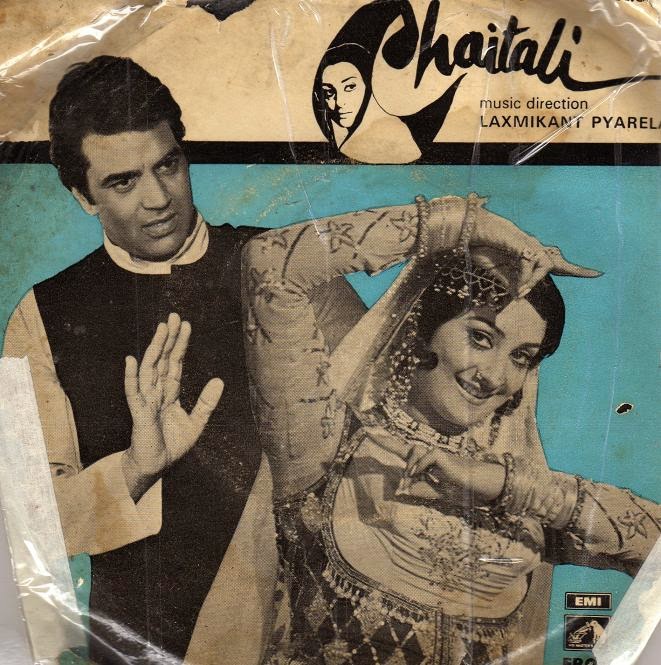
Chaitali (1975)


This is a mid 1970s movie starring Dharmendra and Saira banu in lead roles, and directed by none other than Hrishikesh Mukherjee, a man who helmed arguably some of the best Hindi movies made ever. There is another great matter of prestige attached to this feature, that of it being a Bimal Roy production, albeit posthumous. Bimal Roy, who himself arguably made some of the best Hindi movies ever, is also seen by many as the precursor to Hrishikesh Mukherjee, who he mentored along with a man called  Sampoorn Singh Kalra, better known as Gulzar. So it will be fair to say that ‘Chaitali’, as a movie, boasts of some enviable pedigree. And yet, it is one of those criminally under-seen movies, reflected in just a handful of ratings it has garnered on Imdb (less than 20 on last count). It might have been a commercial failure at that time, but does it deserve the obscurity that it is shrouded in today? For sure not, as, though the film is not faultless, it is still a reasonably engaging dramatic feature that makes a social comment on delinquency, forgiveness, and redemption. 

Adapted from a Bengali short story of the same name, Chaitali inhabits a world that is much different from the general Hrishikesh Mukherjee fold, wherein most of his movies stayed away from depicting the darker strata of our social order. The narrative is centered on Chaitali (Saira Banu in the title role), a woman who has been forced by her circumstances and her unfortunate upbringing to occupy a space that constantly haunts her, but from which she not being able to escape. Creating a stark contrast, her life merges with a more typical Hrishikesh Mukherjee middle-class urban household, full of family values and righteousness. The first few minutes of the movie establish this moral rectitude and bonhomie of this family, headed by a kind matriarch, and assisted by that ever cheerful and passionately loyal servant (Asit Sen yet again). The tone and tenor of the film then changes considerably when Chaitali enters the household, guiltily taking advantage of goodness of the elderly matron, with the intention of swindling some money. All this while, the younger son of the family Manish, (Dharmendra in a mostly subdued role) is aware of the reality of the woman, but takes pity on her circumstances, apart from developing a soft corner for her. The drama later shifts to a religious sanctuary on the hills, where Chaitali shares her life story honestly with Manish, who gets utterly shaken by the grimy details of her upbringing, which include a criminally inclined father on the run, a brothel, many lecherous eyes eager to pounce on her adolescence, and a suitor (played uninhibitedly by Asrani) who is both a danger and a comfort to her in the murky vicinities of her life.  

Throughout the story and its dramatic last act (the best executed out of the lot in my view), Chaitali comes across as a highly complex character, both repulsed by and dependent on crime and delinquency. And this confusion, somehow, gets reflected in the treatment of the film, with its highly uneven tone oscillating between glimmers of hope and pits of hopelessness. Dharmendra’s part is under-cooked and not well defined, with neither his motivations, nor his intentions, and nor his beliefs, coming out on screen clearly. This in some ways gets evened out by strong subsidiary characters- chiefly the lawyer elder brother (who gets a lot to do in the last act) and his wife (Bindu in a meaty part, but hamming it up completely).  

The music of the film, much like the film itself, is not popular at all. There are just three songs, and seen in isolation, two of them are pleasant enough. But none add to the movie in any which way; this lack of memorable tunes another reason for the oblivion the film finds itself today.

Signing off with a vintage 'on-the-set' still from the filming of an outdoor shot from the movie:
http://cinegems.in/dharmendra-hrishikesh-mukherji-durga-khote-and-saira-banu-on-the-locations-of-chaitali-1975/


Sunday, November 13, 2011

Koshish (1972)


Koshish…

The one thing common to all Gulzar movies is that they all have very simple titles. Write a story (or a poem for that matter), and you would know that sometimes it is a lot tougher to think up a title for it than the actual writing itself. Kinaara, Parichay, Khushboo, Mausam, Lekin, Angoor, Kitaab, Namkeen, Achanak, Ijaazat, Maachis… all these names tell so much about their respective movies- not always before viewing them- but more so after you experience them. Try asking a few people to give some alternative names to these stories- most likely you would get really varied answers and none would have the pertinence and relevance of the titles Gulzar chose for them. Only a highly observant and artistically articulate man like him can think of things like these. However, try doing the same exercise for the 1972 movie by him starring Sanjeev Kumar and Jaya Bhaduri, and I don’t think you would need to put in much ‘Koshish’ (effort), for there can really be no other name for this sensitive feature by arguably (and most certainly in my eyes) the best story-teller that Hindi cinema has seen…

It is a movie that would have most certainly provided reference points to films like Khamoshi (The Sanjay Leela Bhansali one). A story of a deaf and dumb couple (Haricharan and Aarti) and their attempts to lead a normal respectable life is a delightful watch for more reasons than one.

First. It’s abstinence from melodrama for most parts- For a movie on two handicapped people, Koshish is amazingly restrained in most things it attempts and refrains from the clichéd trappings of such stories. In that sense it is fresh perspective, and a few scenes bring out this perspective wonderfully well. One such scene is when the two, relieved at finding out that their new-born son does not suffer from the same handicap as they do, start whistling alternately to capture the attention of the kid from two sides of the bed on which he rests comfortably. The rapturous whistles (growing in intensity every second) attract the attention of all the people on the street, who are shunned out in good humor by the joyous father Haricharan. The people continue with daily chores after having a good laugh. It is the treatment of this laughter by the normal people around the two, which is really different here. The focus is entirely on the world between Haricharan and Aarti, and the rest of the world doesn’t really matter. 

Two. The detailing- Utmost care is given in depicting the sign language authentically. In fact the schooling shown for the deaf and dumb kids is heartening to see. The way the two interact with each other and with the rest of the world is so realistic, and so well researched, that it is hard to believe that Sanjeev Kumar and Jaya Bhaduri have the gift of sound and speech in real life.

Three. The thought- The idea is not only to show the difficulties that a handicapped couple may face while trying to lead a respectable life, but also how such people can rise even above the normal people if they remain optimistic and are given the right environment and opportunities to succeed. One thing that is repeated more than once in the film (or in fact said more than once in the film by one of the characters) is the deaf and dumb are blessed for they will never hear the bad things that are said in the world, and will never say the bad things that are said in the world. It is a refreshing view that acts as the thrust for the narrative.

Four. Its love story- If one has to put a genre to this movie (forget for a moment that its leads are handicapped), then it is no question a love story. It has everything- from the initial meeting, to frequent interactions, to those stolen moments, to the hesitancy and ultimately the acceptance. Even post marriage how their love stands the test of time and difficult times, is what the movie emphasizes on.

And Last. Its performances- Yes, it is a kind of movie where even average performances from the leads would have appeared wonderful. But leaving aside this fact, both Sanjeev Kumar and Jaya Bhaduri pitch in with WONDERFUL performances- it is actually hard to find the right words to describe the finesse and the polish in their efforts. Right from the start to the finish, Sanjeev Kumar just converts completely into the deaf and dumb Haricharan on screen, and not even for an iota of a second does his real life persona becomes visible from behind character that he plays. The same goes for Jaya Bhaduri, who delivers a knock-out performance that will rank amongst the best if one has to make a list of the top performances by female actors in Indian cinema. The supporting cast provides able support, especially Om Shivpuri who plays a blind man and a friend to the couple. 


But there are certain portions in the film that are not as convincing as the rest. The entire Asrani track is kind of tangential to the central theme, and does not actually add anything to the plot, except a few bits of drama. The track is not even given a proper closure, which is highly uncharacteristic of Gulzar (but then this was just his second film). Also, I felt that the climax raised more questions rather than answering some- and the end was slightly hurried and meek. But even then, in a delightful trick, Gulzar smartly completes a circle by referencing an earlier dialogue in the narrative. One slightly disappointing thing about the movie is that its music (by Madan Mohan) is nothing to write home about, which is so unlike a Gulzar movie. 

Parting Note: The movie is certainly a must watch for its freshness, its novelty, its finesse, and most importantly- its thought. Another gem from Gulzar…


Wednesday, September 7, 2011

Anamika (1973)


After watching this Sanjeev Kumar and Jaya Bhaduri starrer from the early 70s, I was really surprised why this movie is not talked about more often. It is a light-hearted suspense drama, with some crackling romantic moments between the lead pair and some wonderful songs. Now this may sound like one of those movies that attempt a mishmash of all genres in the garb of producing an entertaining product, but this one has a core strong story too that holds everything together.  And if I may add, it is one of the most entertaining movies I have seen from the 1970s.

Devendra (Sanjeev Kumar in a role far off from what he was more renowned for) plays a famous writer, who incidentally is a misogynist, and an unabashed one at that. He lives with his uncle (AK Hangal), his niece, and a secretary Hanuman (Asrani in a typical comic role). One night, while they all are returning from a press conference, they spot a woman (Jaya Bhaduri) being thrown off from a car on a deserted road near their home. They rush forward to help, and discover that the woman had gone unconscious. On the insistence of his Uncle, Devendra takes her to their place. The next morning, when the woman gains consciousness, she starts behaving oddly and to everyone’s utter surprise, claims to be Devendra’s wife. The family doctor is called for and he tells them that the woman has sustained some internal injuries and needs to be taken care of for fast recovery. Against his will, and again on his Uncle’s insistence, Devendra agrees to let her stay at their home, on the condition that he would not play-act to be her husband. But things begin to change when he starts falling in love with the simplicity, charm, and devotedness of this woman (who they start referring to as Anamika). What happens next and how Devendra gets embroiled in a potentially dangerous turn of events that threaten to play with life and his composure, is what the movie is all about.

The movie has many elements that are associated with most commercial movies of that time. It has a clichéd comic track featuring Asrani, but the guy makes it work by his sheer capacity to embrace buffoonery. It has a seduction number (which is far from seduction and is actually a very cute romantic song), a Helen dance number (a signatory RD Burman offering), an evil villain lusting after the lead heroine, and a quintessential AK Hangal performance. The movie even gives Sanjeev Kumar the opportunity to do some action and beat up some goons (the only time the man looks awkward on screen). But despite all this, it is a highly entertaining enterprise that is lent solidarity by the sincerity and calm presence of its lead actors. They are aided in their endeavor by some fine dialogues and some crisp writing, not to mention the tight pace maintained by the director (Raghunath Jalani) over the sequence of events. The one thing he could have changed (or rather done away completely with), are the last five minutes of the film. But despite that ‘Anamika’ has a runtime of just over 120 minutes.

This movie is an example of how two fine actors can take a good story to a different level altogether. The brilliance of Sanjeev Kumar gets reflected in many scenes, which he handles with the dexterity and command that very few actors of time could have managed without appearing theatrical. The sequences when he falls in love with Anamika are a sheer delight to watch. Jaya Bhaduri gets a meaty role and does full justice to it. Again very few actresses from that time could have done what she has done in this movie convincingly (in fact no one in my opinion). The movie is embellished with some beautiful music by RD Burman, which is given full justice by making the songs a seamless part of the narrative and not mere add-ons (except the Helen number, and understandably so). The songs “Bahon mein Chale aao’ and ‘Meri Bheegi Bheegi si’ deserve special mention.

Parting Note: The movie is a highly enjoyable watch, and I guess can be categorized as ‘intelligent-popcorn cinema’ (if people don’t find it an ‘Oxymoron’ish phrasing).  


Thursday, June 30, 2011

Khushboo (1975)


I have always had a liking for the friendly and warm rural settings in both books and movies. Such settings may seem idealistic and may refrain from showing the murky realities, but their simple tone, and the simple problems that people in such stories have, have always allured me. Malgudi Days is my second favorite book after the Harry Potter series- and I was thrilled when I saw Gulzar’s ‘Khushboo’ unfolding in a manner similar to the RK Narayan’s classic fable based on the lives of people in a fictional village.

Starring Jeetendra and Hema Malini in lead roles, Khushboo is based on a story by Saratchandra Chatterjee (The man who also wrote Devdas). Kusum (essayed by Hema Malini) looks after a wealthy old lady who lives all alone in the village. This lady falls sick and Dr. Brindavan (Jeetendra in a role and look similar to his earlier film with Gulzar-Parichay) is summoned from a nearby village to tend to her. Kusum soon realizes that Dr. Brindavan is none other but the guy who she was engaged to marry as a kid. Their alliance had been fixed when they were very young, but it could not materialize due to certain misunderstandings. Subsequently, she and her mother had been unceremoniously disowned by Brindavan’s family- and while he and his family move on in life- Kusum remains still stuck in the past. She still considers herself married to Brindavan and refuses to marry anybody else.

Soon Kusum learns that Brindavan is married and even has a four year old son Charan. When Dr. Brindavan recognizes her and learns about how she still considers him her husband, he starts to feel a little guilty- but at the same time she gains a lot of respect in his eyes. He decides to marry Kusum (his first wife being no more) and solemnize the possessiveness she felt for him, but due to certain misunderstandings it does not happen. At the same time a beautiful bond develops between his son Charan, and Kusum. Charan also becomes very close to Kusum’s brother (played by Asrani).

The story takes a turn when Dr. Brindavan’s village gets hit by the epidemic of Plague. Many people die, including some of his near and dear ones- his highly efficient and respectful compounder Birju being one of the victims. As many people start leaving the village out of fear- there remains no option for Brindavan to leave Charan with Kusum at her home. He too starts living there on her behest, though most of the time he remains away tending to the victims of the epidemic.

Gulzar treats his stories with a lot of love and affection. I am yet to see many of his works, but I can bet that this would rate as one of his finest efforts ever. He is perhaps the most perfect writer/poet who has graced Hindi Cinema- I won’t exhaust my eulogies for him as, as I mentioned I am yet to see many of his works and hopefully write about. Hema Malini delivers surely one of her best performance ever, and Jeetendra is equally sincere and effective. The supporting cast, that includes the likes of Farida Jalal and Asrani, too leaves a mark with their earnest performances. Special mention must be given to Master Raju (who plays Charan) who simply lights up the screen whenever he appears and is most definitely the best child artist ever in Hindi Cinema.

This movie also boasts of memorable music by RD Burman. Each and every song is a gem and may be a part of the playlists of old Hindi film music lovers- ‘Bechara Dil Kya Kare’, ‘Oh Maajhi re’ being two of the most popular ones. 

Parting note- I loved watching this movie, and people who don’t mind a simple story unfold at a leisurely pace will surely enjoy it.