Showing posts with label Laxikant-Pyarelal. Show all posts

Sunday, May 25, 2014

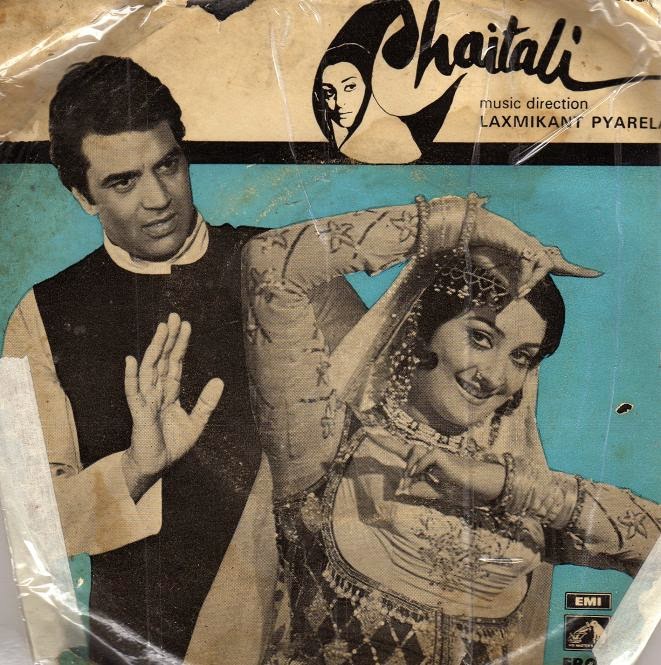
Chaitali (1975)


This is a mid 1970s movie starring Dharmendra and Saira banu in lead roles, and directed by none other than Hrishikesh Mukherjee, a man who helmed arguably some of the best Hindi movies made ever. There is another great matter of prestige attached to this feature, that of it being a Bimal Roy production, albeit posthumous. Bimal Roy, who himself arguably made some of the best Hindi movies ever, is also seen by many as the precursor to Hrishikesh Mukherjee, who he mentored along with a man called  Sampoorn Singh Kalra, better known as Gulzar. So it will be fair to say that ‘Chaitali’, as a movie, boasts of some enviable pedigree. And yet, it is one of those criminally under-seen movies, reflected in just a handful of ratings it has garnered on Imdb (less than 20 on last count). It might have been a commercial failure at that time, but does it deserve the obscurity that it is shrouded in today? For sure not, as, though the film is not faultless, it is still a reasonably engaging dramatic feature that makes a social comment on delinquency, forgiveness, and redemption. 

Adapted from a Bengali short story of the same name, Chaitali inhabits a world that is much different from the general Hrishikesh Mukherjee fold, wherein most of his movies stayed away from depicting the darker strata of our social order. The narrative is centered on Chaitali (Saira Banu in the title role), a woman who has been forced by her circumstances and her unfortunate upbringing to occupy a space that constantly haunts her, but from which she not being able to escape. Creating a stark contrast, her life merges with a more typical Hrishikesh Mukherjee middle-class urban household, full of family values and righteousness. The first few minutes of the movie establish this moral rectitude and bonhomie of this family, headed by a kind matriarch, and assisted by that ever cheerful and passionately loyal servant (Asit Sen yet again). The tone and tenor of the film then changes considerably when Chaitali enters the household, guiltily taking advantage of goodness of the elderly matron, with the intention of swindling some money. All this while, the younger son of the family Manish, (Dharmendra in a mostly subdued role) is aware of the reality of the woman, but takes pity on her circumstances, apart from developing a soft corner for her. The drama later shifts to a religious sanctuary on the hills, where Chaitali shares her life story honestly with Manish, who gets utterly shaken by the grimy details of her upbringing, which include a criminally inclined father on the run, a brothel, many lecherous eyes eager to pounce on her adolescence, and a suitor (played uninhibitedly by Asrani) who is both a danger and a comfort to her in the murky vicinities of her life.  

Throughout the story and its dramatic last act (the best executed out of the lot in my view), Chaitali comes across as a highly complex character, both repulsed by and dependent on crime and delinquency. And this confusion, somehow, gets reflected in the treatment of the film, with its highly uneven tone oscillating between glimmers of hope and pits of hopelessness. Dharmendra’s part is under-cooked and not well defined, with neither his motivations, nor his intentions, and nor his beliefs, coming out on screen clearly. This in some ways gets evened out by strong subsidiary characters- chiefly the lawyer elder brother (who gets a lot to do in the last act) and his wife (Bindu in a meaty part, but hamming it up completely).  

The music of the film, much like the film itself, is not popular at all. There are just three songs, and seen in isolation, two of them are pleasant enough. But none add to the movie in any which way; this lack of memorable tunes another reason for the oblivion the film finds itself today.

Signing off with a vintage 'on-the-set' still from the filming of an outdoor shot from the movie:
http://cinegems.in/dharmendra-hrishikesh-mukherji-durga-khote-and-saira-banu-on-the-locations-of-chaitali-1975/


Monday, April 30, 2012

Palkon Ki Chhaon Mein (1977)


A completely misleading poster of the movie- playing up the drunkard jilted-lover image of Rajesh Khanna, and glorying a five minute Jeetendra appearance. The movie is nothing like what this poster indicates. 

Five minutes into the movie, and you can make out it is a Gulzar film. This Rajesh Khanna and Hema Malini film is though not directed by the maestro himself, but by Meraj, who was an assistant to the man in most his earlier directorial ventures. But everything- be it the dialogues or the treatment, or even the look given to the lead actors- looks straight out of the Gulzar school of film-making. That he has written the screenplay is just a part of this happy occurrence.

The story is set in a village, very much like the Jeetendra- Hema Malini starrer Khushboo that came just two years or so before this movie. But this time, instead of Jeetendra, the moustache is donned by (the then on the wane) superstar, who gets to play a meaty author (read Gulzar)-backed role. Ravi (Rajesh Khanna) is a city bred educated but unemployed youngster, who doesn’t lose his sense of humor and wit despite his many failures to secure a decent employment. A chance encounter leads him to the job of a dakiya (postman) in a nearby village, which he gladly accepts. In the village he soon gets around to doing his job with much sincerity and dedication. Within no time gets acquainted with most of the village folk- each of who have their own story to tell. These include a senile old lady who awaits the return of her son, a young widow who has lost her husband in the war- but has not lost the zest for living, and a young lady named Mohini (Hema Malini) who to Ravi’s pleasant surprise appears more than willing to strike a companionship. Soon Ravi and Mohini start meeting everyday and Ravi falls in love with her, completely oblivious to the fact that she has very little interest in him- the person, and most of her attention is reserved for Ravi- the postman. This is because Mohini expects a letter from her lover, an army-man, to reach her. Ravi’s pleasing ways and respectful manners lead her to confide in him her relationship with this soldier (Jeetendra in a guest appearance). This love story of hers completely shatters Ravi’s heart, who had genuinely felt that Mohini’s affections were a result of them drawing closer to one another with each passing day. But consoling himself, Ravi decides to go the city and look for this soldier who had not written to Mohini despite his many promises. When he returns, the news arrives that Mohini’s beloved is no more and has lost his life in the war. It then becomes his responsibility, being a postman, to break this news to Mohini…

Not unlike Khushboo, this story too looks like a chapter out of Malgudi Days with all its simple and unhurried appeal. The drama in the story is somewhat based on the fact that in those days very few village people could read and write their own letters- and the responsibility of the same then rested upon the village postman- who thus became an essential part of their lives. In that sense the village postman acted like a ‘social glue’, being a common element in all the villagers’ lives. Here the song ‘Dakiya Daak Laya’ reflects on pretty much the same sentiment. While the postman drama is the backdrop, the innocent love-story with all its uncertainty and apprehensions, is the motif in the movie. Ravi’s one sided love, and his expression of the same through his sketches (that are revealed at the end), is quite endearing. The most unique thing about the movie however, is that despite all its underlying tension; it retains a light-hearted spirit on the surface. There are many instances of humor, though like in all other Gulzar movies, they are quite understated. But quite unlike most of his films, the music score here is not too memorable with two of the songs being quite situational, and a forced nautanki dance number (picturised on Rekha) not being as fun as it should have.

Rajesh Khanna puts in an earnest act, and quite underplays his character for most parts. It is easy to make out that he was a very fine actor, and thus his fall from fame appears more baffling (though perhaps that had more to do with his off-screen issues). Hema Malini is effective, though it looks like she walked down straight from the sets to Khushboo to this movie. The supporting cast doesn’t have much to do here with Farida Jalal (another Khushboo connection), Asrani, Amjad Khan, and Master Raju being the most popular ones from the ensemble.

Parting Note: This movie is a sweet love-story that deserves a watch by all those who like such village themes. And when you add the fact that it is almost a lost Gulzar film, it becomes a must watch for his fans.