Showing posts with label simplicity. Show all posts

Monday, March 18, 2013

Anand Ashram (1977)


I pushed back watching this Shakti Samanta movie for quite some time, expecting it to be one of those moralistic tale laced with melodrama and strung together by a few good songs. Another big reason for my lack of enthusiasm was that this movie, unlike most other Shakti Samanta movies of that time, does not star Rajesh Khanna, and instead features Uttam Kumar, an actor I am not particularly fond of. As it turned out, as I finally got around to watching it, I was somewhat right about my pre-conceived notions. But having said that, the movie pleasantly surprised me on many counts, and in fact turned out to be quite a good watch. Also, as the narrative unfolded and moved towards the climax, similarities between its story and that of big ticket Karan Johar magnum opus Kabhi Khushi Kabhi Gham became quite apparent, which were rather interesting to discern. The coincidence that Rakesh Roshan plays the role that would be parallel to what his son Hrithik Roshan performs in the modern day magnum opus, was what triggered the connection in my mind.


A young doctor marries his childhood companion without his father’s consent. The father, a rich and respected landlord with a legacy he is very proud of, is terribly disappointed by his son’s decision to marry a girl from a different religious background. The confrontation leads to the son abandoning his father’s house and giving up on all his inherited wealth. He, along with his wife, then proceeds to fulfil his life’s objective of providing medical services to the underprivileged villages, which lack healthcare infrastructure. A chance encounter with a wannabe do-gooder enables him to open a village dispensary, which he starts to run with his wife supporting him wholeheartedly. Then in a curious turn of fate, his allegiance to the oath of selfless service is put to test. He passes the test but suffers a great personal loss when he is unable to be at his wife’s side as she is delivering their first child. The story from there briskly changes character and soon takes a time leap. With the drama set, the next part is quite entertaining to watch.

Despite the serious theme, a feel-good factor is maintained throughout, thanks to the well defined characters essayed by Ashok Kumar, Utpal Dutt, and Asit Sen. In the second part of the movie the romance angle between Rakesh Roshan and Moushumi Chatterjee also lightens the proceedings. Towards the end, the culmination too is convincing and ties up the drama satisfactorily.
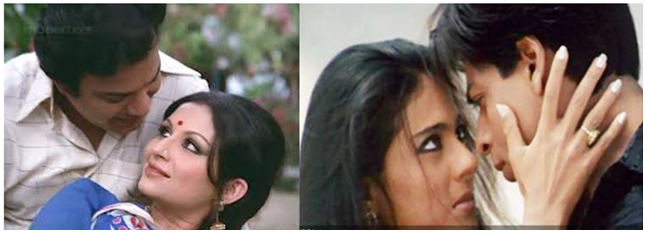

It would not be completely off the mark to say that the basic skeletal of Anand Ashram and K3G is alike. What is most different is the objective and treatment. While Anand Ashram has the theme of selfless service to humanity as its backbone, K3G has no such pretentions and was quite unequivocal in its fidelity to the candyfloss. As a result the characters in the older film are less caricaturish and have more shades to their personalities. And that is strength of Anand Ashram as a more ‘moving’ motion picture. The lead hero, Uttam Kumar, is not very convincing in the initial portions of the story where he plays the rebel lover lip-syncing to songs and romancing a stunning beauty like Sharmila Tagore. But in the later part of the movie he appears in a bearded look and is generally more assured. But Ashok Kumar as the ‘kabhi garam kabhi naram’ granddad (and dad) gives the most heart-warming performance from the lot.

Almost all the songs are nice and don’t really act as speed-breakers. ‘Sara pyaar tumhara’ and ‘Rahee naye naye’ and the most melodious and must have been quite popular in their time.


Parting Note: Anand Ashram has a good original story to tell in a breezy run-time. Also, the message it propagates is universal and quite relevant even in the current times.

Monday, April 30, 2012

Palkon Ki Chhaon Mein (1977)


A completely misleading poster of the movie- playing up the drunkard jilted-lover image of Rajesh Khanna, and glorying a five minute Jeetendra appearance. The movie is nothing like what this poster indicates. 

Five minutes into the movie, and you can make out it is a Gulzar film. This Rajesh Khanna and Hema Malini film is though not directed by the maestro himself, but by Meraj, who was an assistant to the man in most his earlier directorial ventures. But everything- be it the dialogues or the treatment, or even the look given to the lead actors- looks straight out of the Gulzar school of film-making. That he has written the screenplay is just a part of this happy occurrence.

The story is set in a village, very much like the Jeetendra- Hema Malini starrer Khushboo that came just two years or so before this movie. But this time, instead of Jeetendra, the moustache is donned by (the then on the wane) superstar, who gets to play a meaty author (read Gulzar)-backed role. Ravi (Rajesh Khanna) is a city bred educated but unemployed youngster, who doesn’t lose his sense of humor and wit despite his many failures to secure a decent employment. A chance encounter leads him to the job of a dakiya (postman) in a nearby village, which he gladly accepts. In the village he soon gets around to doing his job with much sincerity and dedication. Within no time gets acquainted with most of the village folk- each of who have their own story to tell. These include a senile old lady who awaits the return of her son, a young widow who has lost her husband in the war- but has not lost the zest for living, and a young lady named Mohini (Hema Malini) who to Ravi’s pleasant surprise appears more than willing to strike a companionship. Soon Ravi and Mohini start meeting everyday and Ravi falls in love with her, completely oblivious to the fact that she has very little interest in him- the person, and most of her attention is reserved for Ravi- the postman. This is because Mohini expects a letter from her lover, an army-man, to reach her. Ravi’s pleasing ways and respectful manners lead her to confide in him her relationship with this soldier (Jeetendra in a guest appearance). This love story of hers completely shatters Ravi’s heart, who had genuinely felt that Mohini’s affections were a result of them drawing closer to one another with each passing day. But consoling himself, Ravi decides to go the city and look for this soldier who had not written to Mohini despite his many promises. When he returns, the news arrives that Mohini’s beloved is no more and has lost his life in the war. It then becomes his responsibility, being a postman, to break this news to Mohini…

Not unlike Khushboo, this story too looks like a chapter out of Malgudi Days with all its simple and unhurried appeal. The drama in the story is somewhat based on the fact that in those days very few village people could read and write their own letters- and the responsibility of the same then rested upon the village postman- who thus became an essential part of their lives. In that sense the village postman acted like a ‘social glue’, being a common element in all the villagers’ lives. Here the song ‘Dakiya Daak Laya’ reflects on pretty much the same sentiment. While the postman drama is the backdrop, the innocent love-story with all its uncertainty and apprehensions, is the motif in the movie. Ravi’s one sided love, and his expression of the same through his sketches (that are revealed at the end), is quite endearing. The most unique thing about the movie however, is that despite all its underlying tension; it retains a light-hearted spirit on the surface. There are many instances of humor, though like in all other Gulzar movies, they are quite understated. But quite unlike most of his films, the music score here is not too memorable with two of the songs being quite situational, and a forced nautanki dance number (picturised on Rekha) not being as fun as it should have.

Rajesh Khanna puts in an earnest act, and quite underplays his character for most parts. It is easy to make out that he was a very fine actor, and thus his fall from fame appears more baffling (though perhaps that had more to do with his off-screen issues). Hema Malini is effective, though it looks like she walked down straight from the sets to Khushboo to this movie. The supporting cast doesn’t have much to do here with Farida Jalal (another Khushboo connection), Asrani, Amjad Khan, and Master Raju being the most popular ones from the ensemble.

Parting Note: This movie is a sweet love-story that deserves a watch by all those who like such village themes. And when you add the fact that it is almost a lost Gulzar film, it becomes a must watch for his fans. 

Monday, April 16, 2012

Geet Gaata Chal (1975)

What is the purpose of life? What is a happy state of mind? What is freedom? What is love?

Source: Wikipedia
These are some of the very deep philosophical questions that are extremely hard to answer. We have had tons of books written by the most eminent of thinkers and writers that attempt to give some answers to such human predicaments, but it’s hard to point out one that is the most satisfactory. However if we have to go back and look into our own holy texts- Mahabharata and its subset the Bhagvad Gita- we do get some insights. In these texts, none other than Lord Krishna, God on earth, gives a discourse explaining the meaning of life to Arjuna. Every now and then, he takes up examples from his own life to enlighten the lives of the Padavas. Krishna was a wanderer, a man who despite having a family never really chose to settle down at one place. It is most fascinating the way it has been presented in the texts and even the people who don’t believe in God and religion would find these stories very interesting.

Rajshri ProductionsGeet Gaata Chal, directed by Hiren Nag, is a delightful reconstruction of the ideas given in the text which is presented as an analogy drawn between the life of Krishna and a young man of the name Shyam (essayed by Sachin). This analogy is not too discrete and that comes out through the names given to the characters. Shyam was a name used for Krishna (a name that emerged because of his dark complexion). Here Shyam is a boyish young man who is like a free bird- with no settled home- no emotional attachments- and who keeps on wandering through villages and towns without a care in the world. Neither has he a destination in mind, nor does he have some aim in life- he just keeps traveling and discovering different cultures and places. On the way he meets and befriends various people, but never gets emotionally attached to anyone. It is ironical that his pleasing nature, his honesty, his charisma, and his charm makes it very easy for others to fall in love with him- but he hardly ever reciprocates with the same intensity as his admirers do. The closest companion he has is his flute and the songs on his lips that he keeps singing to the world while he travels.

The movie starts with Shyam watching a village nautanki where he becomes the savior after a loophole on the stage results in a momentary halt in the nautanki. With a melodious song he manages to placate everyone- from the audience to the performers. The troubled lead actress of the nautanki (an alcoholic too) gets attracted to the rakish charm of Shyam and invites him to her tent to spend a few moments alone. The simplicity of the boy prevents him from seeing the vice in the situation- a thing that comes out further when he addresses the lady as ‘didi’ (elder sister). It is the first instance in the film when he forms a bond with someone without him himself realizing the strength of it. This ephemeral attachment is enough for the lady to share a lifelong connection with Shyam, while the next day he leaves the village and moves on…

The next stop for Shyam is a village fair where he saves an elderly lady from a bull stampede. The lady takes Shyam to her family ‘Dharmshala’ (guest house), where he meets her husband (a rich Zamindar of a nearby village) and her daughter Radha (Sarika in a rare lead role). Both the Zamindar and his wife get taken in by the simplicity and likeability of Shyam and invite him to their home for a few days’ stay. Shyam is reluctant in the beginning but agrees when the he is told that the village is situated in the lap of nature and offers wonderful opportunities for sightseeing. Radha is irritated by the attention Shyam gets from her parents but is unable to prevent him from joining them. When they reach their Haveli, she tries to play some childish pranks on Shyam, but unfortunately for her all these tricks backfire. Soon Shyam becomes the cynosure of even Radha’s grandmother’s eyes, who gets mightily impressed by his soulful rendition of the Ramayana. Also, another village belle (Radha’s friend) of the name Meera starts being around Shyam a lot. It is this Meera who sparks a hint of jealously in Radha’s heart and makes her realize how truly wonderful Shyam is. In a dramatic incident when Shyam is playing the flute for Meera, Radha snatches it from his hand and breaks it into two. This is a wonderful moment and again beings out the director’s attempt to draw the analogy between Shyam and lord Krishna. The flute was the only constant in Shyam’s life, but when it is taken away from him- Shyam is more perturbed about Radha’s state of mind rather than worrying about losing his flute.

Soon Shyam gets more and more intermingled in the family affairs his hosts, and Radha gets more and more taken in by him. The Zamindar’s closest friend realizes the companionship between Radha and Shyam and decides to get them married. While the entire household prepares for the marriage, Shyam suddenly realizes that he is being trapped in worldly affairs. It dawns to him that like a caged bird he is about to be confined in the restricted space of a household and that he would never be able to fly again. Without saying a word to anyone, Shyam departs- once again adopting his nomadic ways. Radha is distraught, and so is her family. But she refuses to blame Shyam and decides to live out her entire life as Shyam’s wife. In her heart, he is her only sole soul mate- and she decides to wait for him till eternity.

In his journey Shyam encounters the same nautanki that he had once visited and where he had found an elder sister. He runs and embraces her. He tells her all about Radha and his last few days at her home. He tells her about his predicament- to remain a free bird or become entangled in the worldly affairs. His didi tells him that what he had done with Radha was wrong. Shyam is convinced and he runs back to Radha’s village and takes her hand. This is how the film ends but it is not really clear whether Shyam’s return is his acceptance of the worldly ways, or just a temporary acceptance of Radha’s true love for him.

Source: rajshri.com
Like all Rajshri movies, Geet Gaata Chal takes a very positive view of the world. There are no grey characters, no negative energies. The troubles and controversies are all a state of mind and get cleared up as easily as a few minutes rain clears away the dust in the air. It is certainly a world that borders on the utopian, but the Barjatyas have always believed in Ram (and thus Ram Rajya). Many of the dialogues and exchanges, if seen in isolation, would appear corny to a lot of people fed on the diet of world cinema. But when seen in its entirety the movie is a supremely well crafted effort that has a story to tell and ideas to discuss- which is does with sheer simplicity and joy. The songs by Ravindra Jain complement the story remarkably (like they always did). Now that I have seen a bit of his works, I can safely say that his sense of lyrics and music was simply unmatched. He was a true Hindi film music director- as his songs were tailored for his movies- and their stories. Most of his songs wouldn’t have had the same impact in any other film apart from the ones they were made for. The performances of Sachin and Sarika are nice and Sachin looks every bit the character he plays. No wonder he played the lead in the film ‘Gopal Krishna’.

Parting Note: Geet Gaata Chal is a must watch for anyone who loves family entertainers and is fond of rural settings. It is the kind of cinema that is not seen today- thoughtful and yet simple.  

Sunday, January 1, 2012

Saaheb (1985)

Hrishikesh Mukherjee and Basu Chatterjee enthralled many in the 1970s with their uncomplicated approach to film-making. Their simple tales set in the middle class India acted like a breath of fresh air during the times when Masala potboilers were ruling the roost. In the 1980s however, both these maestros started losing their steam. During that time there were many directors who tried to follow their template and come up with their own takes on the urban middle class people and their day to day living. But most films ended up being a pale shadow of the kind of cinema that was seen in the 1970s. A few notable exceptions were few and far between- for instance Sai Paranjpe most certainly offered something to cheer about with her troika of Katha, Sparsh, and Chashme Buddoor. But still the standard of film-making in the 1980s wasn’t as high as the preceding decades.


Anil Ganguly’s 1985 family drama Saheb starring Anil Kapoor as the central protagonist is one of those rare good movies in the 80s that managed to enliven the spirit of the kind of films made by Hrishikesh Mukherjee in the 1970s. It is an ensemble cast film, but the focus is mostly on Anil Kapoor’s character Saaheb who is the fourth and the youngest son of a retired patriarch Badri Prasad Sharma (Utpal Dutt in a remarkably restrained role). His family is a typical middle class joint family headed by a sexagenarian and ably run by the eldest mother-like ‘Bhabhi’ (Rakhee Gulzar in a quintessential middle aged woman role). Saaheb’s elder brothers and their wives (except Bhabhi) are too much into their own little world and hardly care about the issues and worries of the household. Saaheb’s younger sister ‘Bulti’ has reached the marriageable age post completing her graduation, which, incidentally Saaheb has not been able to complete despite three attempts. The reason for Saaheb’s lack of interest in studies is his love and passion for football. He is the star of his university football team in which he plays as the goalkeeper.


The movie has got not story till about the last half an hour. It is just a pleasant depiction of the world in which Saaheb breathes and aspires. His interactions with his family folk are really interesting. His three brothers and two younger Bhabhis consider him to be a good for nothing fellow, and are always ready with scathing remarks at his idleness despite him doing all their menial jobs with a smile on his face. Saaheb’s father appreciates his zeal for the sport but at the same time is skeptical at his future prospects, especially because he is unable to land even a decent job owing to his lack of qualification. He shares a lovely relationship with his younger sister who respects him despite not knowing anything about the sport he loves. As for his eldest Bhabhi, she is more of a mother to him than a sister-in-law. There is romance too in his life, with Natasha (Amrita Singh in a boisterous role she would repeat in Chameli ki Shaadi), a girl next door having a huge crush on him and making it loud and clear at more instance than once. This romance leads to a few unnecessary songs, including ‘Yaar Bina Chen Kahan Re’ (a really popular and rhythmic song- vintage Bappi Lahri). These songs obstruct the narrative but one can’t really mind them in a film of this nature.

The last half an hour is what elevates this movie from being ‘just average’ to ‘good’. When his father and their home faces a huge financial challenge, Saaheb makes a great personal sacrifice to bail everyone out of the trouble.

Utpal Dutt having a heart to heart with his family
This is a movie that needed strong performances, and the stalwart Utpal Dutt leads the way with a completely natural portrayal of a helpless man just wanting to see his children happy. Recognized for his comic roles and highly energetic characters, here he does a complete U-turn and takes up a laidback character that lacks much drama. Watch him in the scene when he explains his financial position to all his children and asks his sons to take the responsibility of getting their young sister married off. Rakhee Gulzar comes up with an amazing performance by bringing to her character the right amount of affection and selflessness. But the star of the show is a young Anil Kapoor. He is in the title role and the entire drama centers around him, and for such a young actor lacking experience, he does a remarkable job. Post watching Saaheb, I have a completely different impression of Anil Kapoor the actor.

Parting Note: Saaheb is pleasant watch that excels because of its performances and its lack of pretensions. Although it is not the perfect film (with a shoddy comic side-track involving Deven Verma, and 2-3 unnecessary songs), it still has a likeability attached to it that is a result of its honest intentions.

Monday, October 10, 2011

Saath Saath (1982)

The sad demise of Jagjit Singh today marks he end of an era. The following is a write-up on a movie embellished by his 'Ghazals'- a movie that embodies his soul- melodious, thoughtful, and beautiful... 


Togetherness, affection, love… so many of our movies talk about these things, but hardly any of them  try to look into the actual meanings and connotations of these rather abstract emotions, and fewer still try to take a realistic look at these things. Saath Saath, a Farookh Shiekh and Deepti Naval starrer from the early 80s, is a movie that attempts to give an answer to an oft repeated question- ‘What is Love?’ (A question that has left many a philosophers and thinkers grappling, and whose answers, more often than not, are pretty vague ones that stem more from frustration rather than actual understanding or sudden flashes of cognition). This movie is the debut for writer/director Raman Kumar- another of those people who went downhill after showing a lot of promise in their first feature. One striking feature of this movie is that all songs are sung by the husband-wife pair of Jagjit Singh and Chitra Singh, but more on that later.

Saath Saath starts off in a manner, which despite being predictable is fairly engaging. Geeta (Deepti Naval in a girl next door avatar), the only daughter of a rich industrialist, moves into a new college and meets Avinash (Farookh Shiekh in a fiery role of a young socialist), and falls in love with him. Avinash reciprocates, and soon their love blossoms, much to the happiness of their group of friends (all recognizable faces-ranging from Satish Shah to Neena Gupta). It is usually hard to put an exact reason to why someone falls for someone else. But in this case Geeta certainly takes to the revolutionary streak in Avinash, and his zeal for honesty and passion for making a difference in society. He is one who minces no words against the money-minded industrialists who, he believes, revel in their corrupt means and build their empires by exploiting helpless people who agree to become slaves to their exploitative ways just because of lack of other options. Avinash freelances for newspapers, but more often than not, finds his articles rejected on the pretext of them being too realistic and too aggressive against capitalists.

Geeta, despite being a daughter of an industrialist herself, fully empathizes with Avinash’s ideas and thoughts and decides to spend her life with him, despite her parent’s passive resistance. Soon they marry and move into Avinash’s small home; making it a home of their dreams by their understanding and love. Things start to change when Geeta gets pregnant, and because of their rising monetary requirements, Avinash joins the publishing house of his friend (Satish Shah), as an employee. Soon, blinded by his love for Geeta, and his desire to give her and their kid all the comforts in the world, Avinash leaves his path of honesty and starts to compromise on his ideals in the company of his profit minded friend and boss. How Geeta reacts to this, and how she starts to alienate herself from Avinash’s life is what the movie is about in its latter half.

Like most of the realistic movies of that time, Saath Saath too has a simple plot, but is taken to the next level by its thought and its conviction. Its purpose seems to be to highlight the meaning of true love, and at the same time draw out the distinction between life pre and post marriage, when even the best of men can sometimes move away from their staunch ideals due to rising responsibilities and higher stakes in life. Although the narrative gets a bit shaky in parts (especially during attempts to bring in some humor), and the culmination looks a bit simplistic and hurried (as if the writer was forced to end it this way), the movie is a delightful watch for most parts. Certain scenes are truly splendid- the post marriage scene between Avinash and Geeta when they both take up hectic jobs, and the scenes that bring out the change in Avinash’s personality in the latter portions, are worth a mention. But what really adds wonderfully to this movie is its music. This movie, despite being a fairly different and engaging one, is still remembered more for its songs by Jagjit Singh and Chitra Singh. Kuldip Singh is the man behind the compositions, and the words are by Javed Akhtar. The two evergreen songs that form the backbone of this movie are ‘Tumko Dekha toh Yeh Khayal aaya’, and ‘Yeh Tera Ghar Yeh Mera Ghar’. The rest of the songs too are good, but not as popular.

The performances in such movies always appear better than what they are, but despite that it can be said that both Deepti Naval and Farookh Shiekh did an excellent job as the lead pair (though Farookh Shiekh looked a bit theatrical at places- especially during the ‘Tumko Dekha’ song and his scenes of outburst). The supporting cast (Rakesh Bedi, Satish Shah, Neena Gupta, Iftekhar etc.) doesn’t have much to do, and the focus never wavers from Deepti and Farookh.

Parting Note: All in all, Saath Saath is a good breezy watch (at just about 120 min), elevated to a great extent by its music and performances by its lead pair. Signing off with...


P.S: The editing is credited to David Dhawan, who incidently never attempted this kind of cinema after turning director.

Thursday, August 18, 2011

Parichay (1972)


On the maestro Gulzar’s 75th birthday, this is my humble attempt to recall one of my favorite films of his, one that I have watched many a times over the years and still find as endearing and as fresh as the first time I saw it- ‘Parichay’.


One of his early films, Parichay starred Jeetendra, Jaya Bhaduri, Pran, and Sanjeev Kumar (in an important cameo appearance). It is a simple story of an unemployed youngster, Ravi (Jeetendra in his first of the three movies with Gulzar), who takes up the job of coaching and reforming the five grandchildren of a wealthy businessman, Rai Saheb (essayed by Pran), in his uncle’s (AK Hangal) village. The grandchildren include Rama (Jaya Bhaduri), who is the eldest and is thus the leader of the pack. The five children are disrespectful and obstinate, and don’t share good vibes with their grandfather, owing to the strained relationship he shared with his son and their late father (Sanjeev Kumar). In an effort to reform them, Rai Saheb employed a series of tutors prior to Ravi, but all of them had been forced to leave by the five children’s reluctance to study and their penchant for naughty antics.

When Ravi takes up the job, the five of them try to do with him what they had done with their previous tutors and make him a subject of their tricks and pranks. But what leaves them utterly surprised is the calm manner in which Ravi brushes aside these pranks and does not even complain about the same to Rai Saheb and their strict aunt. What furthers their astonishment is that Ravi even refuses to use the stick to reprimand them, much to the displeasure of their aunt. Soon the kids take to his honesty, simplicity and affable nature, and start responding to his methods and his words. He becomes a very important part of their lives, and even Ravi develops a growing fondness for them, especially for Rama. How their relationship pans out is what the film is about.

The one thing that is noticeable about all Gulzar movies is that they all have very simple titles, which however always have some deep meaning attached and some strong connect with the story and the mood of the film. He calls this story Parichay, and rightly so for it is essentially about how the kids get introduced to their grandfather, with whom they don’t share a warm relationship, and vice versa. It is also a story of Ravi’s self discovery and his journey towards developing a purpose in life.

The performances by the leads are fantastic, but the real highlights of the movie are the really cute acts by the two youngest kids, and the stellar performance by Pran as the misunderstood Grandfather who is really out of ideas about how to make up with his distanced grandchildren. Even Asrani pitches in with an honest act- he was really one of the most versatile and efficient character artist of his times. The music of the movie acts as a character in itself, such is its beauty and such is its relevance to the narrative. RD Burman came up with some memorable music for Gulzar’s words, and the result were three splendid songs- the evergreen ‘Musafir hoon yaaron’, the haunting melody ‘Beeti na Bitayi raina’, and the charmingly playful ‘saare ke saare’.

As in all his other films, Gulzar chooses a simple tale with a heart and adds his masterly strokes in the form of witty dialogues, splendid music and moving drama. The craft of caressing a simple plot into an evocative and engaging feature is something that Gulzar practiced with trademark precision and uncanny ease over the years. It is hard to find any other Indian director with such a rich and full body of work, and adding his contributions to the world of poetry and music, he becomes truly unmatched and unparalleled.

Hoping that the magician lives on and on… his films and songs surely will…