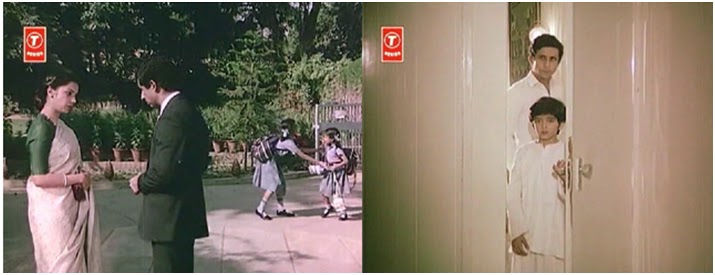
There are slight similarities between the basic thread of Aamir Khan starrer Akele Hum Akele Tum and Mahesh Bhatt's Kaash. Both deal with an estranged couple and are largely centered around a father-son relationship. Also, both the movies are set in the world of showbiz.
This is the age for action. Not just the dishum-dishooom kind. The word of movies has become fast paced- see any new trailer- twenty random shots will pass your eyes even before a single second is registered in your mind. Of course, the editing would be slick- people are hard pressed for time anyways- and it makes sense to cram in as much as possible within as less time as possible. Another explanation for it can be that “Hey, let’s not let them make any sense of it... just pack in some great shots and back it with a zany background score and they will be sold to our film”. It is not just our trailers, but even our films are becoming more ambitious in terms of the expanse of time and space they depict. Today, the camera hardly lingers on the face of an actor when he or she is done with the dialogue. It’s pertinent, for impatience is something which is now a virtue. The more impatient you are, the more you will achieve.
In such time and age, watching a film like Mahesh Bhatt’s 1987 feature Kaash can be an extremely novel experience. The film boasts of just four lead characters and almost no one else. The story is simple; the narrative is singularly linear (apart from a few discernable flashbacks). But more than anything else, the most unique thing about the film is that the camera is in no hurry and has a lot of time to capture what the characters feel and what they do. It is an extremely performance oriented movie that tells the story of a dysfunctional couple- a man who has seen the highs of stardom but is now experiencing the lows of obscurity, and a woman who cannot bear to see her once full of life husband taking to the bottle and giving up on life. Caught between them is their school going son; grappling with the acerbic tension between his parents. The story takes a turn when the kid is diagnosed with a terminal illness.
The film basically is a deeply moving account of a father-son relationship. Said to be inspired by a few moments from Mahesh Bhatt’s personal life, the film has been made with a lot of love and effort. That love and effort is visible through the dialogues and the performances that the writer/director has extracted from his two leads- Jackie Shroff and Dimple Kapadia, as well as from the actor playing their son. Some of the scenes are heart-breaking and it would be tough for even the most stubborn hearts to sit through them without getting moist-eyed.
The songs of the movie are innocent- there is no other word to describe them. If seen in isolation however, they might seem childish- but that’s the intention, for more than just songs, they are playful interactions between the young kid and his doting father. The mother, for most parts, is in absentia owing to her quest for being independent and not compromising on her self-respect, and understandably so as her husband becomes a terrible alcoholic loser post his fall from fame. The performances from both Jackie and Dimple are worthy of being described as textbook ones amongst their class. The former, in my opinion is a mightily underrated actor who is amongst the best in carrying off intense roles- at par with Nana Patekar (who being more theatrical grabs more eyeballs). Of course, the fact that Jackie has done innumerable inconsequential films (including B and C grade ones) goes against him. Anupam Kher plays an important role and the fourth lead (albeit peripheral). Despite him having a largely positive role, he strangely comes across as a grey character with the kind of look that he is given.
After watching this movie, I was going through the filmography of Mahesh Bhatt- and wasn’t he prolific! So many movies and such well remembered ones too. I haven’t seen a lot of them and will watch the better ones soon.
Parting Note: There are a lot of movies made for making you laugh- but here is a semi-autobiographical (allegedly) movie by Mahesh Bhatt that looks like it was designed as one that intended to make people cry. The strong performances and emotional storyline makes it a good watch. Akele Hum Akele Tum (starring Aamir Khan and Manisha Koirala) shares slight similarities with this movie.
These days I have been watching a lot fewer movies than before. After writing my 50th post (on Masoom) in the recall series, I have decided to take a break from old movies for a few days, and now I am catching up on some of the recent acclaimed Hindi movies that I didn’t pay much attention to at the time when they released. So this week I saw Tigmanshu Dhulia’s Haasil (after watching the superb Paan Singh Tomar), Satya (Ram Gopal Varma’s finest hour arguably), and Vishal Bhardwaj’s The Blue Umbrella. Haasil and Satya are widely recognized as brilliant films, and I concur with most of the glowing reviews received by the two movies that I read post watching them. But none of them has the haunting quality that the third film I saw has. Maybe it is because there have been many an attempts to rehash and cash in on the Satya cult (Ram Gopal Varma has done quite a bit of it himself), while the atmospherics of Haasil has been matched by movies like Gulaal and a few others. Or maybe it is just because the settings of Satya and Haasil are more familiar to the average Hindi movie audience.
On the other hand, The Blue Umbrella is truly a unique film. Everything- from its simple storyline, its performances, its setting, its intentions, to its unconventional execution has incredible freshness and charm. Prima facie it is a children’s film based on a novella by Ruskin Bond. Most certainly it is that, but more importantly it is also a film that makes you feel for its lead characters- and for that it takes a very difficult route- it makes you part of the longing the characters experience. Longing for acceptance, longing for joy, and longing for appreciation- wonderfully conveyed through their longing for a beautiful Japanese blue umbrella. The umbrella here is an important plot instrument, as while the story is woven around it, it also acts as a metaphor for all the small joys in life that may not be big achievements, but are certainly no less in the kind of happiness and satisfaction they lead to.
The movie transports you to a small village in Himachal Pradesh. The setting is idyllic and pristine, from the rain-washed valleys to the snow clad roads, from the small kutcha-pucca huts to the almost family like village bonhomie. The people are as simple as they come- uncontaminated and pure. They have aspirations that don’t have the grand vision and scale like the aspirations of the city people have. Their smiles are genuine, their laughs are uninhibited. Their sorrows are sudden and wild like torrential hailstorms that leave behind a brighter landscape when they leave. Their slight quirks, their eccentricities may be jarring to the outsider, but they are a part of their way of life- their way of living.
Movies are stories on celluloid- it is an oft repeated statement. But this particular movie is the quintessential story on celluloid. There is no other way to describe it. It is like a page out of a children’s story book and its imagery gives an impression that that particular story book must be very well illustrated. Mr. Vishal Bhardwaj has certainly followed his instincts and a crystal clear vision. I have seen three of his other films- Makdee, Kaminey, and 7 Khoon Maaf. And ‘The Blue Umbrella’ is my favorite from whatever I have seen of him.
I strongly urge all the people who like movies and fiction- to watch this movie. It is just 90 minutes- and it will surely transport you to a world that is alien to us, but in a certain way a very small part of us. Just a tip- persist with the movie- Pankaj Kapoor’s weird ways and idiosyncrasies might put a few people off in the beginning- but by the end they will be sure to realize the finesse and dexterity of his performance.
This is my 50th post in the series. To mark the milestone I choose one of my favorite films for discussion- Shekhar Kapoor's 1983 feature Masoom, starring Naseeruddin Shah, Shabana Azmi, and Jugal Hansraj (as a child artist) in principal roles. The film is one of the most acclaimed ones from that time and is the winner of many a awards for its actors as well as for the people responsible for its timeless music- Gulzar (lyrics, screenplay, and dialogues), and RD Burman (music director). Shekhar Kapoor also won tremendous appreciation for his able handling of a sensitive subject in his debut directorial effort.
Masoom has quite a following amongst Hindi movie lovers and is widely recalled as one of the most loved films from that time. Thus I design this post as a tribute to the movie where I will recount some of my favorite moments from the film apart from discussing some subtle aspects. For the same I am using some screen-shots from the movie- my first attempt at the method.
The family
One of the most loved aspects about the movie is the wonderful portrait of an urban nuclear family it paints. Indian cinema from the time of its inception has always stressed on the joint family system as the perfect way to live. Rarely did one see a movie in which a nuclear family was shown to be so happy and contented. It was maybe a reflection of our society and our culture which stresses on the importance of living together. Thus seldom did we see a family on celluloid sans the parents or the multitude of siblings and cousins. Masoom is truly unique in that sense for that period of time. It was truly an advertisement for the Government initiative which says 'Chhota Parivaar Sukhi Parivaar'.
Also it was one of the few movies that celebrated the urban way of living. DK Malhotra (Naseerudin Shah) is a successful architect who owns an idyllic house in a posh colony of Delhi. His wife Indu (Shabana Azmi) is the quintessential urban housewife who has a household help for assisting her in the daily chores, has a garden to look after, is educated and helps the kids with their homework. The way their house is set up shouts sophistication and richness. The family has its dinners and lunches and breakfasts on a fancy dinner table. The culinary on the table is all un-Indian and the kids are quite proficient in table manners. The children have a separate room all for themselves, and the parents don't mind going to parties without them. At the parties the wife quite enjoys it when her husband makes a mockery of himself in an inebriated state. The weekends are spent at a posh club with bonfires and all.
The friends
Both DK and Indu are part of the 'high society'. Their friends and acquaintances are from the same world. DK's best friend and confidante Suri (Saeed Jaffrey) is an exuberant Punjabi who likes his wine and women and is quite into sports. He is a proud father of a spoilt kid and enjoys his son's impudence and relishes his slight achievements. But the gregarious fellow is good man at heart and a true friend to DK. With him DK can discuss his worst fears and the biggest mistakes without feeling ashamed. In him he has a 3 AM friend who he can call upon at any time in times of adversity.
But despite all of the urbane feel and the progressive attitude in life, it is still a male dominated world. The women of both the households are housewives who have nothing much to do apart from looking after their home and children while they wait for their husbands to return from work. Indu's friend Chanda (Tanuja) plays a crucial role in shaping her thought process. Chanda, more than a friend, is an influencer who acts as a reference to Indu when times become tough for her. In the initial portions of the movie Chanda is a fiercely independent woman who has adopted a tough persona to hide the sorrow that haunts her from inside caused by her husband abandoning her for some other woman. She vows to never forgive her husband and channelizes the feeling of rejection through her sarcastic and cynic view of the world. But during the end portions of the movie her tough exterior breaks down when her husband returns to her, and she forgives him. This happens at a time when Indu herself is slowly coming to terms with her husband's infidelity and is drawing closer to the young boy her husband had fathered with some other woman.
The Infidelity
A married DK visits his Alma-mater for a reunion and runs into the beautiful and enigmatic young daughter of his teacher- Bhavna (Supriya Pathak). There is something quaintly charming about the lady that pulls him towards her. Their interactions are wistful and thus their encounter is one that has an inexplicable sadness attached to it.Maybe the fact that they both realize the pointless nature of their brief courtship leads to this regretful longing. But Bhavna, despite being cognizant of the ill-fated future, goes ahead with the brief relationship. Soon DK returns to his world and his wife and forgets all about this ephemeral romance. Bhavna to her part never tries to contact him, even when she gives birth to his son. This quirky spirit of Bhavna is strangely alluring. And Gulzar created a similar character (Maya) in his tale of unrequited romance (Ijaazat).
The confession
When DK discovers that he has a son outside his marriage with Bhavna, he is of course devastated. But he makes no effort to hide this fact from Indu. In one of the most poignant scenes from the film, he confesses in front of his wife. This scene comes very early into the narrative, which is again rather unconventional. In such situations in most movies, the guilty party tries to evade this moment of confrontation and makes all efforts to delay it to as late as possible- to eternity if feasible. Here by standing up and facing the truth while admitting to the the worst, DK shows great strength of character. But more than that it shows the amount of love he has for his wife. He knows that he has caused great hurt to her, but he faces this fact head-on without fearing the repercussions.
The arrival
The arrival of Rahul (Jugal Hansraj)is fraught with tension as expected. The boy is quiet and deeply affected by the loss of his mother. But despite all his nervousness, there is an air of confidence in the way he talks and looks around. The aura he has is a quaint cocktail of melancholy and warmth. His eyes are expressive, and gives away more than what his words do. The new setting for him is a challenge. But he is unaware of the fact that his arrival is as big a challenge to Indu, if not more. From this point, the most intriguing moments of the movie are between her and the boy. Her internal struggle, her confusion, and her being unable to take a tough stance against the lovable boy is a real treat to watch. The arrival of Rahul is also a welcome change in the lives of the two girls Pinky and Minni (The elder one played by a young and as sprightly as always Urmila Matondkar).
The new family
The bonding between the three kids is delightful to watch. The younger sister Minnie is less tentative and the more curious of the two. She and Rahul strike a friendship immediately. The elder Pinky is slightly more reserved and takes her time to lose her guard against the stranger boy. But when Rahul helps her with some difficult Maths, she too starts liking him immensely. The song 'Lakri Ki Kaathi' is a joy to watch with the three sharing great camaraderie. Post the song comes one of the most touching moments of the movie when Rahul gifts Indu a self-made wooden box. This is again a moment when the motherly love in Indu is itching to come out and embrace the boy, but the hurt wife in her stops her from doing so.
My favorite scene
DK and Suri's families go for a picnic on a weekend. In a game of cricket Suri's spoilt and bratty boy spanks DK the bowler all over the park. A proud Suri watches his son bat splendidly from behind the wickets. The ball is then taken by Rahul and he runs in to bowl... The result is expected yet sweet. He clean bowls Suri's young boy. What follows is something truly heartwarming. Seeing Rahul beat Suri's son at the game DK exults in joy. There is a feeling of great pride in him which he is unable to restrain. The father in him forgets for a moment the precarious situation that his family faces due to his illegitimate son. He almost proclaims to the world... "he is my son". Only thing is, that there is no one in earshot.
Tujhse Naraaz Nahin Zindagi... Hairan Hoon Main
The genius of Gulzar. Remarkably simple words that convey a sea of emotions. Certainly one of the most memorable songs to have come out of his pen. The soothing tune and the wonderful lyrics are coupled with some excellent visuals with DK and Rahul spending some quality father-son time with each other. The scenes are reminiscent of the Salman Khan starrer 'Jab Pyaar Kisi Se Hota Hai'. The movie that came in the late 90s is most certainly inspired by Masoom, and no wonder it is one of my favorite Salman Khan films :)
The drama
Rahul soon learns that DK is none other than his own father. Unable to take in the shock, Rahul's young mind loses its composure and he runs away from DK's place. His disappearance creates great drama with DK losing his cool and driving all over his portion of the city along with Suri, searching for Rahul. At home the two sisters are unable to handle the stress and break down. Once again the character with the most confused emotions is Indu. She is worried for Rahul, but restrains herself from expressing her worry out aloud.
The differences that were created since Rahul's arrival start creating an inferno in Indu's head while he goes missing. Her's is most certainly the most complex role of the lot and Shabana Azmi does full justice to her. In the end the compassionate mother in her wins over the hurt wife, and that leads to a happy climax!
Parting Note: Masoom is truly a special film. It deserves to be seen and savored by all those who like their movies to be simple yet alluring. Parting with the song that's synonymous with the movie today.
Safar is one of the famous Rajesh Khanna movies from his super-stardom phase. A musical drama that has philosophical undertones, it is one of those ‘it was good while it lasted’ kind of movies. The plot of the movie, directed by Asit Sen, is slightly reminiscent of another Rajesh Khanna classic Anand, with him playing the role of a man who remains jovial and level-headed despite being terminally ill. The major difference between Anand and this movie is that while the former focused on the idea of living your life to the fullest, this movie has romance at its forefront.
Avinash (Rajesh Khanna) is a college student who is more interested in bringing blank canvasses to life using his skill with the brush. There is a face that comes repeatedly in most of his paintings, and he soon discovers Neela (Sharmila Tagore) who shares a striking resemblance with that face. Neela is a diligent college student who aspires to become a successful surgeon. After an initial misunderstanding she treats Avinash to good health after he falls ill. They strike a delightful friendship that extends to Neela’s family comprising of her elder brother and his wife. This results in some of the most sparkling moments in the film, with a candid Avinash joyfully pulling the leg of Neela’s wannabe playwright brother. Soon this friendship translates into love, but fate has something else in store with Avinash soon realizing that he suffers from disease that cannot be cured. At the same time a rich businessman Kailash (Feroz Khanna) too falls in love with Neela, who is also the tuition teacher for his younger brother. When Avinash gets to know of this, he asks Neela to sacrifice their love and marry Kailash who promises a more secure future for her.
This entire premise is very similar to Shah Rukh Khan’s 2004 super-hit ‘Kal Ho Naa Ho’. In fact it is hard to ignore the possibility that Karan Johar/ Nikhil Advani would have been inspired by Safar while writing their movie. And this is not it; the second half of the movie is structured in a way that is very reminiscent of another Shah Rukh Khan starrer from about the same period ‘Hum Tumhare Hain Sanam’, in which he had Salman Khan for company. After Neela gives in to Avinash’s plead and marries Kailash, there begins a family drama with Kailash suspecting his wife of infidelity with Avinash. He finds it very hard to accept their friendship (much like how SRK finds it tough to accept his wife’s companionship with Salman in HTHS).
In fact with such turn of events, the movie changes color dramatically and becomes more melodramatic with the earlier focus being relegated to the background. In fact the culmination of the movie is the most confused part of the movie. It ends on a philosophical note with Neela’s sacrifice coming to prominence. In fact this is one movie where the central focus shifts between three characters- from Avinash in the first half, to Kailash in the post intermission portion, and to Neela in the culmination. When I come to think of it, I find it difficult to remember any other such movie. To the credit of all the three actors playing these characters, they don’t let this aberration become too obvious through the strength of their performances.
Now for the point that I was waiting to make- the songs of this movie are simply delightful. Each and every song is a classic and is truly memorable. In fact, this movie can deserve the tag of a classic just on the strength of its musical score by Kalyanji-Anandji.
The Shashi Kapoor-Shyam Benegal combo worked well in Junoon, which was an adaptation of a Ruskin Bond novella. Apparently wanting to take the successful collaboration forward, they decided to adapt the great Indian epic Mahabharata into a film by weaving it into a corporate modern-day scenario. This was some thirty years before Prakash Jha successfully aped the idea and applied it to a modern-day political setting.
Before I go on to talk about the film; I feel the word ‘epic’ has been coined just to describe the magnanimity of our two ancient relics- Mahabharata and Ramayana. Like most others from my generation I got introduced to both through popular tele-serials and some school text-book reading. Recently however I found time to go through some excellent re-telling of both- CR Rajagopalachari’s Ramayana, and Devdutt Pattnaik’sJaya (an illustrated version of Mahabharata). The latter was a more enriching experience than the former as Mahabharata truly is an amazingly sinuous yet cohesive work of art. It is so wonderfully detailed and multi-dimensional that it is difficult to remember most of the things. On the other hand I know pretty much all the things about Ramayana which, comparatively, is much simpler and easier to comprehend. So post reading Jaya, I got the feeling that I had never really known Mahabharata.
So when I sat down to watch Kalyug, I did it with great anticipation and excitement. I had thing movie with me for the past 3-4 months but never really got down to watching it, for at the back of my mind I always had this thing that I would read the epic once prior to experiencing it. With Shyam Benegal at the helm I was quite certain that the film would enthrall me. But now after watching the movie, in retrospect, I feel that I did great wrong by having such high expectations from this endeavor.
Kalyug is by no means a bad film. It is definitely a notch above the regular 1980s fare. However that aside, I am quite surprised by the lack of a lot of things in the movie. Coherence, for one. Emotional appeal, for another. Good acting (most surprisingly) for another another. The movie starts off with a rather simplistic narration of the rather simplistic (as compared to the one Mahabharata had) family tree of the two families involved. It is perfectly justified, and rather thoughtful, of the makers to keep the number of protagonists limited or else it would have been difficult to do justice to all of them in a 150 min motion picture. The two families are two rich business houses of India, fighting for the same contracts and tenders. The movie wastes no time in establishing the hostilities between these two families of cousins, related by blood but separated by their love for power and ambition.
As soon as the drama started, I excitedly started to draw parallels between the characters from the great epic and the movie. It is surely captivating, for someone who knows a bit of Mahabharata, to decipher and witness the way in which Shyam Benegal has made some interesting moves. Some of the characters are given the same names as in the epic. Karan Singh (Shashi Kapoor) plays Karan, a devoted friend to Duryodhan in the book, who is Dhanraj in the movie (essayed by Victor Banarjee). Karan Singh is pretty much the central character in the movie and it seems to be an adaptation of the saga from his perspective. Other characters with the same names are Subhadra, Krishna, Parikshit, amongst others. Many plot elements are cleverly harmonized with the ones from the book (something that Mani Ratnam tried in Raavan) and identifying the same is quite enjoyable for the first few minutes. Post the hour mark, however, the movie becomes quite bland and lifeless in its treatment.
My main issues with the film are-
·The characters are not well developed. None of them are likeable and the motivations behind many of the things the various people do are quite unclear. I couldn’t understand the role Rekha played for instance. She is Supriya, the wife of Dharmraj (Eldest brother of the troika playing the Pandavas), and throughout the movie comes across as an irritable lady who finds it tough to get along with her mother-in-law and her younger devar’s wife (who is also her niece). This younger devar Bharatraj (Anant Nag interpreting Arjuna) and his Bhabhi share a very unclear relationship. Till the end there is no clarity whether their relationship is just one of mutual respect or something more (In the Mahabharata there is no Bhabhi and Draupadi is wedded to all the five brothers). Similarly the relationship between Dharmraj (Raj Babbar essaying Yudhishtir) and his wife is shown to be dysfunctional but there are no reasons given. Balraj (Kulbhushan Kharbanda as Bheem) is shown as a pleasure-loving guy, but plays no critical role in the narrative (except being a trigger to the accidental death of his cousin Sandeep- a mentally unstable Dushasan?). Also, there is no explanation given for the great dislike Bharatraj has for Karan Singh (The Arjun-Karan war).
·A lot of the things from the Mahabharata are necessarily forced-fitted into the narrative, while many crucial things are not touched upon at all. So there are the incapable parents, growing senile and having no control over the actions of their kids. Similarly Arjun’s marriage to Subhadra (which wasn’t a big plot point in Mahabharata) is given great prominence by the introduction of a sappy and boring romantic track between Bharatraj and Subhadra. There is a Bhishma Pitamah too (played by AK Hangal!), but too plays no real part in the drama unlike the book where he was termed as the root-cause of the entire war. Also, in today’s context a woman bearing kids with Sadhus and priests as a mark of her devotion is too much to digest. There is also a fleeting mention of a past love affair between Supriya and Karan Singh (In the book Draupadi had prevented Karan from participating in her Swayamwar on the grounds of him not being from a royal family. Much later she had admitted to being attracted to him despite her being married to the Pandavas).
·The central conflict in the Mahabharata had its roots in the fight for the throne. Both parties believed that they were the true heir to the throne of Hastinapur. The hostility got to the highest point post the game of dice between Yudhishtir and Shakuni (representing Kauravas), in which Pandavas lose everything, followed by the subsequent disrobing and public humiliation of Draupadi. In the movie, there is no apparent central conflict. There is a slight throwaway to the Draupadi humiliation episode when income tax officers treat Savitri with disrespect while frisking her wardrobe. However the entire war between the two families comes across as manufactured and unreal.
·The acting by many of the leads looks embarrassingly amateurish. A part of the discredit for this should also go to the writers who didn’t really develop any of the characters well. Anant Nag seriously hams it up in the last few portions of the film. Victor Banarjee as Dhanraj fails to evoke sympathy or ethos despite playing a bit of a loser (again contrary to the tough and overbearing Duryodhan of Mahabharata). Sushma Seth is given too much to do, and is unconvincing in many of the scenes. Supriya Pathak irritates as the young bride of Bharatraj who has nothing to do in the world except listening to a formulaic Bappi Lahiri’ish’ love song. The only actor who actually does well is Shashi Kapoor, who is convincing as the angst ridden Karan Singh. He gets the meatiest part and does a good job of it.
It is not that there is nothing to appreciate in the movie. The idea of retelling Mahabharata in the corporate world itself deserves kudos. Some of the references to the epic are done really well. For instance the death of Karan while he is changing the wheel of his car is striking. Similarly at the end how Parikshit (a kid) emerges as the only heir to the entire set-up highlights the futility of the war between the cousins. Apart from these few well thought of references, the entire corporate set-up is done realistically. The fight for a Government contract, the intricacies of law, the dissatisfied union, the import of raw materials etc. is shown in an authentic manner (though in a certain sense it reminds of the Trishul corporate conflict). The first hour is quite fast paced and engaging.
Parting Note: All said and done, Kalyug is in no ways a perfect modern-day interpretation of the Mahabharata. It suffers from the similar flaws as Prakash Jha’s Raajneeti (a far more entertaining film). However, for the people who are aware of the epic saga, this movie is a good watch if only for the effort it makes.
Capital Punishment has a marked prominence in the annals of all recorded history. There has been no civilization where this form of punishment has not been practiced. Be it the Greeks, or the Romans, or the Chinese- all had strict stipulations on human execution as a part of their code of law. Even major religions like Islam, Christianity, and Hinduism have permitted capital punishment for certain offenses. But despite all this, there has always been a serious debate on whether human execution is justified. It has always been argued whether justice is always just; most certainly there have been many recorded instances where apparently innocent have been executed. BR Chopra’s 1960 movie Kanoon essentially debates and discusses this very pertinent issue of whether a human has got the right to take the life of another human, even if it is a means of enforcing punishment. Starring Ashok Kumar, Rajendra Kumar, and Nanda in principal roles along with some splendid lesser known actors essaying crucial roles, Kanoon is a resounding statement on the fallacies of human court of justice and on the inadequacies of the written law.
The movie starts off with a cold blooded murder like many of the other thrillers of the time. However this regularity is just a smokescreen for this apparently routine murder hides an uncomfortable truth behind it and exposes the ineffectual nature of our law. The case is adjudged by Justice Badri Prasad (Ashok Kumar) who is set thinking by the completely unexpected things that it throws up. This sets the ball rolling for a gripping tale that interweaves a poignant family drama into a courtroom battle. Another cold blooded murder takes place; that of a wealthy and manipulative city moneylender. The setting of the murder witnesses an unusual turn of events. Advocate Kailash Khanna (Rajendra Kumar) visits the moneylender to obtain some crucial papers that could put his girlfriend Meena’s (Nanda) family into great financial trouble. His girlfriend is the daughter of none other than Justice Badri Prasad, making the renowned judge his to be father-in-law. While at the moneylender’s place, Kailash spots Badri Prasad from a window, making his way towards the house. To avoid meeting his father-in-law and spilling the beans on his brother-in-law’s carelessness, he goes and hides in the other room. What happens next truly shakes the daylights out of him. Badri Prasad takes out a knife, rams it into the moneylender’s chest, and leaves the place smoothly. Completely shaken and not knowing what to do next, Kailash too runs away from the scene of the murder. Once the place is deserted save for the corpse of the moneylender lying on the floor, an aged thief enters the house with the intention of pilferage. However in the dark of the night he steps onto the corpse, leaves his fingerprints on the knife, and while escaping from the window gets caught by two policemen patrolling the area. Expectedly the poor thief gets embroiled in the case and gets implicated for the murder, with all the evidences pointing towards him. Not wanting to give his father-in-law away, Kailash decides to fight the case for the falsely accused thief and embarks on a battle to save him, while making all the efforts to spur the conscience of his father-in-law. What follows next is a riveting courtroom drama and a completely unexpected climax that throws up a host of questions, while answering a few too along the way.
Kanoon is completely a director’s film. It is an explosive subject and each and every scene shows the kind of efforts that would have gone in writing it. The dialogues are emphatic, the silences even more so. Most of the movies have one or two memorable scenes, but this one boasts of a series of such spectacular scenes that create a tremendous impact- right from the first scene, to the culmination of the drama. If one has to choose the most dramatic scenes, surprisingly a lot of them also come outside the court of law- behind the scenes of all the true drama. My vote would go to the interactions between the father and son in law post the murder, when Badri Prasad finds Kailash peeping into his private diary. Also the dialogue between the accused thief and his defendant Kailash is remarkably handled. There is also a superbly done slight side track when Meena starts suspecting Kailash of the murder, having absolutely just reasons for doing so. This delicate interplay of emotions between the protagonists is a delight to watch. The highpoint, though, as expected is the jaw-dropping climax, complete with the tense buildup and replete with an efficient disrobing of facts post the suspense is revealed.
The actors do more than a fine job, and show great dexterity despite the help they receive from the remarkable written material. I haven’t seen much of Rajendra Kumar, but still can safely assume that this would be one of his best performances (most of the others I believe are in the sappy romantic space where he excelled and thus got knighted as the Jubilee Kumar). Ashok Kumar is truly amazing in his highly sinuous role. His effortless ease is hard to miss. Meena is slightly more than a typical Hindi movie heroine and gets good scope to leave a mark. There are no songs in the narrative, though it does boast of a finely choreographed ballet dance performance that blends seamlessly with the story.
Parting Note: Kanoon is simply a MUST WATCH for the people who love their court-room dramas, and also for those who like watching thrillers (though this is not a thriller in the conventional sense). What elevates it from being just an excellent film is its thought, and its purpose which it conveys in the most effective manner possible- through the route of a highly entertaining story.
Life is showbiz can be a big challenge, especially for ladies for the lines between morality and professionalism and ambition can be pretty thin ones. We have had many movies that have dealt with this subject in recent times- Fashion and The Dirty Picture being the ones that immediately come to mind. In fact there was a time when women working in such vocations were not seen in a good light. The society never encouraged the women to be a part of such set-ups and the women who did end up working in the entertainment world were deemed social outcasts. Also, before cinema and fashion became as big as they are today, something else ruled the heartlands of our country- the good old village nautanki- a celebration of life and all its covert pleasures. Basu Bhattacharya’s first Hindi film, Teesri Kasam, starring Raj Kapoor and Waheeda Rehman is set in such an era. With a rustic backdrop, this film is a heartwarming tale of love between a nautanki star and a bullock-cart driver (Gaadiwaan).
Hiraman (Raj Kapoor in a typical role of a simpleton) is a naïve village bumpkin who is a Gaadiwaan by profession. A god-fearing and righteous fellow, he gets into some unfortunate situations and which lead him to make two promises to himself- one that he would never transport black-market goods on his cart, and two that he would never transport long wooden on it either. These two small incidents at the beginning of the story set the character of Hiraman firmly in place. Soon, he gets the task of making a lady reach a distant village mela on his bullock cart for which he is promised a lucrative payment. Thus, he and the lady embark on a thirty hour long journey through the wilderness to reach their destination. The lady is an ethereal beauty and Hiraman gets struck by her surreal charm. He discovers that her name is Hirabai-making her his namesake (meeta) in a way. Hirabai too gets attracted to Hiraman’s simplicity and goodness. They spend the entire time talking to each other, with Hiraman telling her stories and singing village songs to her. They don’t even realize when the thirty hours reach an end and they reach the mela.
Hiraman soon discovers that Hirabai is a very famous nautanki star and the biggest draw at the village mela. He decides to stay in that village and watch her nautanki after getting special passes for the same from her. So every night he and his friends start visiting the nautanki where they see Hirabai driving the crowds crazy by the grace and finesse of her dancing and singing. But a lot of the things that Hiraman sees in these excursions make him very uncomfortable. By the day he and Hirabai meet and spend a lot of time together in the process drawing a lot closer to one another than they initially imagined. In Hiraman, Hirabai finds a true friend who loves and respects her for what she is in reality, and not for her fame and beauty. She finds it difficult to keep the fact hidden from him that her vocation is not entirely honorable. Similarly Hiraman gets more and more sucked into the world of his meeta, refusing to realize that it would lead him to nothing else but dejection and him making a third promise to himself.
The story is uncomplicated and the emphasis is entirely on the unconventional bond between two people whose worlds are completely diverse. Their interactions are the highlight of the story apart from some truly melodious songs composed by Shankar Jaikisan. The performances by both the leads are terrific- especially from Waheeda Rehman who lives her character with great empathy and is a complete natural. This is one of the early films of her career, and it is safe to say that she was one of the most beautiful actresses of her time. On the contrary this is one of the later films for Raj Kapoor, and he looks quite elder to his co-star (but this age gap is justified in the story). As far as his act is concerned, he is a complete natural as the shy simpleton who takes an idealistic view of the world. The supporting cast is efficient (though I could identify only a few of the actors). Iftekhar plays a Zamindar who is a frequent visitor to Hirabai’s show and yearns for her affection. Asit Sen and Jhonny Walker too have brief appearances.
The film is presented as an almost musical with the songs hogging a great portion of the runtime. And it takes nothing away from the likeability of the movie as the songs are simply superb which some great lyrics that do a great job of saying what is going on inside the hearts of Hiraman and Hirabai. Also, the entire nautanki bit (including the behind the scene action) is handled in an authentic manner with some artistic cinematography and shot-taking.
Parting Note: Teesri Kasam is an endearing tale of love between two completely different people, with a completely rustic background which in itself is pretty alluring. Its charm lies in its rootedness and honest intentions.
P.S.: Basu Chatterjee is credited as one of the assistant directors on the project. It is safe to say that the master film-maker, who went on to make some great films himself, got some solid grounding in the art under his meeta (Basu Bhattacharya).