Showing posts with label Rajesh Khanna. Show all posts

Monday, March 18, 2013

Anand Ashram (1977)


I pushed back watching this Shakti Samanta movie for quite some time, expecting it to be one of those moralistic tale laced with melodrama and strung together by a few good songs. Another big reason for my lack of enthusiasm was that this movie, unlike most other Shakti Samanta movies of that time, does not star Rajesh Khanna, and instead features Uttam Kumar, an actor I am not particularly fond of. As it turned out, as I finally got around to watching it, I was somewhat right about my pre-conceived notions. But having said that, the movie pleasantly surprised me on many counts, and in fact turned out to be quite a good watch. Also, as the narrative unfolded and moved towards the climax, similarities between its story and that of big ticket Karan Johar magnum opus Kabhi Khushi Kabhi Gham became quite apparent, which were rather interesting to discern. The coincidence that Rakesh Roshan plays the role that would be parallel to what his son Hrithik Roshan performs in the modern day magnum opus, was what triggered the connection in my mind.


A young doctor marries his childhood companion without his father’s consent. The father, a rich and respected landlord with a legacy he is very proud of, is terribly disappointed by his son’s decision to marry a girl from a different religious background. The confrontation leads to the son abandoning his father’s house and giving up on all his inherited wealth. He, along with his wife, then proceeds to fulfil his life’s objective of providing medical services to the underprivileged villages, which lack healthcare infrastructure. A chance encounter with a wannabe do-gooder enables him to open a village dispensary, which he starts to run with his wife supporting him wholeheartedly. Then in a curious turn of fate, his allegiance to the oath of selfless service is put to test. He passes the test but suffers a great personal loss when he is unable to be at his wife’s side as she is delivering their first child. The story from there briskly changes character and soon takes a time leap. With the drama set, the next part is quite entertaining to watch.

Despite the serious theme, a feel-good factor is maintained throughout, thanks to the well defined characters essayed by Ashok Kumar, Utpal Dutt, and Asit Sen. In the second part of the movie the romance angle between Rakesh Roshan and Moushumi Chatterjee also lightens the proceedings. Towards the end, the culmination too is convincing and ties up the drama satisfactorily.
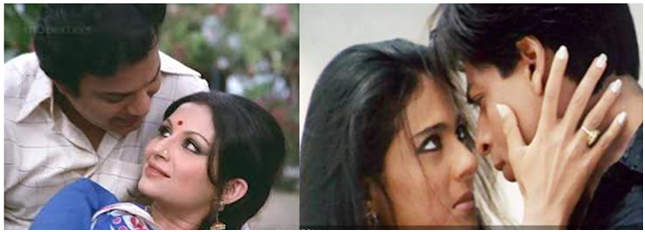

It would not be completely off the mark to say that the basic skeletal of Anand Ashram and K3G is alike. What is most different is the objective and treatment. While Anand Ashram has the theme of selfless service to humanity as its backbone, K3G has no such pretentions and was quite unequivocal in its fidelity to the candyfloss. As a result the characters in the older film are less caricaturish and have more shades to their personalities. And that is strength of Anand Ashram as a more ‘moving’ motion picture. The lead hero, Uttam Kumar, is not very convincing in the initial portions of the story where he plays the rebel lover lip-syncing to songs and romancing a stunning beauty like Sharmila Tagore. But in the later part of the movie he appears in a bearded look and is generally more assured. But Ashok Kumar as the ‘kabhi garam kabhi naram’ granddad (and dad) gives the most heart-warming performance from the lot.

Almost all the songs are nice and don’t really act as speed-breakers. ‘Sara pyaar tumhara’ and ‘Rahee naye naye’ and the most melodious and must have been quite popular in their time.


Parting Note: Anand Ashram has a good original story to tell in a breezy run-time. Also, the message it propagates is universal and quite relevant even in the current times.

Wednesday, May 30, 2012

Mere Jeevan Saathi (1972)


Imagine a scene:

A father and his seven year old son watching an IPL match together. In a commercial break a new Havells advert featuring a diminished and dilapidated old man and his countless fans (literal) captures the attention of the kid. He ignores it the first few times, but finally cannot resist asking his father the question.

“Papa, who is this old looking man, and why are they showing this ad again and again?”

The father looks at his innocent son, wondering what to tell him.

“Beta, he was a very popular film star once.”
“Papa, then what happened to him? Why is he not seen in films anymore?”

At that very moment the strategic timeout ends and the match resumes. The kid forgets the question he had asked his father, and once again gets lost in the glitz and glamour of the festival that celebrates his favorite sport, bat-ball. The old man and his fans are forgotten too, and the next time the ad comes, it is given hardly any attention. Meanwhile the father gives a wry smile when he sees print version of the same ad campaign in the newspaper he reads.
***

The Rajesh Khanna phenomenon is like folklore for the kids of my generation and the subsequent ones. Every now and then, when the topic of cinema and stardom was touched upon during the many family viewings of popular classics on television (mostly Amitabh Bachchan ones-Sholay, Amar Akbar Anthony, Deewar etc.), the name Rajesh Khanna was mentioned and dwelt upon for a few moments, and then life began as usual. The name got relegated to the back of a busy memory storage device, where it lies dust-ridden and ignored.

Ask a film aficionado from the 70s generation or about that time, and chances are that you will get to hear many crazy stories about the star’s sky-high popularity in the early 70s. Some will claim most emphatically that such a phenomenon was never seen again, and that it’s unlikely that it would be repeated anytime soon. His rapid rise to fame and the cruel fall to become an almost B-grade star is a stuff of filmy legends. Even after his fall from grace, he continued to do a lot of films, and even managed some intermittent hits, but never again that time returned when he was the Midas, and he was the gold.

Now when someone watches his films, it is hard to keep it separate from his real life story and the rise and troughs of his career. Almost all his films from the late 1960s to about 1973 (the year when he did a film called Namak Haram with the rising superstar at that time- Amitabh Bachchan), have him at his confident best (or it seems). Many of his later films too have great merit, but he as a performer doesn’t seem as assured and as much in command as he does in his early films. In fact Mere Jeevan Saathi, a 1972 film, is one which gives the impression of being designed to suit his larger than life image. It certainly revels in paying homage to all the things for which he was loved and adored. It is the kind of film which is unrestrained in singing eulogies to a persona that is bigger than anything else in the movie. After one watching this film, one can easily imagine the context and the phase in which it was made. And anyone who is interested in making sense of the Rajesh Khanna phenomenon must experience this one.

The superstar plays a Casanova, an artist, a singer. He gets to strut around in garish and loud clothes (in vogue at that time), gets to flirt with girls ready to eat out of his hands (and what not!), and gets to sing songs to an audience of admirers and fans. All this, and more, happens in the first half of the movie when he is chased by a rich spoilt princess (Helen), and he chases and demure and comely young lady doctor (Tanuja) and falls madly in love with her. In the second half things change color and Rajesh Khanna gets to play the other side of his persona that was quite famous at that time- the romantic hero stuck fighting through tragic circumstances. He meets with an accident and lands up in the palace of the very princess who he had ignored and rejected. At what more, he loses his eyesight and becomes a prisoner of his ardent admirer who treats him like a slave. Meanwhile the heroine (an ophthalmologist) sets up a hospital and meets another suitor and his family. What happens next is not very difficult to predict, but it is that kind of a film that holds not much novelty factor, but just comes across as a very well packaged story playing up the image of its lead star.

The most attractive thing about this film is its songs and music by RD Burman. Classics, all of them and I am signing off with my favorite of them all…


Monday, April 30, 2012

Palkon Ki Chhaon Mein (1977)


A completely misleading poster of the movie- playing up the drunkard jilted-lover image of Rajesh Khanna, and glorying a five minute Jeetendra appearance. The movie is nothing like what this poster indicates. 

Five minutes into the movie, and you can make out it is a Gulzar film. This Rajesh Khanna and Hema Malini film is though not directed by the maestro himself, but by Meraj, who was an assistant to the man in most his earlier directorial ventures. But everything- be it the dialogues or the treatment, or even the look given to the lead actors- looks straight out of the Gulzar school of film-making. That he has written the screenplay is just a part of this happy occurrence.

The story is set in a village, very much like the Jeetendra- Hema Malini starrer Khushboo that came just two years or so before this movie. But this time, instead of Jeetendra, the moustache is donned by (the then on the wane) superstar, who gets to play a meaty author (read Gulzar)-backed role. Ravi (Rajesh Khanna) is a city bred educated but unemployed youngster, who doesn’t lose his sense of humor and wit despite his many failures to secure a decent employment. A chance encounter leads him to the job of a dakiya (postman) in a nearby village, which he gladly accepts. In the village he soon gets around to doing his job with much sincerity and dedication. Within no time gets acquainted with most of the village folk- each of who have their own story to tell. These include a senile old lady who awaits the return of her son, a young widow who has lost her husband in the war- but has not lost the zest for living, and a young lady named Mohini (Hema Malini) who to Ravi’s pleasant surprise appears more than willing to strike a companionship. Soon Ravi and Mohini start meeting everyday and Ravi falls in love with her, completely oblivious to the fact that she has very little interest in him- the person, and most of her attention is reserved for Ravi- the postman. This is because Mohini expects a letter from her lover, an army-man, to reach her. Ravi’s pleasing ways and respectful manners lead her to confide in him her relationship with this soldier (Jeetendra in a guest appearance). This love story of hers completely shatters Ravi’s heart, who had genuinely felt that Mohini’s affections were a result of them drawing closer to one another with each passing day. But consoling himself, Ravi decides to go the city and look for this soldier who had not written to Mohini despite his many promises. When he returns, the news arrives that Mohini’s beloved is no more and has lost his life in the war. It then becomes his responsibility, being a postman, to break this news to Mohini…

Not unlike Khushboo, this story too looks like a chapter out of Malgudi Days with all its simple and unhurried appeal. The drama in the story is somewhat based on the fact that in those days very few village people could read and write their own letters- and the responsibility of the same then rested upon the village postman- who thus became an essential part of their lives. In that sense the village postman acted like a ‘social glue’, being a common element in all the villagers’ lives. Here the song ‘Dakiya Daak Laya’ reflects on pretty much the same sentiment. While the postman drama is the backdrop, the innocent love-story with all its uncertainty and apprehensions, is the motif in the movie. Ravi’s one sided love, and his expression of the same through his sketches (that are revealed at the end), is quite endearing. The most unique thing about the movie however, is that despite all its underlying tension; it retains a light-hearted spirit on the surface. There are many instances of humor, though like in all other Gulzar movies, they are quite understated. But quite unlike most of his films, the music score here is not too memorable with two of the songs being quite situational, and a forced nautanki dance number (picturised on Rekha) not being as fun as it should have.

Rajesh Khanna puts in an earnest act, and quite underplays his character for most parts. It is easy to make out that he was a very fine actor, and thus his fall from fame appears more baffling (though perhaps that had more to do with his off-screen issues). Hema Malini is effective, though it looks like she walked down straight from the sets to Khushboo to this movie. The supporting cast doesn’t have much to do here with Farida Jalal (another Khushboo connection), Asrani, Amjad Khan, and Master Raju being the most popular ones from the ensemble.

Parting Note: This movie is a sweet love-story that deserves a watch by all those who like such village themes. And when you add the fact that it is almost a lost Gulzar film, it becomes a must watch for his fans. 

Sunday, February 26, 2012

Safar (1970)

Safar is one of the famous Rajesh Khanna movies from his super-stardom phase. A musical drama that has philosophical undertones, it is one of those ‘it was good while it lasted’ kind of movies. The plot of the movie, directed by Asit Sen, is slightly reminiscent of another Rajesh Khanna classic Anand, with him playing the role of a man who remains jovial and level-headed despite being terminally ill. The major difference between Anand and this movie is that while the former focused on the idea of living your life to the fullest, this movie has romance at its forefront.
Avinash (Rajesh Khanna) is a college student who is more interested in bringing blank canvasses to life using his skill with the brush. There is a face that comes repeatedly in most of his paintings, and he soon discovers Neela (Sharmila Tagore) who shares a striking resemblance with that face. Neela is a diligent college student who aspires to become a successful surgeon. After an initial misunderstanding she treats Avinash to good health after he falls ill. They strike a delightful friendship that extends to Neela’s family comprising of her elder brother and his wife. This results in some of the most sparkling moments in the film, with a candid Avinash joyfully pulling the leg of Neela’s wannabe playwright brother. Soon this friendship translates into love, but fate has something else in store with Avinash soon realizing that he suffers from disease that cannot be cured. At the same time a rich businessman Kailash (Feroz Khanna) too falls in love with Neela, who is also the tuition teacher for his younger brother. When Avinash gets to know of this, he asks Neela to sacrifice their love and marry Kailash who promises a more secure future for her.

This entire premise is very similar to Shah Rukh Khan’s 2004 super-hit ‘Kal Ho Naa Ho’. In fact it is hard to ignore the possibility that Karan Johar/ Nikhil Advani would have been inspired by Safar while writing their movie. And this is not it; the second half of the movie is structured in a way that is very reminiscent of another Shah Rukh Khan starrer from about the same period ‘Hum Tumhare Hain Sanam’, in which he had Salman Khan for company. After Neela gives in to Avinash’s plead and marries Kailash, there begins a family drama with Kailash suspecting his wife of infidelity with Avinash. He finds it very hard to accept their friendship (much like how SRK finds it tough to accept his wife’s companionship with Salman in HTHS).

In fact with such turn of events, the movie changes color dramatically and becomes more melodramatic with the earlier focus being relegated to the background. In fact the culmination of the movie is the most confused part of the movie. It ends on a philosophical note with Neela’s sacrifice coming to prominence. In fact this is one movie where the central focus shifts between three characters- from Avinash in the first half, to Kailash in the post intermission portion, and to Neela in the culmination. When I come to think of it, I find it difficult to remember any other such movie. To the credit of all the three actors playing these characters, they don’t let this aberration become too obvious through the strength of their performances.
Now for the point that I was waiting to make- the songs of this movie are simply delightful. Each and every song is a classic and is truly memorable. In fact, this movie can deserve the tag of a classic just on the strength of its musical score by Kalyanji-Anandji.

Parting with my favorite song from the movie-


Sunday, January 22, 2012

Kudrat (1981)

There are many different views regarding the number of basic plots possible in storytelling. Some say that there seven; a few argue that there could be twenty. An argument also claims that all kind of plots center on conflict (either internal or external), and in that sense there is only one basic plot in all stories. Whatever be the case, it leaves very little room for storytellers and film-makers to experiment. Or does it? The finest film-makers have, at times, taken the most mundane of stories and have presented them in such a novel manner that they have left the audiences spellbound. They have proven that though the plots may be limited, the possibilities are endless. And this is what essentially Chetan Anand did in his 1981 feature Kudrat starring Rajesh Khanna, Hema Malini, Vinod Khanna, Raajkumar, and Priya Rajvansh in principal roles.


Kudrat is Chetan Anand’s intricate version of Madhumati set entirely in the serene locales of Shimla. It begins with Chandramukhi (Hema Malini) and her family returning to the place of her birth, Shimla, after twenty years. Even though the twenty years haven’t seen the twenty something Chandramukhi return to Shimla, she starts finding a lot of things about the city very familiar. Just two days into their stay, she meets Dr. Naresh Gupta (Vinod Khanna), a family friend, and they start dating all over the city. Just when things look like they couldn’t go any better, Chandramukhi runs into Mohan Kapoor, a city advocate who has the city’s richest man Choudhary Janak Singh (Rajkumar) for his guardian. Although Mohan Kapoor is a stranger to her, she feels a quaint pull towards him, as if they had been romantically involved at some point in their lives. For his part, even Mohan seems a bit perturbed when Chandramukhi is around him, despite having Choudhary Janak Singh’s daughter and his fiancĂ©e Karuna (Priya Rajvansh) with him. 


Over the next few days, Chandramukhi starts getting flashes of her past life triggered by her visiting the places she used to visit with Madho (Rajesh Khanna) in her previous birth. Not only this, she starts getting nightmares that leave her feeling utterly depressed and scared. To help her, Naresh, also a psychiatrist, decides to do a past life regression on her and through it he discovers that what Chandramukhi was claiming was absolutely the truth. She and Mohan Kapoor had been lovers in their past lives and had lived in the very city in which they were present at that point of time. He relays all this to Mohan Kapoor who refuses to believe the story. But soon, even he starts getting convinced about Chandramukhi’s claim. In fact, she makes him recall something more sinister. He and Paro (Chandramukhi in her previous birth) had been separated in their past lives because of a terrible crime. Paro had been raped and killed by an otherwise honorable man who turns out to be none other than Choudhary Janak Singh. What follows next is a riveting courtroom drama in which Mohan Kapoor accuses the most reputable man in Shimla (and also his beloved guardian) of a crime that he had committed twenty years ago. What adds more drama to the proceedings is that the man is defended by none other than his own daughter Karuna, who refuses to believe that her father could commit such a ghastly act.


Chetan Anand laces the screenplay with some brilliant sequences that are truly one of their kinds in Hindi cinema. The past life of the two actors is set in the pre-independence era when Shimla was the summer capital for the Britishers. The past-life regression is done very authentically and the way it has been shot is way ahead of its times. The entire court-room battle and the superb culmination are captivating, and in fact haunt you till much later after finishing the movie. Also, the scene of the crime and the subsequent few minutes, are shot in a style that is not usual for the Hindi cinema. The inherent drama in the script is accentuated by superbly designed situations and some wonderful dialogues. The performances by all the actors complement the brilliantly written screenplay. Hema Malini has the most complex role of all and she does well while looking absolutely gorgeous throughout the movie. Vinod Khanna and Rajesh Khanna are able, while Rajkumar is his usual flair and glory. Priya Rajvansh looks a misfit in the cast as despite the tons of make-up she looks far from the young lady she plays (But then she and Chetan Anand were romantically linked and he used to cast her in all his movies). Even Aruna Irani has a critical role which she performs well.

The entire feel of the movie is of melancholy and suspense. The setting is akin to an old English mystery drama- and rightly so for Shimla is indeed a Victorian town in many ways. What adds to the whole atmospherics is a wonderful tune by RD Burman, who is at his best in the movie. The tune which forms the song ‘Humein Tumse Pyaar Kitna’ comes more than once in the film and complements the soul of the story wonderfully well. The other memorable song in the enterprise is ‘Tune O Rangeele’ which is like a beautiful show-reel of both Shimla’s beauty and Paro and Madho’s romance. The other songs too are good, though not as fondly recalled.


Parting Note: Kudrat is an excellent suspense-mystery-reincarnation-drama movie that boasts of some remarkable sequences and some memorable songs. Although its story seems to be a homage to Madhumati, it has its own uniqueness and own charm which is a result of the brilliant screenplay and direction by Chetan Anand.

Saturday, August 27, 2011

Ittefaq (1969)


To a fan of suspense and mystery movies, there is nothing more satisfying than viewing a taut and fast-paced thriller. ‘Ittefaq’, one of the early movies directed by the much celebrated Yash Chopra (and rightly so), is one such movie that is gripping enough to keep to you thouroughly engaged with its suspenseful plot and unconventional sequence of events. Produced under the BR Chopra banner, which was famous for its mystery movies, Ittefaq can be rated as one of the best thrillers to have been made in Indian cinema. It is an unusual Hindi movie with no songs and a run-time of just over 100 minutes.

The movie starts off in dramatic fashion, and takes no time in coming straight to the point. Painter Dilip Roy’s (Rajesh Khanna in a complex role) wife is found dead in their apartment and he is accused of the crime. His wife’s sister Renu (Bindu) gives testimony against him and despite his many protests and claims of being innocent, Dilip Roy is convicted of murdering his wife. During the course of the judicial proceedings, his wild and unpredictable behavior leads the court to label him as mentally unstable and thereafter he is sent to a mental asylum. One rainy night, Dilip spots an opportunity to escape from the asylum and chances it. With Police on his trail, he enters the first house he spots feasible to break into. He finds the lady of the house, Rekha (Nanda), all alone and forcefully takes refuge there. What transpires in next few hours is what Ittefaq is all about.

With limited characters and the entire drama unfolding almost in one house, the movie has its focus pretty clear and it is one rare movie from its times which has no subplots, no distractions whatsoever. The drama between Dilip and Rekha is the highpoint of the enterprise, with the last thirty minutes being edge of the seat stuff. The only time the movie slacks a bit is around the half-way mark, when it looks like a slight romantic angle in developing between the main leads, but such fears are unfounded as is revealed in the latter half of the film. The twist and the subsequent culmination to the film are fantastically shot and wonderfully performed.

Another element that adds tremendous value to this movie is its background score and its sound design. Each and every sound, disturbing the silence of the night, has some meaning attached to it and plays some or the other role in building up the mystery. The lighting and production values are top notch, and the editing is razor sharp. The characters of the supporting cast are well defined and are performed ably by well known actors from that generation. But as far as the performances go, Rajesh Khanna takes the cake. He is saddled with a very difficult role and is present in almost each and every scene of the movie. In one of the early roles of his career, he performs remarkable, especially during the latter portions of the movie. Nanda, in a very unconventional role does very well and delivers one of her best performance. Iftekhar (the man who can be seen as a Police inspector in almost every movie from that time), plays a CID inspector here and gives an impressive act.

Parting Note: Ittefaq is one of the better suspense movies made in Indian cinema. Fans of this genre will find it highly satisfying, and so will the fans of Rajesh Khanna, for they will get to see one of the best performances of his career. 

Monday, July 4, 2011

Namak Haraam (1973)


What’s more important- profits or people? Now this is a lot closer to my current project in life- the Masters in Business Administration that I am pursuing. And this is also what Hrishikesh Mukherjee essentially tries to debate in his movie Namak Haraam starring Amitabh Bachchan and Rajesh Khanna in principal roles.

A story of two thick friends who can’t even imagine leading their lives without each other, this is a sensitive representation of the clashes between the capitalists and the labor class- a subject that had relevance not only in India, but also the world over.

Vicky (Amitabh in a boisterous and aggressive role that is light days apart from what he played in the earlier Rajesh Khanna-Hrishikesh Mukherjee collaboration ‘Anand’) and Somu (Rajesh Khanna) are alter-egos. While Vicky is the son of a rich industrialist, Somu comes from a family with limited means. Their bonding is so strong that Somu doesn’t mind Vicky funding the day to day activities of his household. They go to work together, they get fired together. They go to ‘mujras’ together and do pretty much everything together (it may be difficult to comprehend such a bonding in today’s times and some people might view it with suspicion).

Their lives take an unexpected turn when Vicky goes to Bombay and look after his business after his father suffers a mild heart attack and is advised rest by the doctor. While handling his business he refuses to accept some demands of the union leader Bipinlal (played by AK Hangal) rather bluntly- leading to the workers going on a strike. Later, on his father’s advice, Vicky has to publicly apologize to the Bipinlal- in an effort to pacify the agitating workers. He considers this act of apologizing utterly humiliating and vows to take revenge. For that very purpose he calls Somu to Bombay and places him at the factory with the workers, as one amongst them. They both hatch a plan which involves Somu gaining the support and trust of the workers, and in the process alienating Bipinlal from rest of the work-force.

Initially the things go according to plan but soon Somu starts getting affected by the plights and pains of the workers while being in close contact with them. The trigger proves to be an alcoholic poet Alam (Raza Murad in a heartwarming performance). Gradually Somu realizes that the workers’ demands for better wages and better working conditions are completely justified and the stance taken by Vicky and his father is a selfish one. There ensues the conflict and it is with Somu’s retaliation to Vicky’s claims that the title of ‘Namak Haraam’ gets justified.

The movie is really different from what was usually attempted in Hindi cinema in the 1970s. Some might even say that it was made with a socialist propaganda and tried to show the capitalist in a negative light. But I feel that such was the demand of that time when there was rampant exploitation of the worker class by the money minting factory owners. Of course today with human rights, labor rights, and Corporate Social responsibility things are much better. But the central idea of Profits Vs People is still relevant.

The performances, as expected, are top notch. Rajesh Khanna’s Somu steals the thunder from Amitabh Bachchan’s Vicky. The former is brilliant as a man caught between his best friend’s interests and the calls of his conscience. Simi Garewal and Rekha pitch in small-almost insignificant supporting acts. But for me the character of Alam was the highlight of the movie in the sense that it performed the role of the catalyst in taking the drama forward. His lines in the movie reflected haunting sadness-

“Nadiya se Dariya, Dariya se Sagar, Sagar se Gehra Jaam- Jaam mein doob gayi hai meri Jeevan ki har shaam”

Parting note- Namak Haram deserves to be seen by the lovers of Hindi cinema for it attempted something different from what was the norm and also boasts of powerhouse performances from two of its most popular superstars.