Showing posts with label RD Burman. Show all posts

Wednesday, October 16, 2013

Dard Ka Rishta (1982)


An artist’s best work is often the one that has risen out the melting pot of his own life experiences.  The best artists in the world are known to create art for themselves, not caring much about the expectations the world burdens their shoulders with.  In fact, there have been innumerable cases where an artist was not even acknowledged during his or her lifetime; the famous painter Van Gogh’s name comes to mind as a prime example of such an occurrence. If we have to looks for an example closer home, the name of Guru Dutt can be mooted in this regard. Although he wasn’t completely unappreciated while he lived and made movies, his true worth was recognized only after an untimely death. Though, it must also be said while citing his example that cinema, as compared to painting or music, is a highly corrupted art form, owing to the fact that films are almost always made for an audience and are hardly ever devoid of commercial considerations.
Another observation that I will make before turning to discuss the movie I wish to discuss in this post, is that it is often painful experiences and grief that act as the most effective catalysts to the most creative of expressions. This particular sentiment has been widely popularized by the movie ‘Rockstar’, but I had to say it to set the context.
Sunil Dutt, was a prolific actor, and more than just an occasional director/producer. In fact it won’t be wrong to say that some of his directorial/production ventures were far more ambitious than most of the movies he starred in as an actor. From ‘Yeh Raaste Hain Pyaar Ke’ which dealt with a taboo real life adultery case, to ‘Yaadein’ that was an unique experiment with just a soliloquy piecing together a narrative, to big canvas dacoit films like ‘Mujhe Jeene Do’ and ‘Reshma aur Shera’, the man was never afraid to challenge the stereotype. In 1981, the year in which his son Sanjay was launched by him in ‘Rocky’, he suffered a huge personal setback when his beloved wife Nargis succumbed to cancer. Out of this great grief must have emerged the story and concept of ‘Dard Ka Rishta’ a movie that he made just after, as a tribute to his wife, and apparently to further the cause of cancer awareness and research. And in my view, this particular movie, made as a labor of love and pain, is the best movie out of all that were produced by him. 
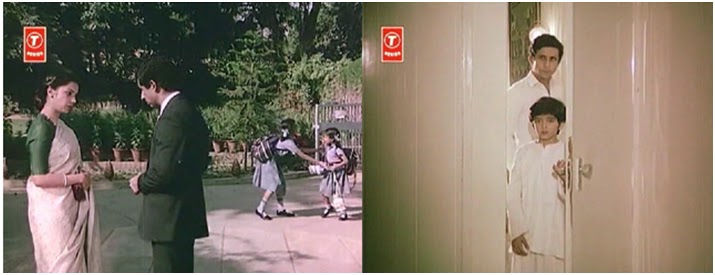
The structure of the story is simple but touches upon many issues that remain relevant even today. One, it highlights the conflict in the mind of an expat originally from a poor/developing country like ours, of whether to lead a somewhat selfish existence where there are many personal gains to be had, or whether to go back to one’s own country and contribute using the skills gain abroad. Two, it talks about the conflict in the mind of a doctor, of how to best use one’s education, that is, to use it as a privilege or as an aid to the society’s betterment, also whether to make best use of what’s current, or whether to throw oneself into research and look for better methods to improve on the current.  Three, it looks at the relationship between an estranged couple, and how it plays out when they meet after many years. Four, it looks at the plights (and the delights) of a single parent, on how kids such raised, mature quicker and come to terms with life’s realities and responsibilities a lot sooner than kids indulged by both the mother and father together. Five, through a somewhat clichéd and yet entertaining side-track it looks at the eternal Hindu-Muslim communal issue, which again is an apparent offshoot of Sunil Dutt’s own life, owing to his marrying a Muslim lady. Lastly, and above all, it highlights how difficult it is to face loss, to watch a loved one die, and not being able to do anything about it.

The story, refreshingly for a Hindi movie of that time, has a broad geographic canvas a narrative that has a wide time span. Thus, the characters and lives evolve and grow as the story progresses. Most impressive is the restraint on melodrama, which is left implied and unsaid on most occasions, truly unique for a 1980s Hindi movie. A lot of this can be attributed to the calmness and grace that is brought to the screen by all the female actors- Smita Patil, Reena Roy, and a young Khushboo (the famous actress in South Indian films) who plays Sunil Dutt’s daughter. Sunil Dutt, essaying the lead male part, expectedly acts with great sincerity and sensitivity. The music by RD Burman is pleasant to the ears and complements the mood of the film.

Also unlike most Hindi movies, it is difficult to decide what the best parts/scenes of the movie are. The father-daughter relationship is heartwarming and in essence is the core to the plot, but the subsidiary emotional linkages, for instance the relationship the girl shares with the servants/helpers of their household comes out very well through some nicely written scenes. The NRI portions of the story, which would have done Jhumpa Lahri proud, have a stamp of finesse and class. The medical procedures and functioning of a foreign health-care setup, as shown in the movie, give the impression of being well researched. The only dated bit of the movie is the part where Sunil Dutt has to marry Reena Roy because of certain unfortunate circumstances, but even that can be excused as a well-received big-star movie used the same plot device as much as twenty-five years later (How Shahrukh Khan ends up marrying Anushka Sharma in his blockbuster hit Rab Ne Bana Di Jodi).

 
Overall, the movie is well worth its slightly long duration, and is quite a classic if you consider the period it was made in, and the personal element of the maker involved. It is unfortunate that this movie is seldom talked about in the media circles (it even fails to receive a mention in the main body text of Sunil Dutt’s Wikipedia page).

Wednesday, January 23, 2013

Jallian Wala Bagh (1977)

I was watching some interviews of Gulzar recently on YouTube. One thing that he mentioned in almost all his conversations was the impact of India’s partition on his life and works. Not surprising for someone who was born on the other side of the border that wasn’t present at that point of time, Gulzar talked very fondly about the land that was once a part of his being, and that presently was alienated from him, at least in terms of physical distances. But despite this admission, we find that the man was hardly ever a part of any cinematic venture that explored the stories of that painful time. Most of his work that revolved around that motif was not done for the big screen. His poems, his stories, and anecdotes on the subject are a part of his poetry books, his memoirs, and some plays that have been adapted from the same.

Gulzar in a still from Jallian Wala Bagh
However my quick research reminded me of one movie set in pre-independence India, which Gulzar contributed to immensely. Jallian Wala Bagh, a movie directed by Mr. Balraj Tah (one time director/film-maker), had its screenplay and dialogues written by the maestro of words. Chronicling the events around the horrific incident that gave a new impetus to the Indian Nationalist movement, the movie can also be termed as a sketchy biography of Shaheed Uddham Singh, the revolutionary young man who murdered the man largely responsible for the mass massacre that happened on 13th April, 1919.

Parikshit Sahni essays the role of Uddham Singh, while Vinod Khanna and Deepti Naval play major parts that bring in some star value to the otherwise non-commercial looking venture. Shabana Azmi has an insignificant cameo, but the surprise of the show is a meaty role by none other than Gulzar. As a young man contributing to the freedom struggle while living in London, Gulzar delivers a patchy performance that vindicates his decision of not going in front of the camera ever again. However the portions involving him are some of the most polished part of the otherwise amateurish attempt by the first time director.

The movie is far from being a very fine one. However, at just over 100 minutes in length, it is a reasonably good watch, at least from the point of view of being an important film based on true events. It is tough to describe it as a biopic as it fails to do justice to that genre despite having Uddham Singh as a fulcrum for the narrative. As an effort that documents a critical chapter of our freedom movement, the movie again falls short. Ultimately it ends up as a confused attempt that could have been made into a defining feature, had some more research and effort been done before making it. Some of the factors that redeem the movie are:

Non-violence vs Violence: How to get India to revolt?
  • Its depiction of the underling conflict between the extreme revolutionaries and the moderate (and non-violent) Gandhian reformers. The characters of Om Shivpuri and Vinod Khanna, father and son, are at constant loggerheads regarding the approach that the freedom struggle should adopt. Here Deepti Naval provides the balancing act and articulates the difficulty in making one choice out of the two. This debate later continues between Uddham Singh and Om Shivpuri’s character in London, two decades after the incident of Jallian Wala Bagh.
  • The introduction of a global perspective to the proceedings in the later part of the film. When Uddham Singh reaches London, the world is in a state of conflict, with Hitler on the warpath. It is refreshing to see a movie talk about the broader canvas, while not losing the grip of the core plot. The use of an English lady’s character that supports Uddham Singh and Sunil (Gulzar) against the British is done really well, and executed sans any stereotypes.
  • A major part of the second part (which is set in England) is in English. This again is quite different for a movie that largely talks to a Hindi speaking audience. In fact this leads me to believe that the second part of the movie, which has much finesse as compared to the first, must have been shot first. The first hour of the movie (the events leading to the massacre) might have been shot later with more mainstream appeal in the hope of giving the movie a commercial release.
Parikshit Sahni as 'Uddham Singh', the revolutionary who killed  Micheal O'Dwyer, the man responsible for the massacre of Jallian Wala Bagh


In the hands of an expert (or rather more ambitious) director, the subject of the movie could have been exploited better. Haven’t we seen many Hollywood movies going back to the past to churn our Oscar winning films? Here it must be said that our Hindi film industry has not made use of the vast source of literature that our pre-independence days resulted it. Neither has our period of struggle been given its due importance in many of our films. We have a very few films that talk about that era, and sadly many of them are on similar subjects (with the life of Bhagat Singh seeing more than five cinematic representations over the years). 

A Poster of the movie: Highlighting the commercial elements, while concealing the real ones

Wednesday, May 30, 2012

Mere Jeevan Saathi (1972)


Imagine a scene:

A father and his seven year old son watching an IPL match together. In a commercial break a new Havells advert featuring a diminished and dilapidated old man and his countless fans (literal) captures the attention of the kid. He ignores it the first few times, but finally cannot resist asking his father the question.

“Papa, who is this old looking man, and why are they showing this ad again and again?”

The father looks at his innocent son, wondering what to tell him.

“Beta, he was a very popular film star once.”
“Papa, then what happened to him? Why is he not seen in films anymore?”

At that very moment the strategic timeout ends and the match resumes. The kid forgets the question he had asked his father, and once again gets lost in the glitz and glamour of the festival that celebrates his favorite sport, bat-ball. The old man and his fans are forgotten too, and the next time the ad comes, it is given hardly any attention. Meanwhile the father gives a wry smile when he sees print version of the same ad campaign in the newspaper he reads.
***

The Rajesh Khanna phenomenon is like folklore for the kids of my generation and the subsequent ones. Every now and then, when the topic of cinema and stardom was touched upon during the many family viewings of popular classics on television (mostly Amitabh Bachchan ones-Sholay, Amar Akbar Anthony, Deewar etc.), the name Rajesh Khanna was mentioned and dwelt upon for a few moments, and then life began as usual. The name got relegated to the back of a busy memory storage device, where it lies dust-ridden and ignored.

Ask a film aficionado from the 70s generation or about that time, and chances are that you will get to hear many crazy stories about the star’s sky-high popularity in the early 70s. Some will claim most emphatically that such a phenomenon was never seen again, and that it’s unlikely that it would be repeated anytime soon. His rapid rise to fame and the cruel fall to become an almost B-grade star is a stuff of filmy legends. Even after his fall from grace, he continued to do a lot of films, and even managed some intermittent hits, but never again that time returned when he was the Midas, and he was the gold.

Now when someone watches his films, it is hard to keep it separate from his real life story and the rise and troughs of his career. Almost all his films from the late 1960s to about 1973 (the year when he did a film called Namak Haram with the rising superstar at that time- Amitabh Bachchan), have him at his confident best (or it seems). Many of his later films too have great merit, but he as a performer doesn’t seem as assured and as much in command as he does in his early films. In fact Mere Jeevan Saathi, a 1972 film, is one which gives the impression of being designed to suit his larger than life image. It certainly revels in paying homage to all the things for which he was loved and adored. It is the kind of film which is unrestrained in singing eulogies to a persona that is bigger than anything else in the movie. After one watching this film, one can easily imagine the context and the phase in which it was made. And anyone who is interested in making sense of the Rajesh Khanna phenomenon must experience this one.

The superstar plays a Casanova, an artist, a singer. He gets to strut around in garish and loud clothes (in vogue at that time), gets to flirt with girls ready to eat out of his hands (and what not!), and gets to sing songs to an audience of admirers and fans. All this, and more, happens in the first half of the movie when he is chased by a rich spoilt princess (Helen), and he chases and demure and comely young lady doctor (Tanuja) and falls madly in love with her. In the second half things change color and Rajesh Khanna gets to play the other side of his persona that was quite famous at that time- the romantic hero stuck fighting through tragic circumstances. He meets with an accident and lands up in the palace of the very princess who he had ignored and rejected. At what more, he loses his eyesight and becomes a prisoner of his ardent admirer who treats him like a slave. Meanwhile the heroine (an ophthalmologist) sets up a hospital and meets another suitor and his family. What happens next is not very difficult to predict, but it is that kind of a film that holds not much novelty factor, but just comes across as a very well packaged story playing up the image of its lead star.

The most attractive thing about this film is its songs and music by RD Burman. Classics, all of them and I am signing off with my favorite of them all…


Thursday, April 12, 2012

Buddha Mil Gaya (1971)

Hrishikesh Mukherjee and Salim-Javed never collaborated on a movie. In the 1970s, these were two institutions of the Hindi film industry that operated in different spaces altogether- and yet were able to enthrall the same audience with their distinct approaches to telling a story on screen. Both were prolific, and both were big brands. At the start of the decade Hrishikesh Mukherjee directed Buddha Mil Gaya’, comedy-thriller that is funnier than most out and out comedies of that time, and also has more thrills than most out and out thrillers of the period. And the striking thing about the movie is its almost ‘Salim-Javed’ian plot treated by Mukherjee in his own trademark manner. Also, it is one of those rare non-art-house Hindi movies in which the hero of the show is an old man- essayed by the inimitable Om Prakash. And what makes it more unique is that the old man here is not shown as frail or dependent on someone. The man here fights his own battles and takes everything head on, while not losing his sense of humor even for a moment. This elderly fellow is younger than most youngsters at heart- he is quick, he is nimble, he is charming, and he is brave. And he is remarkably entertaining.

The movie stars Deven Verma and Navin Nischal as slackers who do a bit of photography to earn their daily bread. Tenants to a kind yet fiery old lady and her granddaughter, the two guys are forever hard pressed for money. Then one day they see an advertisement announcing for a missing old man to report himself to his corporate partners in the next fifteen days, or else be at the risk of losing all his money to them. The two of them wish to catch hold of this old fellow and apprise him of this news. They think that this might lead them to a handsome sum of money. In a happy coincidence they spot the old man in one of the photographs they had clicked a few days back and very soon run into him at the same place where they clicked it. They request the man to accompany them to their home, and the man agrees because of a personal reason. The two however are unaware that this old fellow is on a grave mission to rest the ghosts of his past. Within no time they too get well and truly embroiled in the dangerous game of the old fellow. What follows next is what the movie is all about.


There are slight cinematic liberties that Mukherjee takes in the movie, especially in the first half. But all in all he has a taut script at hand which he executes with great dexterity on screen. It looks like the making of the film was a joyride and that fun and frolic gets reflected in the way the characters perform. The humor in the film is clean and sans any innuendos (as you expect with any Hrishikesh Mukherjee film), and it is remarkable the way the director derives genuine laughs in the most simple and innocuous of situations. The two heroines opposite Deven and Navin are Aruna Irani and Archana. The exchanges between the two couples are most deftly designed and it is ensured that none of it is the run of the mill stiff.

When the old man enters their lives and Deven and Navin get involved in his affairs- the two of them form a pair not far off from the Amar-Prem Jodi from Andaaz Apna Apna- two not-so-smart people led by the slightly less duffer but vastly more articulate fellow on the trail of something intricate. Both the actors do a fine job, more so Deven Verma who lights up the scenes with his flair for comedy. However, the life and soul of the film is the performance of Om Prakash. He is effervescent on screen and completely owns the second half of the story. The way he expresses himself in the ‘thumri’ he teaches Archana is simply amazing. It is pretty evident the man knew that he would never get many such opportunities to play such a flamboyant character- and thus makes the most of it. The story and the intentions of his characters in the film are kept as suspense till the last few minutes, and this adds an additional dimension of intrigue to the narrative.

The music by RD Burman is superb- two of the songs are quite popular. ‘Raat Kali Ek Khwab Mein Aayi’ is one of the timeless romantic numbers created by the maestro. There is also one slightly weird comic dance number with Om Prakash as the center of the attraction that comes towards the end of the film and works well in the context of the narrative.

Parting Note: Buddha Mil Gaya is the closest Hrishikesh Mukherjee gets to the Salim Javed brand of entertainment. But what makes it a must watch is his own trademark touches that ensure lots of fun throughout the film. I would place it slightly ahead of Bawarchi in the list of my favorite Hrishikesh Mukherjee films- a list that is led by Golmaal, Anand, and Chupke Chupke. 

Saturday, March 3, 2012

Masoom (1983)

This is my 50th post in the series. To mark the milestone I choose one of my favorite films for discussion- Shekhar Kapoor's 1983 feature Masoom, starring Naseeruddin Shah, Shabana Azmi, and Jugal Hansraj (as a child artist) in principal roles. The film is one of the most acclaimed ones from that time and is the winner of many a awards for its actors as well as for the people responsible for its timeless music- Gulzar (lyrics, screenplay, and dialogues), and RD Burman (music director). Shekhar Kapoor also won tremendous appreciation for his able handling of a sensitive subject in his debut directorial effort. 
Masoom has quite a following amongst Hindi movie lovers and is widely recalled as one of the most loved films from that time. Thus I design this post as a tribute to the movie where I will recount some of my favorite moments from the film apart from discussing some subtle aspects. For the same I am using some screen-shots from the movie- my first attempt at the method. 

The family

One of the most loved aspects about the movie is the wonderful portrait of an urban nuclear family it paints. Indian cinema from the time of its inception has always stressed on the joint family system as the perfect way to live. Rarely did one see a movie in which a nuclear family was shown to be so happy and contented. It was maybe a reflection of our society and our culture which stresses on the importance of living together. Thus seldom did we see a family on celluloid sans the parents or the multitude of siblings and cousins. Masoom is truly unique in that sense for that period of time. It was truly an advertisement for the Government initiative which says 'Chhota Parivaar Sukhi Parivaar'.

Also it was one of the few movies that celebrated the urban way of living. DK Malhotra (Naseerudin Shah) is a successful architect who owns an idyllic house in a posh colony of Delhi. His wife Indu (Shabana Azmi) is the quintessential urban housewife who has a household help for assisting her in the daily chores, has a garden to look after, is educated and helps the kids with their homework. The way their house is set up shouts sophistication and richness. The family has its dinners and lunches and breakfasts on a fancy dinner table. The culinary on the table is all un-Indian and the kids are quite proficient in table manners. The children have a separate room all for themselves, and the parents don't mind going to parties without them. At the parties the wife quite enjoys it when her husband makes a mockery of himself in an inebriated state. The weekends are spent at a posh club with bonfires and all. 

The friends

Both DK and Indu are part of the 'high society'. Their friends and acquaintances are from the same world. DK's best friend and confidante Suri (Saeed Jaffrey) is an exuberant Punjabi who likes his wine and women and is quite into sports. He is a proud father of a spoilt kid and enjoys his son's impudence and relishes his slight achievements. But the gregarious fellow is good man at heart and a true friend to DK. With him DK can discuss his worst fears and the biggest mistakes without feeling ashamed. In him he has a 3 AM friend who he can call upon at any time in times of adversity. 

But despite all of the urbane feel and the progressive attitude in life, it is still a male dominated world. The women of both the households are housewives who have nothing much to do apart from looking after their home and children while they wait for their husbands to return from work. Indu's friend Chanda (Tanuja) plays a crucial role in shaping her thought process. Chanda, more than a friend, is an influencer who acts as a reference to Indu when times become tough for her. In the initial portions of the movie Chanda is a fiercely independent woman who has adopted a tough persona to hide the sorrow that haunts her from inside caused by her husband abandoning her for some other woman. She vows to never forgive her husband and channelizes the feeling of rejection through her sarcastic and cynic view of the world. But during the end portions of the movie her tough exterior breaks down when her husband returns to her, and she forgives him. This happens at a time when Indu herself is slowly coming to terms with her husband's infidelity and is drawing closer to the young boy her husband had fathered with some other woman. 

The Infidelity
A married DK visits his Alma-mater for a reunion and runs into the beautiful and enigmatic young daughter of his teacher- Bhavna (Supriya Pathak). There is something quaintly charming about the lady that pulls him towards her. Their interactions are wistful and thus their encounter is one that has an inexplicable sadness attached to it.Maybe the fact that they both realize the pointless nature of their brief courtship leads to this regretful longing. But Bhavna, despite being cognizant of the ill-fated future, goes ahead with the brief relationship. Soon DK returns to his world and his wife and forgets all about this ephemeral romance. Bhavna to her part never tries to contact him, even when she gives birth to his son. This quirky spirit of Bhavna is strangely alluring. And Gulzar created a similar character (Maya) in his tale of unrequited romance (Ijaazat). 

The confession
When DK discovers that he has a son outside his marriage with Bhavna, he is of course devastated. But he makes no effort to hide this fact from Indu. In one of the most poignant scenes from the film, he confesses in front of his wife. This scene comes very early into the narrative, which is again rather unconventional. In such situations in most movies, the guilty party tries to evade this moment of confrontation and makes all efforts to delay it to as late as possible- to eternity if feasible. Here by standing up and facing the truth while admitting to the the worst, DK shows great strength of character. But more than that it shows the amount of love he has for his wife. He knows that he has caused great hurt to her, but he faces this fact head-on without fearing the repercussions. 

The arrival

The arrival of Rahul (Jugal Hansraj)is fraught with tension as expected. The boy is quiet and deeply affected by the loss of his mother. But despite all his nervousness, there is an air of confidence in the way he talks and looks around. The aura he has is a quaint cocktail of melancholy and warmth. His eyes are expressive, and gives away more than what his words do. The new setting for him is a challenge. But he is unaware of the fact that his arrival is as big a challenge to Indu, if not more. From this point, the most intriguing moments of the movie are between her and the boy. Her internal struggle, her confusion, and her being unable to take a tough stance against the lovable boy is a real treat to watch. The arrival of Rahul is also a welcome change in the lives of the two girls Pinky and Minni (The elder one played by a young and as sprightly as always Urmila Matondkar). 

The new family

The bonding between the three kids is delightful to watch. The younger sister Minnie is less tentative and the more curious of the two. She and Rahul strike a friendship immediately. The elder Pinky is slightly more reserved and takes her time to lose her guard against the stranger boy. But when Rahul helps her with some difficult Maths, she too starts liking him immensely. The song 'Lakri Ki Kaathi' is a joy to watch with the three sharing great camaraderie. Post the song comes one of the most touching moments of the movie when Rahul gifts Indu a self-made wooden box. This is again a moment when the motherly love in Indu is itching to come out and embrace the boy, but the hurt wife in her stops her from doing so. 

My favorite scene
DK and Suri's families go for a picnic on a weekend. In a game of cricket Suri's spoilt and bratty boy spanks DK the bowler all over the park. A proud Suri watches his son bat splendidly from behind the wickets. The ball is then taken by Rahul and he runs in to bowl... The result is expected yet sweet. He clean bowls Suri's young boy. What follows is something truly heartwarming. Seeing Rahul beat Suri's son at the game DK exults in joy. There is a feeling of great pride in him which he is unable to restrain. The father in him forgets for a moment the precarious situation that his family faces due to his illegitimate son. He almost proclaims to the world... "he is my son". Only thing is, that there is no one in earshot. 

Tujhse Naraaz Nahin Zindagi... Hairan Hoon Main
The genius of Gulzar. Remarkably simple words that convey a sea of emotions. Certainly one of the most memorable songs to have come out of his pen. The soothing tune and the wonderful lyrics are coupled with some excellent visuals with DK and Rahul spending some quality father-son time with each other. The scenes are reminiscent of the Salman Khan starrer 'Jab Pyaar Kisi Se Hota Hai'. The movie that came in the late 90s is most certainly inspired by Masoom, and no wonder it is one of my favorite Salman Khan films :)

The drama
Rahul soon learns that DK is none other than his own father. Unable to take in the shock, Rahul's young mind loses its composure and he runs away from DK's place. His disappearance creates great drama with DK losing his cool and driving all over his portion of the city along with Suri, searching for Rahul. At home the two sisters are unable to handle the stress and break down. Once again the character with the most confused emotions is Indu. She is worried for Rahul, but restrains herself from expressing her worry out aloud. 
The differences that were created since Rahul's arrival start creating an inferno in Indu's head while he goes missing. Her's is most certainly the most complex role of the lot and Shabana Azmi does full justice to her. In the end the compassionate mother in her wins over the hurt wife, and that leads to a happy climax!

Parting Note: Masoom is truly a special film. It deserves to be seen and savored by all those who like their movies to be simple yet alluring. Parting with the song that's synonymous with the movie today. 


Sunday, January 22, 2012

Kudrat (1981)

There are many different views regarding the number of basic plots possible in storytelling. Some say that there seven; a few argue that there could be twenty. An argument also claims that all kind of plots center on conflict (either internal or external), and in that sense there is only one basic plot in all stories. Whatever be the case, it leaves very little room for storytellers and film-makers to experiment. Or does it? The finest film-makers have, at times, taken the most mundane of stories and have presented them in such a novel manner that they have left the audiences spellbound. They have proven that though the plots may be limited, the possibilities are endless. And this is what essentially Chetan Anand did in his 1981 feature Kudrat starring Rajesh Khanna, Hema Malini, Vinod Khanna, Raajkumar, and Priya Rajvansh in principal roles.


Kudrat is Chetan Anand’s intricate version of Madhumati set entirely in the serene locales of Shimla. It begins with Chandramukhi (Hema Malini) and her family returning to the place of her birth, Shimla, after twenty years. Even though the twenty years haven’t seen the twenty something Chandramukhi return to Shimla, she starts finding a lot of things about the city very familiar. Just two days into their stay, she meets Dr. Naresh Gupta (Vinod Khanna), a family friend, and they start dating all over the city. Just when things look like they couldn’t go any better, Chandramukhi runs into Mohan Kapoor, a city advocate who has the city’s richest man Choudhary Janak Singh (Rajkumar) for his guardian. Although Mohan Kapoor is a stranger to her, she feels a quaint pull towards him, as if they had been romantically involved at some point in their lives. For his part, even Mohan seems a bit perturbed when Chandramukhi is around him, despite having Choudhary Janak Singh’s daughter and his fiancée Karuna (Priya Rajvansh) with him. 


Over the next few days, Chandramukhi starts getting flashes of her past life triggered by her visiting the places she used to visit with Madho (Rajesh Khanna) in her previous birth. Not only this, she starts getting nightmares that leave her feeling utterly depressed and scared. To help her, Naresh, also a psychiatrist, decides to do a past life regression on her and through it he discovers that what Chandramukhi was claiming was absolutely the truth. She and Mohan Kapoor had been lovers in their past lives and had lived in the very city in which they were present at that point of time. He relays all this to Mohan Kapoor who refuses to believe the story. But soon, even he starts getting convinced about Chandramukhi’s claim. In fact, she makes him recall something more sinister. He and Paro (Chandramukhi in her previous birth) had been separated in their past lives because of a terrible crime. Paro had been raped and killed by an otherwise honorable man who turns out to be none other than Choudhary Janak Singh. What follows next is a riveting courtroom drama in which Mohan Kapoor accuses the most reputable man in Shimla (and also his beloved guardian) of a crime that he had committed twenty years ago. What adds more drama to the proceedings is that the man is defended by none other than his own daughter Karuna, who refuses to believe that her father could commit such a ghastly act.


Chetan Anand laces the screenplay with some brilliant sequences that are truly one of their kinds in Hindi cinema. The past life of the two actors is set in the pre-independence era when Shimla was the summer capital for the Britishers. The past-life regression is done very authentically and the way it has been shot is way ahead of its times. The entire court-room battle and the superb culmination are captivating, and in fact haunt you till much later after finishing the movie. Also, the scene of the crime and the subsequent few minutes, are shot in a style that is not usual for the Hindi cinema. The inherent drama in the script is accentuated by superbly designed situations and some wonderful dialogues. The performances by all the actors complement the brilliantly written screenplay. Hema Malini has the most complex role of all and she does well while looking absolutely gorgeous throughout the movie. Vinod Khanna and Rajesh Khanna are able, while Rajkumar is his usual flair and glory. Priya Rajvansh looks a misfit in the cast as despite the tons of make-up she looks far from the young lady she plays (But then she and Chetan Anand were romantically linked and he used to cast her in all his movies). Even Aruna Irani has a critical role which she performs well.

The entire feel of the movie is of melancholy and suspense. The setting is akin to an old English mystery drama- and rightly so for Shimla is indeed a Victorian town in many ways. What adds to the whole atmospherics is a wonderful tune by RD Burman, who is at his best in the movie. The tune which forms the song ‘Humein Tumse Pyaar Kitna’ comes more than once in the film and complements the soul of the story wonderfully well. The other memorable song in the enterprise is ‘Tune O Rangeele’ which is like a beautiful show-reel of both Shimla’s beauty and Paro and Madho’s romance. The other songs too are good, though not as fondly recalled.


Parting Note: Kudrat is an excellent suspense-mystery-reincarnation-drama movie that boasts of some remarkable sequences and some memorable songs. Although its story seems to be a homage to Madhumati, it has its own uniqueness and own charm which is a result of the brilliant screenplay and direction by Chetan Anand.

Sunday, December 4, 2011

Namkeen (1982)

What would be the worst part of living a nomad’s life? The lack of a settled dwelling? Or the felling of constant disengagement with the society?


Human beings are not meant to live alone. People, who try to fool themselves into believing that they need no one else in their lives, are usually the ones who get the worst out of this unforgiving world.  One can never stop having attachments in the world around us, and one cannot really leave everything behind and move to another location taking everything away with him. This is because while moving from one place to the other, some small part of one’s heart always does get left behind. One cannot really escape this, however hard one tries. And that’s the reason people find it so hard to say goodbye.

Gulzar’s ‘Namkeen’ is a simple film about simple people who have to work very hard to make a decent living. It is a story of a nomadic truck driver Gerulal (Sanjeev Kumar in one of the last significant roles of his illustrious career) who picks up contractual work that requires him to travel to various towns, and that does not allow him to settle down at one place for long. For his latest assignment, he has to live in a small hilly village for a few days, and he picks up residence as a paying guest with a family of four ladies- one mother (Waheeda Rehman) and her three young daughters (Sharmila Tagore, Shabana Azmi, and Kiran Vairale). Soon, he gets sucked into their world- their problems, their hopes, and their day to day living. But before he can truly make them a part of his life (although at one level that happens just days into his stay with them), he has to leave the village and move on.


This is one movie where the drama is understated, and a lot of time is given to the building up of the relationship between the three girls and Gerulal. How he becomes so important to them and how manages to win the trust of them all, including their mother, is shown with the help of a series of bitter-sweet exchanges between them, most of which leave a smile of the face of the viewer. There are subtle references to the hardships that a household, composed entirely of women, has to face in a rural setting. The bonding between the three sisters, their respect for their senile mother, and their warm acceptance of a complete stranger in their lives- all of this reflects the rootedness and simplicity of the people of our villages. On the other hand Gerulal, the foul mouthed-large hearted truck driver, is equally respectful and warm towards his hosts and he demonstrates this warmth through his genuine concern for the ladies and his efforts to alleviate the challenges they face.

Gulzar mounts the story (written by Samresh Basu who had collaborated with Gulzar previously for Kitaab) on a very realistic canvas. The proceedings gradually transport you to the quaint little world of a small hill-station, and therein lay the magical Gulzar touch that makes make-believe believable. The dialogues are crisp and witty- another of the man’s hallmark. The performances are quite good, which is somewhat needless to say for Gulzar could have made even logs act, and this movie boasted of few of the most celebrated performers of that time. Sanjeev Kumar is Sanjeev Kumar- restrained, believable, and completely natural. Sharmila Tagore pitches in with a much more polished act than her previous attempt in a Gulzar movie- Mausam. Shabana Azmi is saddled with one of her rare supporting roles. 
The scene stealer however is the youngest sister, played by Kiran Vairale. Hers is a fiery character with a streak of rebellion, and she manages to hold her own in front of the best actors of those times. Waheeda Rehman, the veteran, in the role of the mother is effective, but hers does seem to be a labored performance.

The music by RD Burman doesn’t boast of a truly memorable song, but all songs are melodious and go with the texture of the narrative. The best one is ‘Raah pe Rahte hain’, a song in the same philosophical mode as ‘Musafir Hoon Yaaron’ from Parichay.


Parting Note: Namkeen is another good movie from Gulzar’s stable; I guess there isn’t really any below the mark movie made by the maestro (just a few left for me to catch up on). I guess a thoughtful and articulate man as Gulzar who was primarily a writer (and a superb one at that) would have found it hard to make a movie which was not at least above average.  

Thursday, August 18, 2011

Parichay (1972)


On the maestro Gulzar’s 75th birthday, this is my humble attempt to recall one of my favorite films of his, one that I have watched many a times over the years and still find as endearing and as fresh as the first time I saw it- ‘Parichay’.


One of his early films, Parichay starred Jeetendra, Jaya Bhaduri, Pran, and Sanjeev Kumar (in an important cameo appearance). It is a simple story of an unemployed youngster, Ravi (Jeetendra in his first of the three movies with Gulzar), who takes up the job of coaching and reforming the five grandchildren of a wealthy businessman, Rai Saheb (essayed by Pran), in his uncle’s (AK Hangal) village. The grandchildren include Rama (Jaya Bhaduri), who is the eldest and is thus the leader of the pack. The five children are disrespectful and obstinate, and don’t share good vibes with their grandfather, owing to the strained relationship he shared with his son and their late father (Sanjeev Kumar). In an effort to reform them, Rai Saheb employed a series of tutors prior to Ravi, but all of them had been forced to leave by the five children’s reluctance to study and their penchant for naughty antics.

When Ravi takes up the job, the five of them try to do with him what they had done with their previous tutors and make him a subject of their tricks and pranks. But what leaves them utterly surprised is the calm manner in which Ravi brushes aside these pranks and does not even complain about the same to Rai Saheb and their strict aunt. What furthers their astonishment is that Ravi even refuses to use the stick to reprimand them, much to the displeasure of their aunt. Soon the kids take to his honesty, simplicity and affable nature, and start responding to his methods and his words. He becomes a very important part of their lives, and even Ravi develops a growing fondness for them, especially for Rama. How their relationship pans out is what the film is about.

The one thing that is noticeable about all Gulzar movies is that they all have very simple titles, which however always have some deep meaning attached and some strong connect with the story and the mood of the film. He calls this story Parichay, and rightly so for it is essentially about how the kids get introduced to their grandfather, with whom they don’t share a warm relationship, and vice versa. It is also a story of Ravi’s self discovery and his journey towards developing a purpose in life.

The performances by the leads are fantastic, but the real highlights of the movie are the really cute acts by the two youngest kids, and the stellar performance by Pran as the misunderstood Grandfather who is really out of ideas about how to make up with his distanced grandchildren. Even Asrani pitches in with an honest act- he was really one of the most versatile and efficient character artist of his times. The music of the movie acts as a character in itself, such is its beauty and such is its relevance to the narrative. RD Burman came up with some memorable music for Gulzar’s words, and the result were three splendid songs- the evergreen ‘Musafir hoon yaaron’, the haunting melody ‘Beeti na Bitayi raina’, and the charmingly playful ‘saare ke saare’.

As in all his other films, Gulzar chooses a simple tale with a heart and adds his masterly strokes in the form of witty dialogues, splendid music and moving drama. The craft of caressing a simple plot into an evocative and engaging feature is something that Gulzar practiced with trademark precision and uncanny ease over the years. It is hard to find any other Indian director with such a rich and full body of work, and adding his contributions to the world of poetry and music, he becomes truly unmatched and unparalleled.

Hoping that the magician lives on and on… his films and songs surely will…


Thursday, June 30, 2011

Khushboo (1975)


I have always had a liking for the friendly and warm rural settings in both books and movies. Such settings may seem idealistic and may refrain from showing the murky realities, but their simple tone, and the simple problems that people in such stories have, have always allured me. Malgudi Days is my second favorite book after the Harry Potter series- and I was thrilled when I saw Gulzar’s ‘Khushboo’ unfolding in a manner similar to the RK Narayan’s classic fable based on the lives of people in a fictional village.

Starring Jeetendra and Hema Malini in lead roles, Khushboo is based on a story by Saratchandra Chatterjee (The man who also wrote Devdas). Kusum (essayed by Hema Malini) looks after a wealthy old lady who lives all alone in the village. This lady falls sick and Dr. Brindavan (Jeetendra in a role and look similar to his earlier film with Gulzar-Parichay) is summoned from a nearby village to tend to her. Kusum soon realizes that Dr. Brindavan is none other but the guy who she was engaged to marry as a kid. Their alliance had been fixed when they were very young, but it could not materialize due to certain misunderstandings. Subsequently, she and her mother had been unceremoniously disowned by Brindavan’s family- and while he and his family move on in life- Kusum remains still stuck in the past. She still considers herself married to Brindavan and refuses to marry anybody else.

Soon Kusum learns that Brindavan is married and even has a four year old son Charan. When Dr. Brindavan recognizes her and learns about how she still considers him her husband, he starts to feel a little guilty- but at the same time she gains a lot of respect in his eyes. He decides to marry Kusum (his first wife being no more) and solemnize the possessiveness she felt for him, but due to certain misunderstandings it does not happen. At the same time a beautiful bond develops between his son Charan, and Kusum. Charan also becomes very close to Kusum’s brother (played by Asrani).

The story takes a turn when Dr. Brindavan’s village gets hit by the epidemic of Plague. Many people die, including some of his near and dear ones- his highly efficient and respectful compounder Birju being one of the victims. As many people start leaving the village out of fear- there remains no option for Brindavan to leave Charan with Kusum at her home. He too starts living there on her behest, though most of the time he remains away tending to the victims of the epidemic.

Gulzar treats his stories with a lot of love and affection. I am yet to see many of his works, but I can bet that this would rate as one of his finest efforts ever. He is perhaps the most perfect writer/poet who has graced Hindi Cinema- I won’t exhaust my eulogies for him as, as I mentioned I am yet to see many of his works and hopefully write about. Hema Malini delivers surely one of her best performance ever, and Jeetendra is equally sincere and effective. The supporting cast, that includes the likes of Farida Jalal and Asrani, too leaves a mark with their earnest performances. Special mention must be given to Master Raju (who plays Charan) who simply lights up the screen whenever he appears and is most definitely the best child artist ever in Hindi Cinema.

This movie also boasts of memorable music by RD Burman. Each and every song is a gem and may be a part of the playlists of old Hindi film music lovers- ‘Bechara Dil Kya Kare’, ‘Oh Maajhi re’ being two of the most popular ones. 

Parting note- I loved watching this movie, and people who don’t mind a simple story unfold at a leisurely pace will surely enjoy it.