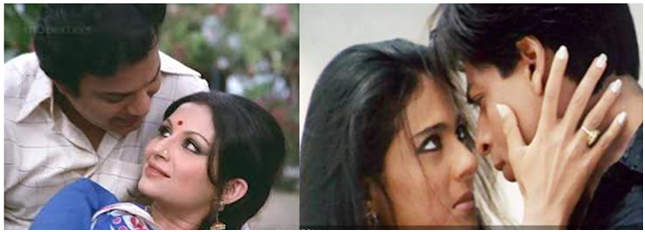
Last night saw 'Apradhi Kaun', a 1957 murder mystery produced by Bimal Roy and directed by Asit Sen. It could have been a taut and gripping tale, had it not been for some silly side-tracks and romantic adventures. The first 40-50 mins of the film are deceptive, as they promise a delicious Agatha Christie kind of an atmospheric murder mystery. But once the actual crime is committed, things go haywire. Although the suspense element is intriguing, I guessed it right very early into the film, owing to some obvious hints they didn't bother to disguise . After that it was all about how the sleuth would work things out. But to my surprise, the sleuth was an ultimate buffoon, rather not much different from his silly assistant. In fact, I have never seen a worse detective on screen. Then too many songs and too many ridiculous plot turns later, the mystery ended with a 2-3 minute explanation from this genius (which in a serious film should form a major chunk of the entire last act) . It was too funny actually, but I don't know whether the makers intended to make a comic-mystery. The film also features a KatrinaKaifesque woman in a meaty role. She is terrible on the acting department, but her character is a so dumb that it is a joy to watch. That can be said for the whole film really. The songs by Salil Chaudary, although melodious, are quite ridiculous in the context of the film. But the actors have had so much fun performing them, that it made me smile. Quite entertaining actually. But not the neat mystery I expected.
Showing posts with label asit sen. Show all posts
Wednesday, July 8, 2015
Apradhi Kaun (1957)- A short Note
Last night saw 'Apradhi Kaun', a 1957 murder mystery produced by Bimal Roy and directed by Asit Sen. It could have been a taut and gripping tale, had it not been for some silly side-tracks and romantic adventures. The first 40-50 mins of the film are deceptive, as they promise a delicious Agatha Christie kind of an atmospheric murder mystery. But once the actual crime is committed, things go haywire. Although the suspense element is intriguing, I guessed it right very early into the film, owing to some obvious hints they didn't bother to disguise . After that it was all about how the sleuth would work things out. But to my surprise, the sleuth was an ultimate buffoon, rather not much different from his silly assistant. In fact, I have never seen a worse detective on screen. Then too many songs and too many ridiculous plot turns later, the mystery ended with a 2-3 minute explanation from this genius (which in a serious film should form a major chunk of the entire last act) . It was too funny actually, but I don't know whether the makers intended to make a comic-mystery. The film also features a KatrinaKaifesque woman in a meaty role. She is terrible on the acting department, but her character is a so dumb that it is a joy to watch. That can be said for the whole film really. The songs by Salil Chaudary, although melodious, are quite ridiculous in the context of the film. But the actors have had so much fun performing them, that it made me smile. Quite entertaining actually. But not the neat mystery I expected.
Labels:
asit sen,
Bimal Roy,
comedy,
mala sinha,
murder,
mystery,
Salil Chaudhary
Sunday, May 25, 2014
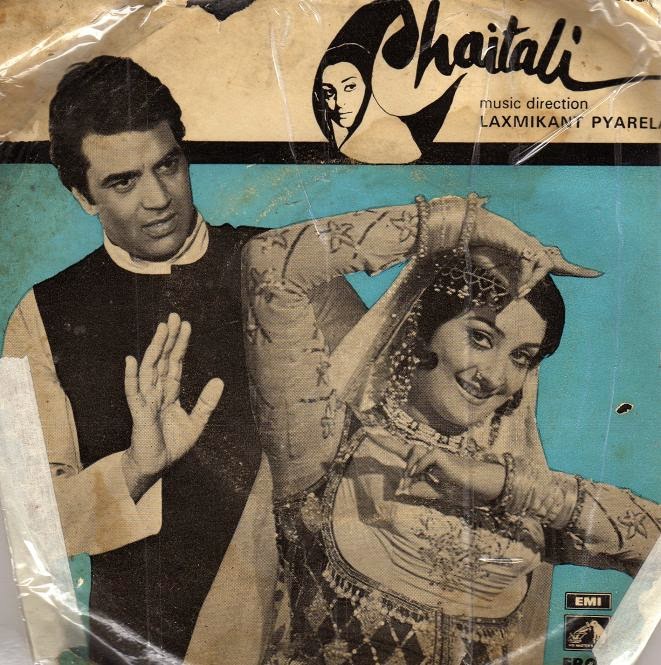
Chaitali (1975)
This is a mid 1970s movie
starring Dharmendra and Saira banu in lead roles, and directed by none other than
Hrishikesh Mukherjee, a man who helmed arguably some of the best Hindi movies
made ever. There is another great matter of prestige attached to this feature,
that of it being a Bimal Roy production, albeit posthumous. Bimal Roy, who
himself arguably made some of the best Hindi movies ever, is also seen by many
as the precursor to Hrishikesh Mukherjee, who he mentored along with a man
called Sampoorn Singh Kalra, better
known as Gulzar. So it will be fair to say that ‘Chaitali’, as a movie, boasts
of some enviable pedigree. And yet, it is one of those criminally under-seen
movies, reflected in just a handful of ratings it has garnered on Imdb (less
than 20 on last count). It might have been a commercial failure at that time, but
does it deserve the obscurity that it is shrouded in today? For sure not, as,
though the film is not faultless, it is still a reasonably engaging dramatic
feature that makes a social comment on delinquency, forgiveness, and redemption.
Adapted from a Bengali short
story of the same name, Chaitali inhabits a world that is much different from the
general Hrishikesh Mukherjee fold, wherein most of his movies stayed away from depicting
the darker strata of our social order. The narrative is centered on Chaitali (Saira
Banu in the title role), a woman who has been forced by her circumstances and her
unfortunate upbringing to occupy a space that constantly haunts her, but from
which she not being able to escape. Creating a stark contrast, her life merges
with a more typical Hrishikesh Mukherjee middle-class urban household, full of
family values and righteousness. The first few minutes of the movie establish
this moral rectitude and bonhomie of this family, headed by a kind matriarch, and
assisted by that ever cheerful and passionately loyal servant (Asit Sen yet again). The tone and
tenor of the film then changes considerably when Chaitali enters the household,
guiltily taking advantage of goodness of the elderly matron, with the intention
of swindling some money. All this while, the younger son of the family Manish, (Dharmendra
in a mostly subdued role) is aware of the reality of the woman, but takes pity
on her circumstances, apart from developing a soft corner for her. The drama later
shifts to a religious sanctuary on the hills, where Chaitali shares her life
story honestly with Manish, who gets utterly shaken by the grimy details of her
upbringing, which include a criminally inclined father on the run, a brothel, many
lecherous eyes eager to pounce on her adolescence, and a suitor (played uninhibitedly
by Asrani) who is both a danger and a comfort to her in the murky vicinities of
her life.
Throughout the story and its
dramatic last act (the best executed out of the lot in my view), Chaitali comes
across as a highly complex character, both repulsed by and dependent on crime
and delinquency. And this confusion, somehow, gets reflected in the treatment
of the film, with its highly uneven tone oscillating between glimmers of hope
and pits of hopelessness. Dharmendra’s part is under-cooked and not well
defined, with neither his motivations, nor his intentions, and nor his beliefs,
coming out on screen clearly. This in some ways gets evened out by strong
subsidiary characters- chiefly the lawyer elder brother (who gets a lot to do
in the last act) and his wife (Bindu in a meaty part, but hamming it up
completely).
The music of the film, much like
the film itself, is not popular at all. There are just three songs, and seen in
isolation, two of them are pleasant enough. But none add to the movie in any
which way; this lack of memorable tunes another reason for the oblivion the
film finds itself today.
Signing off with a vintage 'on-the-set' still from the filming of an outdoor shot from the movie:
![]() |
| http://cinegems.in/dharmendra-hrishikesh-mukherji-durga-khote-and-saira-banu-on-the-locations-of-chaitali-1975/ |
Labels:
asit sen,
Asrani,
Bimal Roy,
crime,
dharmendra,
Hrishikesh,
Hrishikesh Mukherjee,
Laxikant-Pyarelal,
Saira Banu,
social
Monday, March 18, 2013
Anand Ashram (1977)
I pushed back watching this
Shakti Samanta movie for quite some time, expecting it to be one of those
moralistic tale laced with melodrama and strung together by a few good songs.
Another big reason for my lack of enthusiasm was that this movie, unlike most
other Shakti Samanta movies of that time, does not star Rajesh Khanna, and
instead features Uttam Kumar, an actor I am not particularly fond of. As it
turned out, as I finally got around to watching it, I was somewhat right about
my pre-conceived notions. But having said that, the movie pleasantly surprised
me on many counts, and in fact turned out to be quite a good watch. Also, as the
narrative unfolded and moved towards the climax, similarities between its story
and that of big ticket Karan Johar magnum opus Kabhi Khushi Kabhi Gham became
quite apparent, which were rather interesting to discern. The coincidence that
Rakesh Roshan plays the role that would be parallel to what his son Hrithik
Roshan performs in the modern day magnum opus, was what triggered the
connection in my mind.
A young doctor marries his childhood
companion without his father’s consent. The father, a rich and respected landlord
with a legacy he is very proud of, is terribly disappointed by his son’s
decision to marry a girl from a different religious background. The confrontation
leads to the son abandoning his father’s house and giving up on all his
inherited wealth. He, along with his wife, then proceeds to fulfil his life’s
objective of providing medical services to the underprivileged villages, which
lack healthcare infrastructure. A chance encounter with a wannabe do-gooder
enables him to open a village dispensary, which he starts to run with his wife
supporting him wholeheartedly. Then in a curious turn of fate, his allegiance
to the oath of selfless service is put to test. He passes the test but suffers
a great personal loss when he is unable to be at his wife’s side as she is
delivering their first child. The story from there briskly changes character
and soon takes a time leap. With the drama set, the next part is quite
entertaining to watch.
Despite the serious theme, a
feel-good factor is maintained throughout, thanks to the well defined
characters essayed by Ashok Kumar, Utpal Dutt, and Asit Sen. In the second part
of the movie the romance angle between Rakesh Roshan and Moushumi Chatterjee
also lightens the proceedings. Towards the end, the culmination too is convincing
and ties up the drama satisfactorily.
It would not be completely off
the mark to say that the basic skeletal of Anand Ashram and K3G is alike. What is
most different is the objective and treatment. While Anand Ashram has the theme
of selfless service to humanity as its backbone, K3G has no such pretentions
and was quite unequivocal in its fidelity to the candyfloss. As a result the
characters in the older film are less caricaturish and have more shades to
their personalities. And that is strength of Anand Ashram as a more ‘moving’
motion picture. The lead hero, Uttam Kumar, is not very convincing in the initial
portions of the story where he plays the rebel lover lip-syncing to songs and
romancing a stunning beauty like Sharmila Tagore. But in the later part of the
movie he appears in a bearded look and is generally more assured. But Ashok
Kumar as the ‘kabhi garam kabhi naram’ granddad (and dad) gives the most
heart-warming performance from the lot.
Almost all the songs are nice and
don’t really act as speed-breakers. ‘Sara pyaar tumhara’ and ‘Rahee naye naye’
and the most melodious and must have been quite popular in their time.
Parting Note: Anand Ashram has a
good original story to tell in a breezy run-time. Also, the message it propagates
is universal and quite relevant even in the current times.
Sunday, October 28, 2012
Annadata (1972)
A rich industrialist Amba Prasad
(essayed by an immensely likable Om
Prakash) is referred to as annadata because
of his largesse and charitable disposition. In the urban jungle that incubates
the battle between the haves and the have-nots, he stands tall as someone who
uses his wealth for the good of everyone, and not just for himself. However, false
news of his death opens a can of worms when a large number of his blood relatives
start fighting amongst themselves while staking a claim to his empire. But what
truly breaks his heart is when his adopted daughter claims to have been an
illicit relationship with him (forced by her gold-digging parents), just to
proclaim herself to be a true heir to his vast empire. This cruel accusation
completely shatters the old man’s faith in the world and he leaves everything
he owns in care of his manager, while embarking on a journey, with only his pet
dog accompanying him, to discover his lost belief in mankind.
On his journey when he is just
about to give up all hope, a chance encounter brings him in touch with Aarti (Jaya Bhaduri), who nurses him to good
health. In the days that follow Amba Prasad discovers how one woman epitomized
all that he was looking for in the world- honesty, selflessness, benevolence,
and righteousness. When he had started getting the feeling of been marooned on
an island of spite and no respite, Aarti’s care and love ensnares him in her
small yet salubrious world that blossoms with empathy of its occupants. Amba
Prasad also strikes a quaint companionship with Aarti’s lover Arun (Anil Dhawan), an idealist painter whose
lack of means makes him hesitant to solemnize his love for Aarti.
The movie is far from perfect
despite the well intentioned premise. There are unnecessary scenes and also
some shoddy acting, led by a very stiff and unintentionally hilarious Anil Dhawan.
A polished actor would have definitely added tremendous weight to some complex
scenes that fail to achieve their purpose with the present actor. The songs by Salil Chowdhary,
though melodious, aren’t as neatly woven with the story as say Gulzar film songs
would be. But Jaya Bhaduri and Om Prakash’s assured presence, and the brevity
of most scenes that could have fallen in the trap of sermonizing, ensures that
the film remains a light yet meaningful watch that ends on a positive note. In
fact the film traverses the gargantuan distance between pessimism and optimism
in just about two hours.
Parting Note: Annadata is
akin to a Hrishikesh Mukherjee film that has its screenplay woven around a good
idea, and is given a light-hearted treatment with melodrama kept to the
bare minimum.
Labels:
asit sen,
classic,
drama,
jaya bhaduri,
light-hearted,
Om Prakash,
Salil Chaudhary,
social
Sunday, February 26, 2012
Safar (1970)
Safar is one of the famous Rajesh Khanna movies from his super-stardom phase. A musical drama that has philosophical undertones, it is one of those ‘it was good while it lasted’ kind of movies. The plot of the movie, directed by Asit Sen, is slightly reminiscent of another Rajesh Khanna classic Anand, with him playing the role of a man who remains jovial and level-headed despite being terminally ill. The major difference between Anand and this movie is that while the former focused on the idea of living your life to the fullest, this movie has romance at its forefront.
Avinash (Rajesh Khanna) is a college student who is more interested in bringing blank canvasses to life using his skill with the brush. There is a face that comes repeatedly in most of his paintings, and he soon discovers Neela (Sharmila Tagore) who shares a striking resemblance with that face. Neela is a diligent college student who aspires to become a successful surgeon. After an initial misunderstanding she treats Avinash to good health after he falls ill. They strike a delightful friendship that extends to Neela’s family comprising of her elder brother and his wife. This results in some of the most sparkling moments in the film, with a candid Avinash joyfully pulling the leg of Neela’s wannabe playwright brother. Soon this friendship translates into love, but fate has something else in store with Avinash soon realizing that he suffers from disease that cannot be cured. At the same time a rich businessman Kailash (Feroz Khanna) too falls in love with Neela, who is also the tuition teacher for his younger brother. When Avinash gets to know of this, he asks Neela to sacrifice their love and marry Kailash who promises a more secure future for her.
This entire premise is very similar to Shah Rukh Khan’s 2004 super-hit ‘Kal Ho Naa Ho’. In fact it is hard to ignore the possibility that Karan Johar/ Nikhil Advani would have been inspired by Safar while writing their movie. And this is not it; the second half of the movie is structured in a way that is very reminiscent of another Shah Rukh Khan starrer from about the same period ‘Hum Tumhare Hain Sanam’, in which he had Salman Khan for company. After Neela gives in to Avinash’s plead and marries Kailash, there begins a family drama with Kailash suspecting his wife of infidelity with Avinash. He finds it very hard to accept their friendship (much like how SRK finds it tough to accept his wife’s companionship with Salman in HTHS).
In fact with such turn of events, the movie changes color dramatically and becomes more melodramatic with the earlier focus being relegated to the background. In fact the culmination of the movie is the most confused part of the movie. It ends on a philosophical note with Neela’s sacrifice coming to prominence. In fact this is one movie where the central focus shifts between three characters- from Avinash in the first half, to Kailash in the post intermission portion, and to Neela in the culmination. When I come to think of it, I find it difficult to remember any other such movie. To the credit of all the three actors playing these characters, they don’t let this aberration become too obvious through the strength of their performances.
Now for the point that I was waiting to make- the songs of this movie are simply delightful. Each and every song is a classic and is truly memorable. In fact, this movie can deserve the tag of a classic just on the strength of its musical score by Kalyanji-Anandji.
Parting with my favorite song from the movie-
Sunday, February 5, 2012
Teesri Kasam (1966)
Life is showbiz can be a big challenge, especially for ladies for the lines between morality and professionalism and ambition can be pretty thin ones. We have had many movies that have dealt with this subject in recent times- Fashion and The Dirty Picture being the ones that immediately come to mind. In fact there was a time when women working in such vocations were not seen in a good light. The society never encouraged the women to be a part of such set-ups and the women who did end up working in the entertainment world were deemed social outcasts. Also, before cinema and fashion became as big as they are today, something else ruled the heartlands of our country- the good old village nautanki- a celebration of life and all its covert pleasures. Basu Bhattacharya’s first Hindi film, Teesri Kasam, starring Raj Kapoor and Waheeda Rehman is set in such an era. With a rustic backdrop, this film is a heartwarming tale of love between a nautanki star and a bullock-cart driver (Gaadiwaan).
Hiraman (Raj Kapoor in a typical role of a simpleton) is a naïve village bumpkin who is a Gaadiwaan by profession. A god-fearing and righteous fellow, he gets into some unfortunate situations and which lead him to make two promises to himself- one that he would never transport black-market goods on his cart, and two that he would never transport long wooden on it either. These two small incidents at the beginning of the story set the character of Hiraman firmly in place. Soon, he gets the task of making a lady reach a distant village mela on his bullock cart for which he is promised a lucrative payment. Thus, he and the lady embark on a thirty hour long journey through the wilderness to reach their destination. The lady is an ethereal beauty and Hiraman gets struck by her surreal charm. He discovers that her name is Hirabai-making her his namesake (meeta) in a way. Hirabai too gets attracted to Hiraman’s simplicity and goodness. They spend the entire time talking to each other, with Hiraman telling her stories and singing village songs to her. They don’t even realize when the thirty hours reach an end and they reach the mela.
Hiraman soon discovers that Hirabai is a very famous nautanki star and the biggest draw at the village mela. He decides to stay in that village and watch her nautanki after getting special passes for the same from her. So every night he and his friends start visiting the nautanki where they see Hirabai driving the crowds crazy by the grace and finesse of her dancing and singing. But a lot of the things that Hiraman sees in these excursions make him very uncomfortable. By the day he and Hirabai meet and spend a lot of time together in the process drawing a lot closer to one another than they initially imagined. In Hiraman, Hirabai finds a true friend who loves and respects her for what she is in reality, and not for her fame and beauty. She finds it difficult to keep the fact hidden from him that her vocation is not entirely honorable. Similarly Hiraman gets more and more sucked into the world of his meeta, refusing to realize that it would lead him to nothing else but dejection and him making a third promise to himself.
The story is uncomplicated and the emphasis is entirely on the unconventional bond between two people whose worlds are completely diverse. Their interactions are the highlight of the story apart from some truly melodious songs composed by Shankar Jaikisan. The performances by both the leads are terrific- especially from Waheeda Rehman who lives her character with great empathy and is a complete natural. This is one of the early films of her career, and it is safe to say that she was one of the most beautiful actresses of her time. On the contrary this is one of the later films for Raj Kapoor, and he looks quite elder to his co-star (but this age gap is justified in the story). As far as his act is concerned, he is a complete natural as the shy simpleton who takes an idealistic view of the world. The supporting cast is efficient (though I could identify only a few of the actors). Iftekhar plays a Zamindar who is a frequent visitor to Hirabai’s show and yearns for her affection. Asit Sen and Jhonny Walker too have brief appearances.
The film is presented as an almost musical with the songs hogging a great portion of the runtime. And it takes nothing away from the likeability of the movie as the songs are simply superb which some great lyrics that do a great job of saying what is going on inside the hearts of Hiraman and Hirabai. Also, the entire nautanki bit (including the behind the scene action) is handled in an authentic manner with some artistic cinematography and shot-taking.
Parting Note: Teesri Kasam is an endearing tale of love between two completely different people, with a completely rustic background which in itself is pretty alluring. Its charm lies in its rootedness and honest intentions.
P.S.: Basu Chatterjee is credited as one of the assistant directors on the project. It is safe to say that the master film-maker, who went on to make some great films himself, got some solid grounding in the art under his meeta (Basu Bhattacharya).
Subscribe to:
Posts (Atom)